This article continues my series examining the trumps of the Tarot de Marseille, adapted from my unpublished manuscript, Tarot de Marseille: The Picturebook of Fate. As throughout this series, the emphasis is placed upon the traditional eikōn of the card, its historical context, and the practical significations I have found useful through divinatory practice. The interpretations presented here reflect my own experience of working with the Tarot de Marseille and should be understood as a working method rather than a definitive authority.
The Ones in Action:
Let us now turn to a practical example.
The following is a simple three-card spread intended to provide a clear answer to a specific question. After shuffling the Fool and twenty-one trumps and cutting the deck, three cards are drawn as follows:
01 – 03 – 02
- Position 1: The querent and their approach to the matter.
- Position 2: The question or situation itself.
- Position 3: The answer or outcome.
Sallie-Anne had been involved in an intermittent relationship with Dean for approximately two years. She worked as an emergency department nurse and led a busy, structured life. Dean, by contrast, struggled to maintain stable employment and drifted from one opportunity to another.
Following several months of separation, Dean had returned seeking reconciliation. He insisted that he had changed and asked for another chance. Sallie-Anne’s friends were unanimously opposed to the idea, believing she would be making a serious mistake by taking him back.
Her question was simple: “Would it be different this time?”
The cards drawn were:
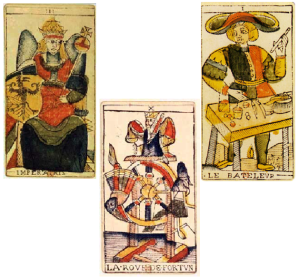
- Position 1: The Empress
- Position 2: The Juggler
- Position 3: The Wheel of Fortune
The answer is a clear no.
The Empress describes Sallie-Anne’s role within the situation. Although we have not yet examined this trump in detail, it portrays a capable, open, and communicative individual. The card suggests someone who approaches others directly and seeks to build relationships through honesty and cooperation.
The Juggler describes the situation itself and, in relationship readings, will often represent the other party. Here the card paints a familiar picture. Dean is charming, persuasive, and highly skilled at telling people what they wish to hear. The Juggler’s essence is cunning and his function misdirection. He understands Sallie-Anne’s hopes and expectations and knows how to present himself in the most favourable light.
The outcome is shown by the Wheel of Fortune. Rather than indicating meaningful change, the Wheel suggests recurrence and repetition. Circumstances are destined to follow a familiar course. The same patterns that characterised the previous relationship are likely to emerge once more.
My conclusion was straightforward. Dean undoubtedly knew what Sallie-Anne wished to hear and was telling her precisely that. There would almost certainly be a honeymoon period in which matters appeared improved. Yet the Wheel of Fortune strongly suggested that, once the novelty wore off, the relationship would return to its former cycle of highs and lows. Whatever promises had been made, the underlying circumstances had not changed.
§
Tarot Cards: Jean Dodal Tarot via Wikipedia Commons. Public Domain.
Featured Image: Ancient Tarot Major Arcana © BP Grimaud/John Waddington Ltd, Leeds & London, Les Tarot de Marseille Jean Noblet, 1650 © Editions «letarot.com» (2001 [hand stencilled trumps]). Les Tarot de Marseille Jean Dodal, 1701 et 1715 © Editions «letarot.com» (2002 [hand stencilled trumps])
 Journal of a Cartomante