

This article continues my series examining the trumps of the Tarot de Marseille, adapted from my unpublished manuscript, Tarot de Marseille: The Picturebook of Fate. As throughout this series, the emphasis is placed upon the traditional eikōn of the card, its historical context, and the practical significations I have found useful through divinatory practice. The interpretations presented here reflect my own experience of working with the Tarot de Marseille and should be understood as a working method rather than a definitive authority.
The Twos in Action:
Let us now consider a second practical example.
We shall utilise the same spread as before. After shuffling the twenty-one trumps together with the Fool and cutting the deck, three cards are drawn:
01 – 03 – 02
- Position 1: The querent and their approach to the matter.
- Position 2: The question or situation itself.
- Position 3: The answer or outcome.
Renee was in her late forties and had worked for the same organisation for approximately twenty years. Her record was exemplary, she was highly experienced, and she enjoyed the respect of her colleagues. Consequently, she was surprised and disappointed when her application for a team manager position proved unsuccessful.
Her question was straightforward: “Why was I unsuccessful?”
The cards drawn were:
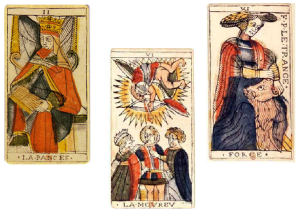
- Position 1: The Popess.
- Position 2: Fortitude.
- Position 3: The Lover.
The answer becomes apparent once the cards are considered together.
The Popess describes Renee’s approach to the matter. As we have seen, the Popess signifies contemplation, study, and expertise. She is intelligent, knowledgeable, and diligent. However, she is also reserved and somewhat withdrawn. Communication is not her strongest suit. The card suggests someone who prefers to demonstrate competence through work rather than through visibility, persuasion, or personal relationships.
Fortitude describes the position itself. This was not merely a technical role requiring knowledge and experience. The successful candidate would be expected to lead others, maintain standards, resolve disputes, motivate difficult personalities, and remain steadfast when faced with pressure or opposition. In short, the organisation was seeking someone capable not merely of performing the work, but of mastering both themselves and others in a challenging environment.
The answer is supplied by the Lover. The essence of the Lover is vacillation and its function is to divide. The card suggests that the hiring panel perceived a lack of decisiveness. They may have questioned whether Renee would be comfortable making difficult decisions, enforcing unpopular policies, or managing competing demands and expectations. The transition from colleague to manager frequently requires a person to balance conflicting interests and, at times, place organisational needs ahead of personal relationships. The Lover indicates that the panel was unconvinced she would be comfortable in such a position.
My conclusion was therefore that Renee’s experience and technical competence were not in doubt. The issue lay elsewhere. The organisation was seeking a manager capable of taking firm decisions, exercising authority, and managing competing priorities with confidence. The feedback she later received from the hiring manager confirmed this interpretation, emphasising concerns about leadership style and decisiveness rather than knowledge or ability.
§
Tarot Cards: Jean Dodal Tarot via Wikipedia Commons. Public Domain.
Featured Image: Ancient Tarot Major Arcana © BP Grimaud/John Waddington Ltd, Leeds & London, Les Tarot de Marseille Jean Noblet, 1650 © Editions «letarot.com» (2001 [hand stencilled trumps]). Les Tarot de Marseille Jean Dodal, 1701 et 1715 © Editions «letarot.com» (2002 [hand stencilled trumps])
 Journal of a Cartomante