This article continues my series examining the trumps of the Tarot de Marseille, adapted from my unpublished manuscript, Tarot de Marseille: The Picturebook of Fate. As throughout this series, the emphasis is placed upon the traditional eikōn of the card, its historical context, and the practical significations I have found useful through divinatory practice. The interpretations presented here reflect my own experience of working with the Tarot de Marseille and should be understood as a working method rather than a definitive authority.
The Threes: The Empress, the Hanged Man and the World
Trump XII, Le Pendu, or the Hanged Man, is both an intriguing and unsettling card. Does it signify self-sacrifice and the promise of future rewards? Is it merely a card of stasis and stagnation? Or does it ask us to view the world from a different perspective? Whilst such themes are often associated with the card, they do not fully explain its peculiar image. The Marseille Hanged Man is less concerned with enlightenment than with disgrace, exclusion, and the consequences of damaged reputation.
The essence of the Hanged Man is dishonour; its function is to suspend. Although these concepts may initially seem severe, they provide the key to understanding the card’s operation in a reading. The Hanged Man does not move freely within the world. Something has happened which prevents progress. Whether deserved or not, his ability to act has been curtailed, his position compromised, and his affairs placed on hold.
The traditional eikōn is both striking and historically grounded. We see a man suspended by one ankle, hanging upside down from a wooden frame. To modern eyes the image appears strange, yet it derives from a genuine early modern practice known as pitture infamanti or defaming portraits. Such images were displayed upon public buildings in order to shame individuals accused of fraud, bankruptcy, debt, treason, or other offences against the community. The subjects were often prominent figures whose standing and reputation were essential to their influence. Public dishonour became a means of public punishment.
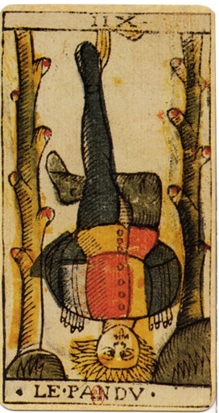
The image is reinforced by long-standing associations between hanging and disgrace. Through its connection with Judas Iscariot, hanging came to be regarded as a particularly dishonourable end. The Hanged Man therefore depicts not simply punishment, but the loss of standing, credibility, and trust.
From this, the card’s function becomes clear. The purpose of defamation is not merely to embarrass, but to undermine. A damaged reputation limits opportunities, erodes confidence, and impedes action. In short, it suspends. The principle remains recognisable today. Rumours, gossip, false allegations, public scandal, and social ostracism all operate in much the same way. Whether justified or unjustified, the result is often that a person’s progress grinds to a halt.
When the Hanged Man appears in a reading, it frequently indicates that the past is hindering the present. A previous mistake, poor financial history, unfavourable references, damaged relationships, or an unfortunate reputation may be creating obstacles. Sometimes these concerns are real; at other times they arise from perception rather than reality. The surrounding cards will usually reveal whether the difficulties are justified, exaggerated, or entirely unfounded.
In practical divination, the Hanged Man is frequently a sign of delay, frustration, and suspended progress. Aspirations are postponed, plans encounter obstacles, and forward movement becomes difficult. It often marks a downward turn in fortune, not necessarily permanent, but sufficient to require patience whilst circumstances run their course. Before progress can resume, the matter causing the suspension must first be addressed.
General: The arrival of a difficult period marked by delays, setbacks, and frustration. Plans may be suspended, opportunities withdrawn, and progress slowed by circumstances beyond the querent’s control. The card frequently signifies defamation, gossip, scandal, or modern forms of public shaming. Past mistakes, whether real or alleged, may return with unwelcome consequences. The Hanged Man reminds us that reputation, once damaged, can be difficult to restore.
Love: The Hanged Man is seldom a welcome sight in matters of the heart. For those who are single, it often signifies a lack of meaningful opportunities or the pursuit of relationships that are unlikely to endure. The querent may be misled, kept waiting, or investing in someone who cannot offer a genuine commitment. In established relationships, previous mistakes, old grievances, or unresolved issues may resurface and place the partnership under considerable strain. Progress becomes difficult until these matters are confronted directly.
Career: The Hanged Man is associated with prisons, probation services, and occupations connected with punishment, rehabilitation, and social reintegration. It may also signify charitable work, particularly involving disadvantaged individuals, vulnerable groups, or young people. In career matters more generally, the card often points towards obstacles to employment, promotion, or advancement arising from past mistakes, poor references, financial difficulties, or a damaged reputation.
Finance: Delays, restrictions, or setbacks affecting financial affairs. Previous decisions may have consequences that limit present opportunities. Credit difficulties, unpaid debts, or problems arising from reputation may feature prominently. Bankruptcy.
Health: Anatomically, the Hanged Man is associated with the knees and the legs. More generally, the card frequently signifies delayed recovery, prolonged treatment, or conditions that restrict movement and activity. Progress may be slower than desired, requiring patience and perseverance.
Essence: Dishonour.
Function: Suspend.
Polarity: Negative.
Astrological Association: Capricorn.
Timing: January.
§
Tarot Cards: Jean Dodal Tarot via Wikipedia Commons. Public Domain.
Featured Image: Ancient Tarot Major Arcana © BP Grimaud/John Waddington Ltd, Leeds & London, Les Tarot de Marseille Jean Noblet, 1650 © Editions «letarot.com» (2001 [hand stencilled trumps]). Les Tarot de Marseille Jean Dodal, 1701 et 1715 © Editions «letarot.com» (2002 [hand stencilled trumps])
 Journal of a Cartomante