This article continues my series examining the trumps of the Tarot de Marseille, adapted from my unpublished manuscript, Tarot de Marseille: The Picturebook of Fate. As throughout this series, the emphasis is placed upon the traditional eikōn of the card, its historical context, and the practical significations I have found useful through divinatory practice. The interpretations presented here reflect my own experience of working with the Tarot de Marseille and should be understood as a working method rather than a definitive authority.
The Threes: The Empress, the Hanged Man and the World
Let us now consider a different style of reading.
This example uses the tirage en ligne, or linear draw, a common feature of the French cartomantic tradition. Unlike the previous examples, there are no fixed positions. Instead, the cards are read sequentially, each developing the story told by the previous card.
The reading was conducted for Patricia. Her husband, Kevin, was a self-employed carpenter who had begun to experience difficulties obtaining sufficient work. As both were now in their early sixties, Patricia was understandably concerned that a prolonged decline in business could affect their retirement plans.
Her question was:
“What can be done to increase the business?”
The cards drawn were:
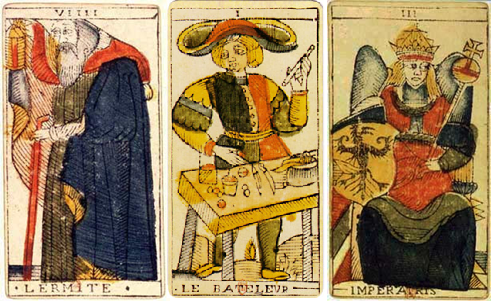
The Hermit – The Juggler – The Empress
The Hermit describes Kevin’s current approach. Like the Hermit, he relies upon experience, reputation, and the quality of his work. There is a sense of prudence and discretion here. Existing customers value his skills, but the card also suggests a reluctance to promote himself or adapt to changing circumstances. The Hermit carries a lantern rather than a banner. He seeks to be discovered rather than noticed.
The Juggler introduces the necessary change. Whereas the Hermit is discreet, the Juggler actively attracts attention. He understands presentation, visibility, and differentiation. The card suggests that Kevin must identify what distinguishes him from the many other carpenters operating in the area. What particular skills, services, or experience set him apart? The Juggler asks him to define his unique selling point and make it visible to potential customers.
For example, Kevin may possess specialist knowledge in restoration work, bespoke cabinetry, traditional joinery, or some other area in which he excels. Such expertise has considerable value, but only if potential customers are aware of it. The cards suggest that he should stop marketing himself merely as a carpenter and begin promoting whatever makes his business distinctive.
Having identified those strengths, the Empress shows how they should be used. The Empress is a communicator and network builder. She spreads information, makes introductions, and ensures that people know what is available. The card therefore advises greater emphasis upon marketing, referrals, networking, local advertising, social media, and recommendations from satisfied customers. It is not enough to possess expertise; others must know that expertise exists.
The three cards form a natural sequence. The Hermit possesses knowledge and experience. The Juggler packages that experience into something distinctive and memorable. The Empress then communicates it to the wider world. The problem is not a lack of skill, but the failure to move through the latter two stages.
It is also worth noting that the reading begins with the Hermit and concludes with the Empress. Symbolically, this is a movement from privacy towards visibility. Kevin’s experience remains his greatest asset, but the cards indicate that he has become too discreet. The knowledge that serves him well must now be brought into the public eye.
My conclusion was that Kevin’s difficulty did not arise from a lack of ability or experience. The opposite was true. The Hermit suggested that he possessed valuable skills developed over many years. The problem was visibility. Those skills first needed to be defined and differentiated by the Juggler, and then communicated by the Empress. In short, Kevin did not need to become a better carpenter; he needed to become better known.
This example illustrates an important principle of the tirage en ligne: each card develops the action of the previous one. The cards do not merely provide three separate answers. Together, they tell a story.
§
Tarot Cards: Jean Dodal Tarot via Wikipedia Commons. Public Domain.
Featured Image: Ancient Tarot Major Arcana © BP Grimaud/John Waddington Ltd, Leeds & London, Les Tarot de Marseille Jean Noblet, 1650 © Editions «letarot.com» (2001 [hand stencilled trumps]). Les Tarot de Marseille Jean Dodal, 1701 et 1715 © Editions «letarot.com» (2002 [hand stencilled trumps])
 Journal of a Cartomante