This article continues my series examining the trumps of the Tarot de Marseille, adapted from my unpublished manuscript, Tarot de Marseille: The Picturebook of Fate. As throughout this series, the emphasis is placed upon the traditional eikōn of the card, its historical context, and the practical significations I have found useful through divinatory practice. The interpretations presented here reflect my own experience of working with the Tarot de Marseille and should be understood as a working method rather than a definitive authority.
The Fours: The Emperor and Death
Trump IV, L’Empereur, or the Emperor, is a card often overshadowed by more flamboyant trumps. What is there to know? Is the Emperor merely a symbol of masculine authority or the father archetype? Does he speak of status and worldly success? Or is he simply the overbearing manager determined to control every aspect of our lives? As is so often the case, the truth lies somewhere in between.
The traditional eikōn of the Emperor is remarkably consistent throughout the classical tarot tradition. An enthroned ruler sits in profile, crowned and armoured, holding an oversized sceptre as the emblem of his authority. His legs are traditionally crossed and a large shield rests at his side. Everything about the image communicates stability, power, and command. Unlike many of the other trumps, the Emperor is not engaged in any obvious activity. He has already secured his position and now concerns himself with maintaining it.
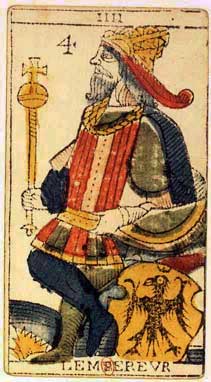
The essence of the Emperor is control; his function is to manage. The card therefore speaks of structure, order, responsibility, and authority. The Emperor understands that ambitions, resources, and people require direction if they are to achieve anything worthwhile. Whilst the Empress brings people together through interaction and communication, the Emperor takes responsibility for ensuring that things are done.
Unlike the Empress, the Emperor does not meet our gaze. He has little interest in conversation for its own sake. His attention is directed towards the affairs of his realm. He is concerned with leadership, administration, and practical results. Where others discuss possibilities, the Emperor asks what must be done and who will do it. The Emperor’s authority should not be understood as privilege alone. It is also a burden. Someone must maintain order, make difficult decisions, allocate resources, and accept responsibility when matters go wrong. The Emperor therefore signifies stewardship as much as power. His concern is not merely obtaining authority, but exercising it wisely and ensuring that obligations are met.
For this reason, the Emperor is often a favourable card in a reading. It frequently points towards a successful outcome, particularly where discipline, organisation, and sound judgement are required. Yet success brings responsibilities of its own. The Emperor reminds us that achievement is not merely a matter of obtaining something; it is also a matter of maintaining and protecting it.The card frequently appears when success ceases to be an aspiration and becomes a responsibility. Acquiring a home, accepting a promotion, starting a business, or becoming a parent all bring obligations that cannot be ignored. The Emperor therefore asks not simply whether we can attain our objectives, but whether we are prepared to bear the burden of what follows.
At other times, the Emperor appears because the querent must assume responsibility themselves. The card may indicate that matters have drifted for long enough and now require firm direction. Decisions must be made, standards enforced, and leadership shown. Whatever is under consideration cannot be left to chance. The Emperor demands that someone take control of the situation and steer it towards a satisfactory conclusion.
General: The successful conclusion of an undertaking and the attainment of a position of stability, authority, or influence. The Emperor brings structure, order, and permanence. What has been built is now established, but with success comes responsibility. The card frequently signifies leadership, accountability, and the need to maintain what has been achieved.
Love: Relationships under the Emperor are built upon strong foundations and characterised by stability, loyalty, and long-term potential. The card may indicate a partner who is reserved, pragmatic, and reluctant to discuss their emotions openly. Nevertheless, their feelings are usually genuine and expressed through actions rather than words. For those who are single, the Emperor often points towards a relationship arising through work or professional connections. Such relationships tend to progress quickly towards commitment, although the card cautions that one partner may prefer to take charge. Whether this dynamic is desirable is a matter for the querent to consider.
Career: The Emperor is associated with positions of authority, management, leadership, corporate governance, and politics. It frequently appears in connection with senior appointments, business ownership, administration, and executive roles. For women, the card may signify employment within traditionally male-dominated professions, such as construction, engineering, mechanics, or other skilled trades. More generally, the Emperor promises favourable career prospects, advancement, increased responsibility, and improved remuneration.
Finance: Financial circumstances are generally secure and well managed under the Emperor. The card signifies stability, careful planning, and the accumulation of assets. However, it often suggests that money could be employed more effectively. Investments, pensions, property, and other long-term financial arrangements may warrant attention. The emphasis is not merely upon preserving wealth, but upon managing it wisely so that it continues to grow.
Health: Anatomically, the Emperor is associated with the spine, back, and heart. It may indicate cardiovascular conditions, including hypercholesterolaemia, hypertension, hypotension, angina, and cardiac arrhythmias. More broadly, the card is associated with andrology and illnesses more commonly encountered in men, including heart disease, Parkinson’s disease, and lung cancer. In positive contexts, it signifies resilience, stability, and the ability to manage long-term health concerns effectively.
Essence: Control.
Function: Manage.
Polarity: Neutral.
Astrological Association: Leo.
Timing: August.
§
Tarot Cards: Jean Dodal Tarot via Wikipedia Commons. Public Domain.
Featured Image: Ancient Tarot Major Arcana © BP Grimaud/John Waddington Ltd, Leeds & London, Les Tarot de Marseille Jean Noblet, 1650 © Editions «letarot.com» (2001 [hand stencilled trumps]). Les Tarot de Marseille Jean Dodal, 1701 et 1715 © Editions «letarot.com» (2002 [hand stencilled trumps])

