In November 2019, my principal Lenormand deck was nowhere to be found.
Ordinarily, once a reading has been completed, the cards are returned to their proper place. On opening the appropriate drawer in an old apothecary cabinet, however, I discovered that the deck was absent. Drawer after drawer was searched. Everything else was where it ought to have been, but the cards themselves had vanished.
The missing deck was the Carta Mundi Lenormand. Since first acquiring that edition, I had developed a particularly strong affinity with it. It was neither the first nor the last Lenormand deck to enter my life, yet it had very much become my Lenormand, both personally and professionally.
I was thoroughly dismayed. Where could they possibly have gone? I had last used them the previous day whilst performing a Grand Tableau.
Thus began an increasingly desperate search.
The process was not helped by my cats, who appeared deeply offended by the amount of attention being lavished upon a pack of cards. Their displeasure was unmistakable.
After more than forty minutes of fruitless searching, I concluded that the most sensible course of action was to employ a traditional where-is-it? horary. I noted the time, opened my laptop, and cast the figure.
Chart:
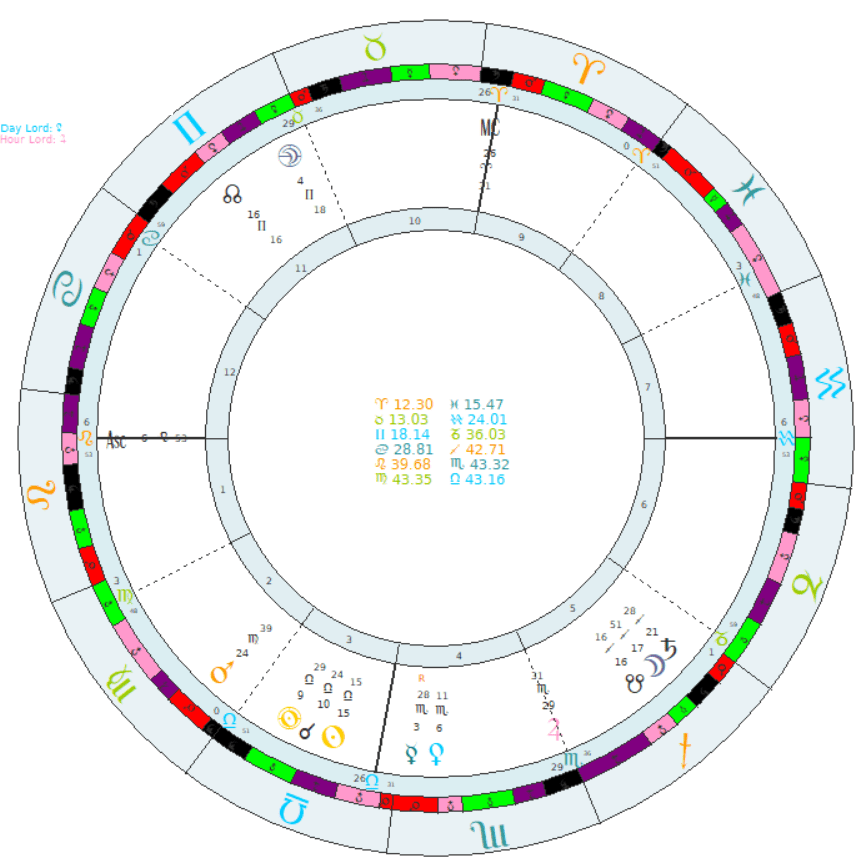
We find 6° Leo rising, with the chart cast in the hour of Jupiter. Jupiter is the nocturnal lord of the eastern (fire) triplicity. None of the usual considerations of judgement suggest that the chart should not be judged.
With Leo ascending, the Sun signifies the querent—that is, myself. The object sought is known in horary as the quesited.
Various authorities offer differing approaches to identifying the significator of a lost object. Al-Kindī advocates the Moon1, the natural significator of lost possessions. As Dr Benjamin Dykes observes, the use of the Moon rather than the ruler of the second house acknowledges that the item is no longer in the owner’s possession. Should the Moon apply to the ascendant, it is often regarded as a strong indication that the object will be recovered.
Others favour the rulers of the second or fourth houses, particularly in questions concerning inanimate objects. In my own practice, the second house generally proves sufficient.
In this chart, Virgo occupies the second house and is ruled by Mercury. For a deck of divinatory cards, Mercury is an entirely appropriate significator. Accordingly, I took Mercury to represent the missing deck.
Where, then, was Mercury?
We find him at 3° Scorpio in the fourth house and conjunct Venus. The fourth house is one of the angles, and in charts concerning missing possessions an angular significator frequently indicates that the object is nearby. Mercury is also retrograde. As Lilly notes2, a retrograde significator often signifies the return of a missing article.
Mercury’s angularity and retrogradation were simultaneously reassuring and perplexing. If the deck was nearby, surely I should have found it already? Moreover, Mercury’s proximity to the cusp appeared significant, though I was unable immediately to determine how.
Time was passing, and no cards had appeared.
I forced myself to begin again from first principles.
The fourth house is associated with cellars and underground places—neither of which was applicable here. It also pertains to the sitting room, family rooms, and places of domestic comfort. The last place I had used the cards was indeed the sitting room, which I had already searched repeatedly.
Mercury occupies the first five degrees of Scorpio and is separating from Venus. The closer a planet lies to a house cusp, the nearer the object is often found to a doorway or threshold3. The third house can indicate a study or office but may also describe passages, hallways, and corridors on the ground floor.
My thoughts turned briefly to an antique fall-front desk standing in one corner of the room. I searched it thoroughly, but again to no avail.
Scorpio, in domestic questions, often signifies bathrooms, cupboards, storage areas, and places where cleaning materials are kept. Venus likewise has associations with cleanliness, adornment, and clothing.
At that moment, the answer became obvious.
Immediately opposite the sitting-room door is a small cupboard beneath the staircase. It serves as a cloak cupboard, containing coats, umbrellas, scarves, and similar items.
Several garments were hanging there in readiness for collection by the dry cleaner the following day.
Among them was a coat that I had intended to wear on the previous afternoon. Owing to heavy rain, I had changed my mind at the last moment and selected a different jacket instead.
I removed the coat from its hanger and searched the pockets.
There were the cards.
Mercury—the missing deck—had been concealed within an item of clothing signified by Venus, awaiting cleaning in a Scorpionic place of storage, beneath the stairs and therefore appropriately described by the fourth house. Mercury’s retrograde motion in a fixed water sign neatly reflected my last-minute change of mind on account of the weather.
In retrospect, the symbolism was remarkably straightforward.
My error had been to focus almost exclusively upon Mercury’s retrogradation and angularity whilst largely ignoring Venus. Yet Venus was clearly integral to the testimony. She was not only conjunct Mercury but also in a partile square to the ascendant, making a direct connection with me and the circumstances of the loss.
Thankfully, my Lenormand deck was restored to its rightful place.
The cats seemed pleased as well.
At last, I was able to retire for the night.
Images:
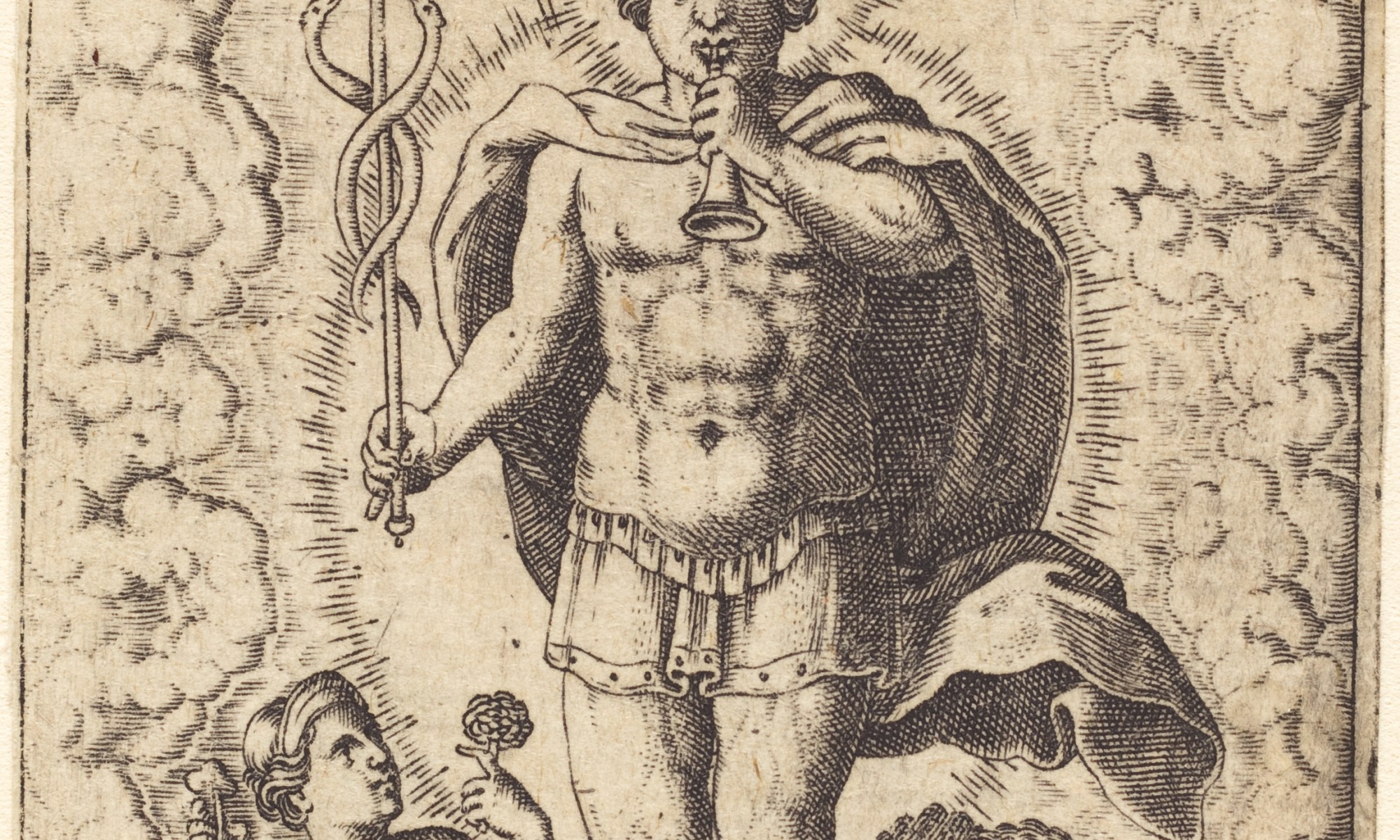
Featured Image: Sebald Beham, Mercury, NGA 4358. National Gallery of Art, CC0, via Wikimedia Commons
Chart: Delphic Oracle.
References
 Journal of a Cartomante
I have never been able to get my head around astrology in spite of multiple attempts, but your posts are always a pleasure to read. Thanks for sharing your knowledge ❤️
LikeLike
Thank you very much for your kind words; they are greatly appreciated.
Of the various methods of divination I have studied, astrology was by far the most challenging to learn. We often hear people speak of “traditional” and “modern” astrology, but I find those labels rather misleading (there has never been a single continuous stream in traditional astrology, that’s why I prefer terms like Hellenistic and Renaissance). The real difficulty for most beginners is not deciding between traditional and modern approaches, but finding a sound introduction in the first place.
For many years I scarcely touched natal astrology at all. Much of the introductory material available to me was confusing, superficial, or overwhelmingly focused on Sun signs or “psychological” astrology, which I found neither particularly illuminating nor representative of astrology as a whole. So many writers discussed the signs as behaviours and characters but signs don’t “act.” Only the planets do. As a result, it took me rather longer than it should have done to discover the depth and sophistication of the subject.
If I were recommending introductory texts today, there are two that I return to again and again. The first is Benjamin Dykes’ Traditional Astrology for Today, which provides an excellent introduction to the underlying philosophy and practice of astrology. The second is On the Heavenly Spheres by Helena Avelar and Luís Ribeiro, which remains one of the clearest and most comprehensive introductions available. I believe the latter is available in both Portuguese and English. After that, John Frawley’s Horary Book is good. The older astrologers tended to start with the basics, move on to elections, then horary and then natal.
In my view, beginning with good foundational texts makes an enormous difference. A great many of the confusions that plague students arise not from astrology itself, but from the way in which it is often presented.
LikeLike
Thank you so much for being generous with your knowledge and sharing your recommendations. I will definitely study the books you have mentioned and see where it takes me. As always, I am deeply grateful and wish you all the best! ❤️
LikeLike