
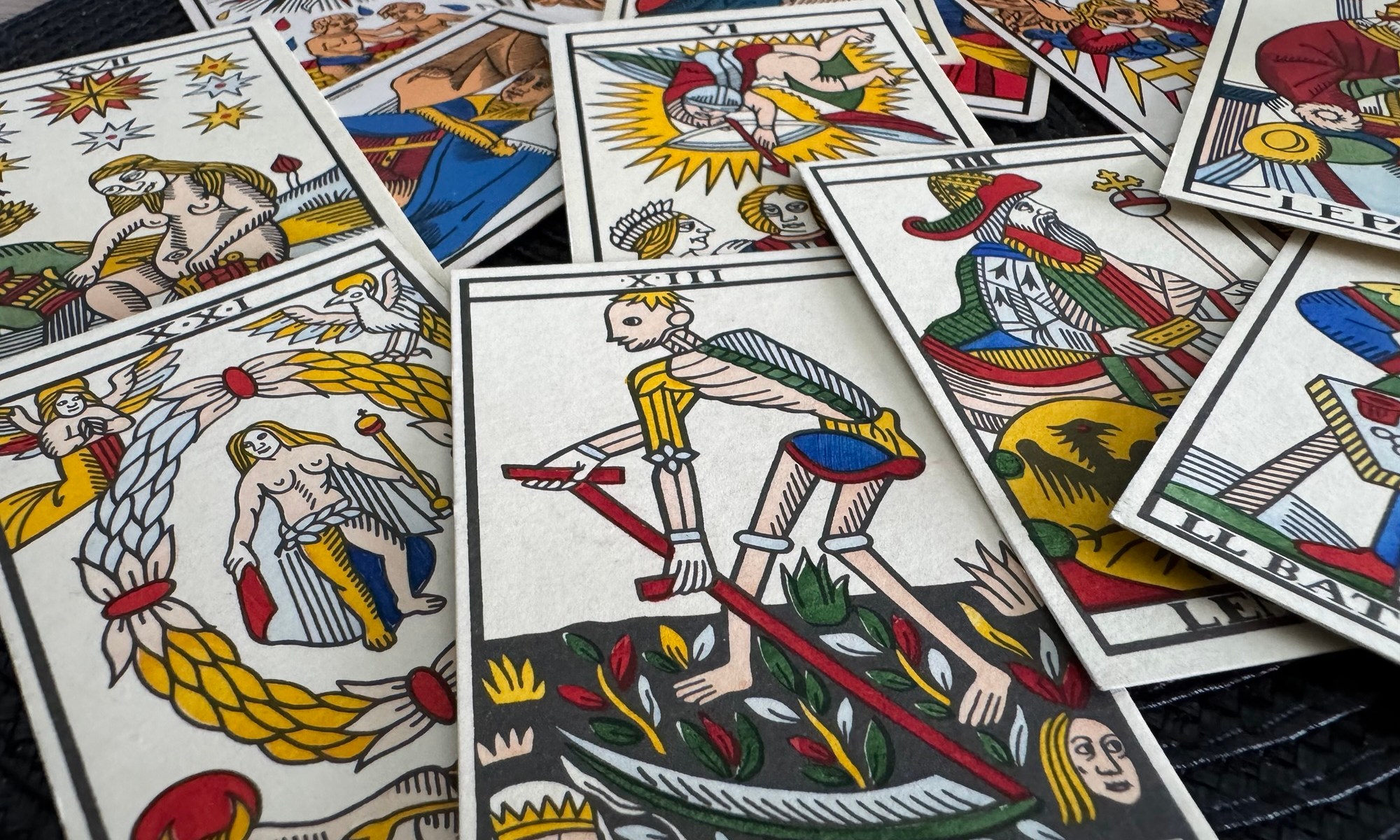

This article continues my series examining the trumps of the Tarot de Marseille, adapted from my unpublished manuscript, Tarot de Marseille: The Picturebook of Fate. As throughout this series, the emphasis is placed upon the traditional eikōn of the card, its historical context, and the practical significations I have found useful through divinatory practice. The interpretations presented here reflect my own experience of working with the Tarot de Marseille and should be understood as a working method rather than a definitive authority.
The Fives: The Pope and Temperance
Trump XIV, Tempérance, is a card whose meaning is often taken for granted. Is it simply a card of moderation? Does it advocate abstinence and self-denial? Why have some occult authors referred to it as the Angel of Time? Whilst these interpretations touch upon aspects of the card, they often overlook its central principle. Temperance is concerned not with abstaining from life, but with measuring it correctly.
The traditional eikōn of Temperance is remarkably consistent. We see a winged celestial being pouring liquid from one vessel into another. The action appears simple, yet it requires care, precision, and judgement. Too much or too little would spoil the operation. The angel therefore embodies the principle of measured action, continually adjusting and correcting to achieve the desired result.

The essence of Temperance is measurement; its function is to measure. This distinction is important. Contrary to popular belief, Temperance has little to do with abstinence and cannot be reduced to the simple maxim that everything is good in moderation. True temperance is the exercise of reason and faith to regulate desire. It is the ability to determine not merely whether something should be done, but how much, how often, and under what circumstances.
Human beings rarely achieve such balance naturally. In our fallen state, our appetites, passions, and desires frequently exceed what is good for us, whilst fear, indifference, or weakness may lead us to do too little. Earlier generations understood this imbalance through the theory of the humours, whereby an excess of choler, phlegm, melancholy, or sanguinity could distort not only bodily health but temperament itself. A person dominated by choler becomes rash, aggressive, and impatient, and feverish; one overwhelmed by phlegm passive, inert, and unwilling to act and easily becomes overweight. In either case, reason ceases to govern properly and the individual falls out of balance.
Temperance therefore seeks neither suppression nor indulgence, but right order. It is the virtue by which competing impulses are brought into proper proportion and directed towards the good. The challenge is that the correct measure is never universal. What is appropriate for one person may be excessive for another. What is suitable today may be unsuitable tomorrow. Temperance is therefore not static but dynamic. The angel does not simply divide the contents of the vessels equally; she transfers precisely the amount required.
When Temperance appears in a reading, it frequently indicates that a situation must be reassessed before progress can be made. The querent may need to balance enthusiasm with caution, emotion with reason, or ambition with practicality. Success will not be achieved through force, impulse, or wishful thinking, but through the correct application of effort, resources, and restraint. Vitality and passion must be married to intelligence and good judgement. The desired outcome is attained through the proper balance of skill, timing, and perseverance.
Some esoteric traditions have referred to this trump as the Angel of Time1, a title which at first appears curious. For many years I struggled to see its relevance to the Marseille tradition. Yet time itself is a form of measurement. Days, months, seasons, and years are all ordered according to measure. In this sense, the association is entirely appropriate. Temperance often poses a simple but important question: is this the right time? The answer may not always accord with our wishes. Sometimes the card advises action; at others, patience. In either case, its lesson remains the same: the desired outcome is achieved not by forcing events, but by finding the correct measure and acting accordingly.
General: The careful and correct application of resources, effort, and judgement. Progress comes through adaptability and recognising what circumstances require. Temperance signifies balance, co-operation, and the ability to adjust to changing conditions without losing sight of the desired outcome. The card also has a strong association with timing, particularly knowing when to act and when to wait.
Love: Relationships characterised by mutual respect, patience, and a willingness to accommodate differences. Each partner recognises the strengths and weaknesses of the other and works towards shared goals. Temperance is an excellent card for reconciliation, compromise, and restoring harmony following disagreements. For those seeking love, the card frequently points towards friendship developing gradually into something deeper. The emphasis is upon steady growth rather than passionate intensity.
Career: Temperance is associated with the hospitality industry, including food, drink, accommodation, tourism, and recreation. It may also signify professions concerned with balance, regulation, and quality control, such as food science, environmental health, and similar specialist fields. In career matters, the card generally indicates stability and security, though advancement may be gradual. Temperance advises patience, as lasting success is achieved through steady progress rather than sudden opportunity.
Finance: Temperance signifies a healthy balance between income and expenditure. Whilst significant financial gains are seldom indicated, the card provides reassurance that resources are being managed appropriately. Major purchases should be approached carefully and viewed as long-term commitments. The key question is not whether something can be afforded, but whether it is necessary, appropriate, and proportionate.
Health: Temperance is generally a favourable indicator of both physical and mental wellbeing. The card emphasises balance, moderation, and sensible lifestyle choices, particularly with regard to diet, exercise, rest, and stress management. It advocates neither deprivation nor excess. Anatomically, Temperance is associated with the circulatory system, legs and ankles and the body’s capacity to maintain equilibrium.
Essence: Measurement.
Function: Measure.
Polarity: Positive.
Astrological Association: Aquarius.
Timing: February.
- See work of Levi and Lind ↩︎

