
This article continues my series examining the trumps of the Tarot de Marseille, adapted from my unpublished manuscript, Tarot de Marseille: The Picturebook of Fate. As throughout this series, the emphasis is placed upon the traditional eikōn of the card, its historical context, and the practical significations I have found useful through divinatory practice. The interpretations presented here reflect my own experience of working with the Tarot de Marseille and should be understood as a working method rather than a definitive authority.
The Fives: The Pope and Temperance
Let us now turn to another example and, in doing so, introduce a new spread.
The tirage en croix, or cross spread, is perhaps the most popular layout in continental cartomancy. One of the principal reasons for its enduring popularity is its capacity to provide a clear and decisive response to a question—indeed, where appropriate, it may even yield a simple affirmative or negative answer. Several variations exist, and the one presented here is simply the version I utilise most often.
The twenty-one trumps and the Madman or Fool are shuffled and cut, after which four cards are dealt in the form of a cross.
03
01 – 05 – 02
04
- Card 1 (Left): The querent and their manner of approaching the situation.
- Card 2 (Right): The situation itself, including external influences, whether favourable or adverse.
- Card 3 (Above): Advice and guidance.
- Card 4 (Below): The outcome.
- Card 5 (Centre): The synthesis.
Unlike the first four cards, the fifth is not drawn but calculated. One adds together the numerical values of the four cards already laid, using the numbering of the Major Arcana, and reduces the result to a number not exceeding twenty-two.
For example, should one draw the Madman (0), Justice (8), the Lover (6), and the Sun (19), the calculation is as follows:
0 + 8 + 6 + 19 = 33
As this exceeds twenty-two, one reduces it further:
3 + 3 = 6
The resulting number corresponds to the Lover, which serves as the synthesis.
It should be evident that this synthesis card is not to be read as an additional outcome; that function is already fulfilled by the fourth card. Rather, the synthesis reveals the underlying dynamics of the matter—the deeper currents and governing principles operating behind the question.
A brief note should be made regarding the Madman. When it appears amongst the first four cards, it is assigned the numerical value of zero for the purposes of calculation. However, the matter is treated somewhat differently in the case of the synthesis. Should the final total reduce to twenty-two, the Madman itself becomes the synthesis card.
Michelle was a gregarious, witty, and gifted amateur artist and jewellery maker who was difficult to overlook. Sadly, she lost her job during lockdown and struggled to find similar employment thereafter. When she secured an interview for a receptionist role, she wanted to know whether she would be successful.
The cards were:
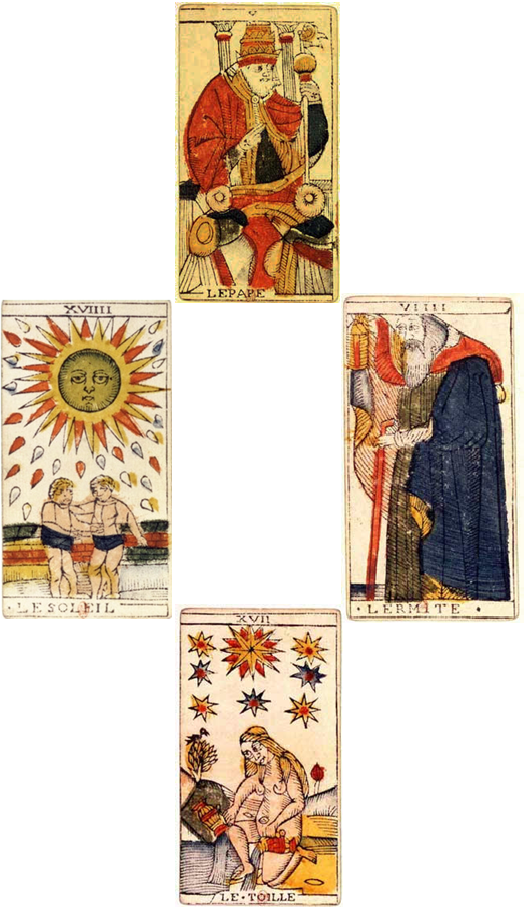
- Position 1: The Sun
- Position 2: The Hermit
- Position 3: The Pope
- Position 4: The Star
- Position 5 (Synthesis): The Pope
The reading begins with the Sun in the position of the querent. This card described Michelle remarkably well. She was warm, engaging, enthusiastic, and impossible to ignore. The Sun is open, honest, and direct. It illuminates everything around it and has little interest in concealment or reserve. Michelle’s natural inclination was therefore to approach the interview with confidence, sincerity, and considerable personal charm.
The situation itself was represented by the Hermit. Here we immediately encounter a contrast. Whereas the Sun shines brightly, the Hermit carries only a small lantern. The position Michelle sought required discretion, patience, and good judgement rather than exuberance and visibility.
A receptionist often acts as the public face of an organisation whilst simultaneously serving as a gatekeeper. Sensitive information may pass through their hands and they are required to deal with people tactfully and professionally. Consequently, the role demanded qualities that did not come as naturally to Michelle as the Sun’s warmth and openness.
The Hermit did not suggest that she suppress her personality altogether. Rather, it advised moderation. Michelle would need to turn down the brightness of the Sun somewhat and demonstrate a more thoughtful, careful, and measured side of herself.
In the position of advice appeared the Pope. This card proved crucial to the interpretation, and its significance became even more apparent when it later reappeared as the synthesis.
The Pope advised Michelle to combine confidence with empathy, strength of character with perceptiveness, and communication with understanding. Reception work is fundamentally a mediating role. One must listen carefully, assess situations quickly, and respond appropriately to a wide variety of people. The Pope therefore encouraged Michelle to demonstrate not merely competence, but wisdom in the application of that competence.
The card also suggested that she would benefit from learning as much as possible about the organisation beforehand. Speaking with someone familiar with the establishment, researching its culture, or gaining a clearer understanding of what the employer valued would allow her to present herself more effectively and show how her skills could benefit the organisation.
The outcome was represented by the Star, a highly encouraging card. The Star signifies renewal, hope, and guidance, all of which pointed towards a favourable result.
More importantly, the card highlighted adaptability. Just as the maiden directs water from her two pitchers, Michelle possessed the ability to apply her talents in different ways according to the needs of the situation. The Star suggested that she had the natural qualities required for the role and, crucially, the ability to adapt those qualities appropriately.
The synthesis was calculated as the Pope, reinforcing the importance of that card. Whenever a card appears both within the spread and as the synthesis, it deserves particular attention. Such repetition indicates that the principles symbolised by the card form the very heart of the matter.
The Pope revealed that the interview was not fundamentally about experience or qualifications. It was about demonstrating wisdom, tact, empathy, intuition, and sound judgement. Michelle already possessed the confidence and charisma represented by the Sun. Her challenge was to temper those qualities with the maturity, discernment, and understanding represented by the Pope.
True strength, the Pope reminds us, is not merely confidence. It is confidence guided by wisdom. Likewise, intuition is not guesswork, but perception informed by experience and understanding. The Pope therefore represented both the advice and the solution.
My conclusion was that Michelle had every chance of obtaining the position. Success depended less upon dazzling the interview panel and more upon convincing them that she possessed the judgement and interpersonal skills required for the role. If she could combine the warmth of the Sun with the wisdom of the Pope, the Star strongly suggested that the opportunity would be hers.
And so, it was! Michelle was successful and is still in post four years on.
This example illustrates another important principle of the tirage en croix. Repeated cards and recurring themes frequently reveal the true heart of a reading. Here, the Pope appeared twice, emphasising that genuine strength lay not in confidence alone, but in the wisdom to know how, when, and where that confidence should be applied.
§
Tarot Cards: Jean Dodal Tarot via Wikipedia Commons. Public Domain.
Featured Image: Ancient Tarot Major Arcana © BP Grimaud/John Waddington Ltd, Leeds & London, Les Tarot de Marseille Jean Noblet, 1650 © Editions «letarot.com» (2001 [hand stencilled trumps]). Les Tarot de Marseille Jean Dodal, 1701 et 1715 © Editions «letarot.com» (2002 [hand stencilled trumps])

