This article continues my series examining the trumps of the Tarot de Marseille, adapted from my unpublished manuscript, Tarot de Marseille: The Picturebook of Fate. As throughout this series, the emphasis is placed upon the traditional eikōn of the card, its historical context, and the practical significations I have found useful through divinatory practice. The interpretations presented here reflect my own experience of working with the Tarot de Marseille and should be understood as a working method rather than a definitive authority.
The Sixes: The Lover and the Devil
Trump VI, L’Amoureux, or the Lover, is one of the strangest and most misunderstood cards in the Tarot. Some see it as a card of love and romance. Others interpret it as a card of choice and decision-making. Still others focus upon complex relationships and outside interference. Yet the Marseille image suggests something rather different. Rather than depicting love fulfilled or a decision made, it portrays a man caught between competing influences and unable to move forward.
The traditional eikōn of the Lover is unusual and immediately striking. A young man stands between two women, each touching or holding him. Above this curious trio hovers a winged Cupid set within a radiant sun, bow drawn and arrow ready to strike. It is a scene charged with tension, yet remarkably little action occurs. No choice is made. No union is achieved. Instead, the central figure appears caught between opposing forces.
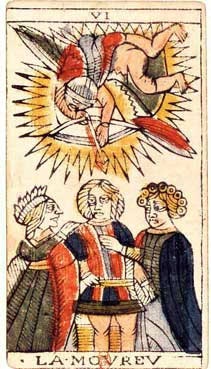
The essence of the Lover is vacillation; its function is to paralyse. For many years this card was a private nemesis of mine. I attempted to read it as a card of love and, later, as a card of choice. Neither interpretation fully satisfied me. Were the card truly about choice, one might expect to see a figure weighing options and reaching a conclusion. Yet the young man does nothing of the sort. He appears trapped by indecision. His companions exert influence from either side, whilst Cupid’s arrow introduces yet another force beyond his control.
The card therefore depicts what happens when reason is subjugated to desire. Conflicting wants, loyalties, attractions, and obligations pull us in opposing directions until we become incapable of meaningful action. We want incompatible things simultaneously. We fear making the wrong choice. Self-preservation urges caution whilst desire urges action. The result is hesitation, confusion, and ultimately paralysis. The Lover is the card of the divided heart. Hosea’s observation1 remains as relevant now as when it was first written: conflicting loyalties render us unstable and uncertain. We are drawn simultaneously towards incompatible desires and find ourselves unable to pursue any of them wholeheartedly. Thus the card signifies not the making of a choice, but the paralysis that arises when we cannot bring ourselves to make one.
For this reason, the Lover often appears when the querent is being pulled in different directions and cannot determine the best course of action. A pervasive feeling of discomfort accompanies the card. One finds oneself at a crossroads, yet no path appears satisfactory. Progress stalls because the underlying problem is not a lack of options but a lack of clarity regarding what is truly wanted. Until this confusion is resolved, the querent remains unable to realise their full potential.
Quite often, the Lover signifies the influence of a third party: someone whose presence complicates matters or exerts undue influence over the situation. In relationship readings this can indeed manifest as the classic love triangle, though not necessarily through infidelity. More often it reflects divided loyalties, emotional uncertainty, or the emergence of feelings for another person whilst an existing relationship is neglected.
The principle extends beyond romance. In business and employment matters, the Lover frequently reveals rivalry, competition, and competing interests. The querent may find themselves struggling to establish a clear position or differentiate themselves from others. Unless they are willing to commit to a particular course of action, competitors may seize the opportunities that indecision leaves behind. The Lover reminds us that vacillation has a cost, for whilst we hesitate, the world continues to move forward.
General: Being pulled in different directions by competing interests, loyalties, or desires. The card signifies uncertainty, hesitation, and difficulty committing to a particular course of action. Third parties often complicate matters, introducing confusion or conflicting advice. Conflicts of interest, divided loyalties, and an inability to decide are common manifestations of the Lover.
Love: In established relationships, the Lover frequently heralds a period of doubt and uncertainty regarding the future. Communication is often poor, with one or both partners reluctant to express their true feelings or concerns. The card may indicate the influence of a third party, whether through interference, divided affections, or the emergence of romantic feelings elsewhere. For those who are single, the Lover often brings opportunities which ultimately fail to develop into lasting relationships. Initial attraction may be strong, but long-term goals and expectations are seldom aligned. The card also warns that not everyone is being entirely candid.
Career: The Lover is associated with professions concerned with relationships and human interaction, including relationship counselling, sexual health services, matchmaking, and similar fields. It may also signify temporary, part-time, or flexible employment. More commonly, however, the card indicates uncertainty regarding career direction. The querent may be struggling to identify the right path forward and would benefit from impartial advice. Within existing employment, the card can reveal rivalry, office politics, conflicting expectations, and unhealthy competition between colleagues.
Finance: Financial difficulties frequently arise through indecision, poor planning, or conflicting priorities. Income and expenditure may have fallen out of balance, requiring difficult choices and a reassessment of financial goals. Dissatisfaction and emotional frustration can encourage impulsive spending, often to temporary effect. The card advises seeking trusted advice and committing to a clear financial strategy.
Health: The Lover is associated with sexual health and may indicate sexually transmitted infections and diseases. More generally, the card often points towards disorders in which desire, impulse, or compulsion override reason and good judgement. This includes conditions such as intermittent explosive disorder, compulsive eating, kleptomania, compulsive spending, and related difficulties with impulse control. Psychological distress arising from internal conflict, indecision, or competing desires may also be present.
Essence: Vacillation.
Function: Paralyse.
Polarity: Neutral.
Astrological Association: Venus.
Timing: Friday. Within seven months.
§
Tarot Cards: Jean Dodal Tarot via Wikipedia Commons. Public Domain.
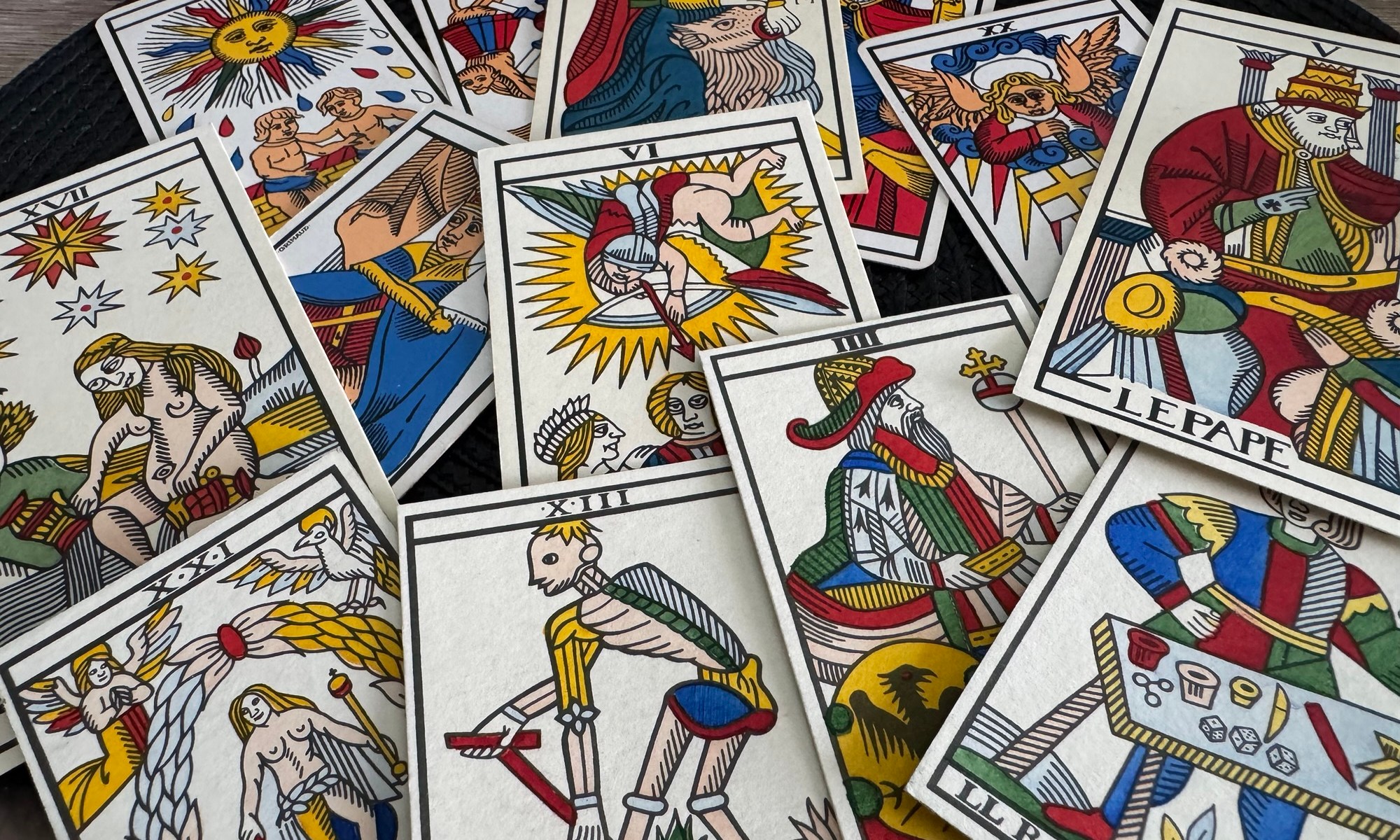
Featured Image: Ancient Tarot Major Arcana © BP Grimaud/John Waddington Ltd, Leeds & London, Les Tarot de Marseille Jean Noblet, 1650 © Editions «letarot.com» (2001 [hand stencilled trumps]). Les Tarot de Marseille Jean Dodal, 1701 et 1715 © Editions «letarot.com» (2002 [hand stencilled trumps])
- Their heart is a divided heart; very well, they must pay for it. Hosea 10:2, Jerusalem Translation. ↩︎

