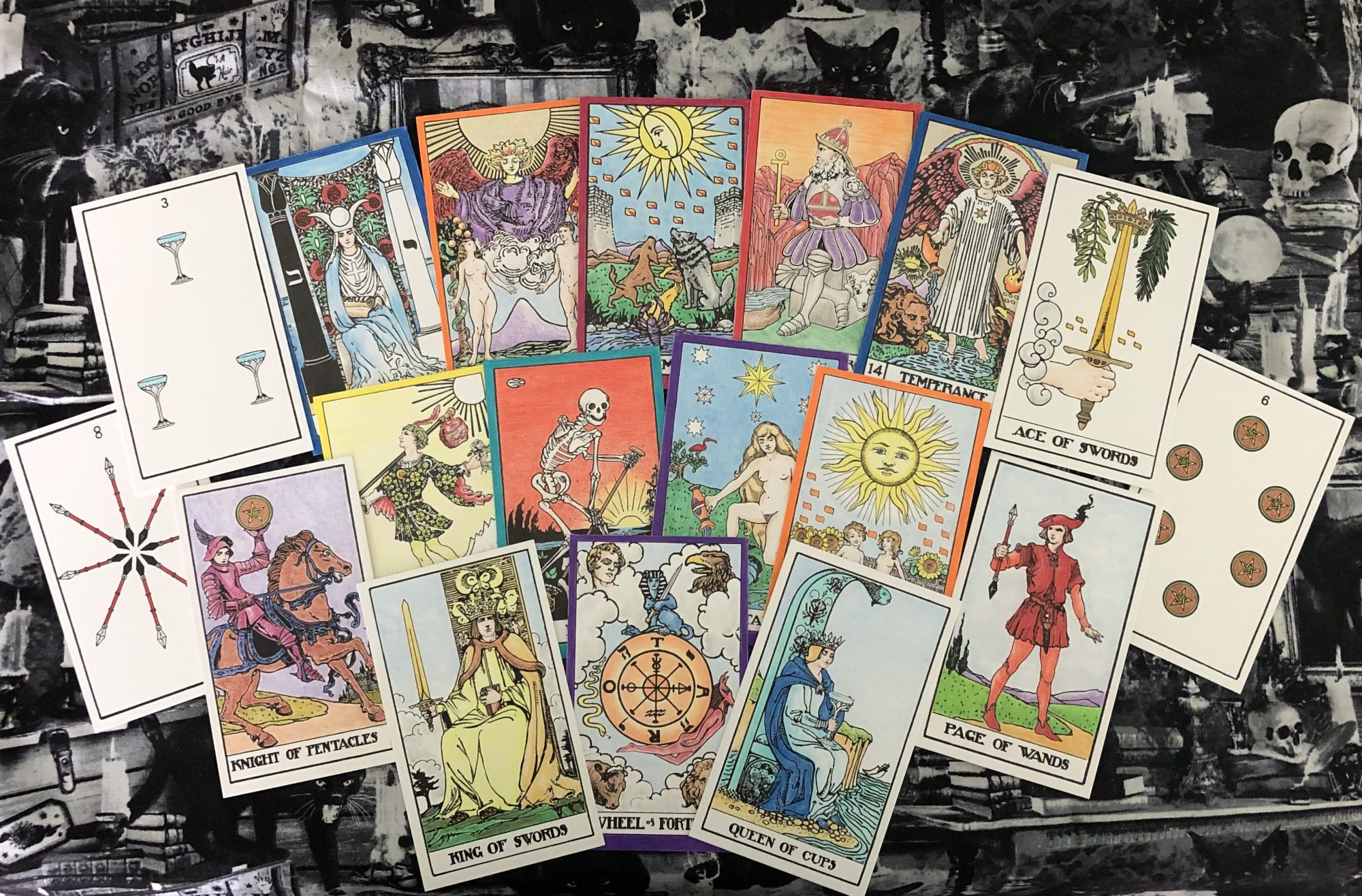
My friend, Hugh, acquired Regina Russell’s well-regarded Card Reader’s Handbook earlier this year. He was impressed. Valuing his opinion, I took the plunge. It is a brilliant treatise on the art of cartomancy. The cards’ significations are close to those I use and echo Dr. Leo Martello.
In her text, Russell introduces a three-stage reading process. Before the 1970s/80s, such sequential readings were not uncommon. Even Juliet Sharman-Burke included the practice in her correspondence course and book, The Complete Book of Tarot. However, then as now, you can use each spread individually.
The fifteen-card spread, which Russell starts her readings with, has become a personal favorite. You can use it outside the staged process. Since acquiring the book, I’ve used it with Playing Cards and Tarot cards in addition to the Mlle Lenormand Oracle and Kipperkarten cards. It’s brilliant.
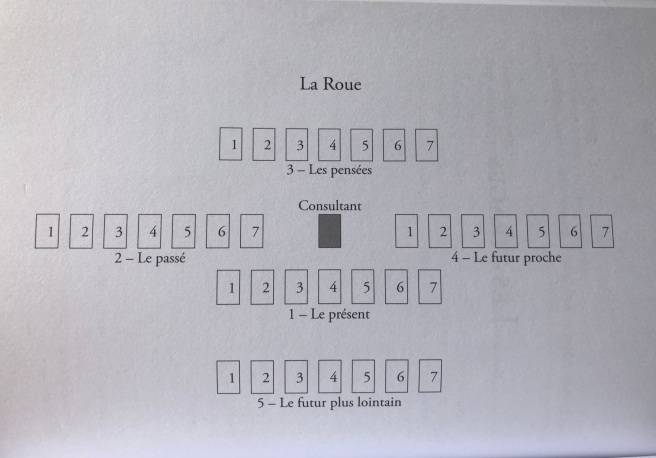
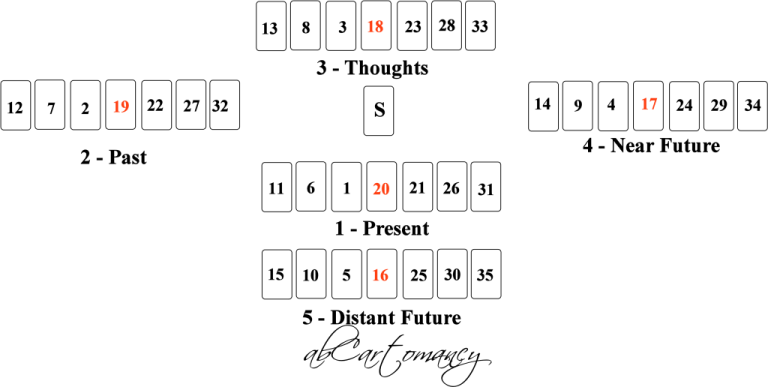
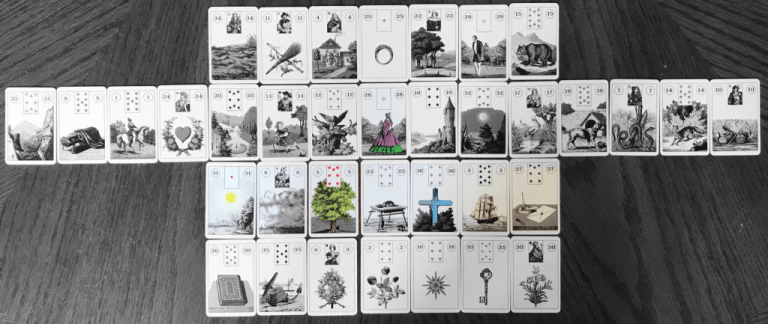
Essentially, the spread is five fans of three cards. They are laid out as follows:
The cards in the center are what is closest to the Questioner. To the left is the recent past or something just about to happen. The cards to the right are something new coming into the Questioner’s life. The cards above are set to occur within two months—those below in two months’ time.
Last month I used the spread to read for a husband and wife, Niamh and Fionn. Niamh and I met several years ago. Fionn is self-employed and in February underwent an emergency ileostomy.
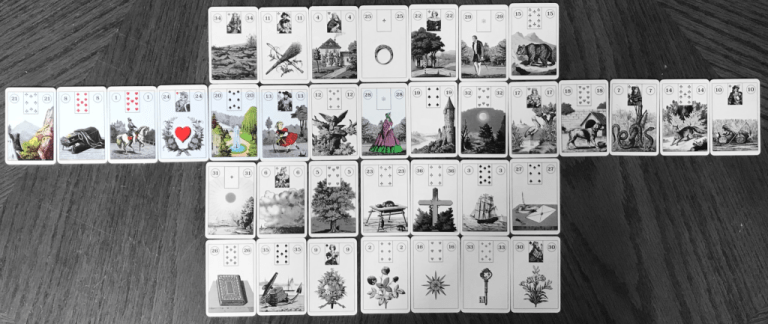
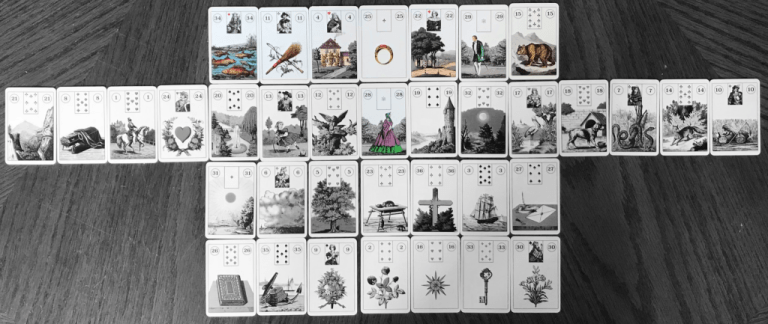
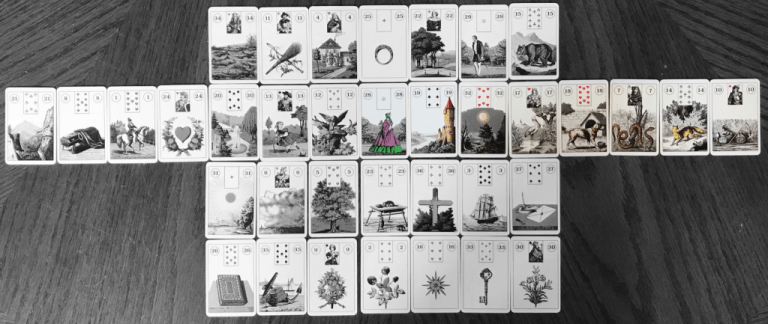
Fionn’s reading was as shown below.
Most of the cards are black, and clubs and spades are in the majority, so Fionn has his work cut out (clubs) to overcome his challenges (spades). The difficulties are financial (3 Diamonds).
Considering Fionn’s circumstances, the presence of the 8 of Spades at the center is unsurprising. It is the card of the doctor. Next to it is the Ace of Clubs: we have a hospital. Fionn had an appointment that week and would have some investigations (3 of Spades). On turning the 3 of Spades over, I immediately seized on x-rays. Fionn said “no” to this, but I said he might be surprised. However, the 3 of Spades covers all tests and investigations.
The Ace of Clubs also signifies documents, particularly official ones, and his treating physician (8 of Spades) may be asked to clarify some matters regarding his needs (3 of Spades + the fan on the right). Essentially, we have a medical report.
The trio to the left can signify the recent past and present. Fionn is worried about his surgery’s effect on his business (7 of Spades). 8 of Clubs often indicates our work. He runs a small landscape gardening and block paving company. Before his admission, things had been going well with a slight expansion and taking on a part-time trainee (3 of Clubs). This has now stalled (7 of Spades) as Fionn cannot lift, is in pain, tires quickly, etc. Fionn wants clarity on his recovery time.
The three cards to the right describe events occurring within a month or something new coming in Fionn’s life. Remembering the Ace of Clubs, we can see a decision (Ace of Spades) will be made within a month regarding what financial assistance Fionn is entitled to (4 of Spades + 2 of Diamonds). As the 2 of Diamonds falls last, we can be reasonably sure it is favorable. Fionn will get some form of social assistance. There will also be a discussion about realistic recovery times and how Fionn might need to adapt and slow down (Ace of Spades + 4 of Spades). Some of these changes will also be diet-related (2 of Diamonds) due to changes in digestion (Spades = elimination system).
The three cards above and below the center cards refer to events occurring within two months and in two months, respectively.
Fionn will receive a further helping hand (2 of Clubs) within the next two months following a business deal with a man (10 of Clubs + 6 of Heart). The 6 of Hearts is often a friend, brother, son, or son-in-law. Whoever he is, he’s got good business sense and ideas (10 of Clubs). Sometimes the 10 of Clubs is a journey, usually over water, and I wondered if this could be one of Fionn’s relatives from Ireland. Otherwise, Fionn will be traveling to see a friend who is supportive.
Let’s look at the final fan. Russell states that the three cards below can indicate something the Questioner doesn’t want to happen, associating the position with delay and dislike. I’ve not found this to be the case all the time. Sometimes it is just something occurring in two months’ time.
The 5 of Clubs can indicate reorganization and reevaluating. With the 10 of Diamonds, Fionn will need to look at his business plan and make changes to cover him until he can return to work (5 of Clubs). He can do things more efficiently and cheaply, and should look at supplies, etc. I also suspect this could be via further investment (10 of Diamonds) from either a loan or his earlier dividends (7 of Diamonds). The 7 of Diamonds at the end promises benefit in the long run even if Fionn is reluctant.
Fionn had his appointment with his consultant and was given a form for a chest x-ray because he had a drain fitted during his admission due to fluid build-up. He was surprised. When something seizes the Reader, it is best to go with it even if the Questioner disagrees. Time will tell. You or they may be wrong. The cards will invariably be right.
Fionn was also advised that his consultant had been contacted about his benefits claim. I’ve asked Fionn to keep me up-to-date.
§
Deck: Deluxe Playing Cards (Alf Cooke), c. 1930 – 1940.
Card Reader’s Handbook, self published by Regina Russell in 1976. The Complete Book of Tarot by Juliet Sherman-Burke, published by Pan Macmillan in 1985.
Think of the universal substance, of which thou hast a very small portion; and of universal time, of which a short and indivisible interval has been assigned to thee; and of that which is fixed by destiny, and how small a part of it thou art.
Marcus Aurelius, The Meditations Book V (Long trans.)
Cartomantes have long favoured “star” patterns of varying sizes and operations. Here, we will look at a late nineteenth-century variation I refer to as the Dame’s Nowl.
Like Basil Ivan Rakoczi’s Coven of Thirteen – popularised by Dawn R. Jackson – the Dame’s Nowl employs 13 cards. Unlike Rakoczi’s variation, the Dame’s Nowl forgoes mirroring for positional contexts: charting the past, the present and the future alongside unhelpful influences or problems. Consequently, it is an excellent alternative to spreads such as the Celtic Cross.
“The Fashionable Fortune-Teller”
Between 1896 and 1913, “Minetta” authored two books on cartomancy and one on tasseomancy. Minetta also conceived a Bésigue-style deck, specifically for cartomancy, and provided the instructions for a Petit Lenormand published as the Gypsy Bijou Fortune Telling Cards.
Minetta’s identity has never been identified. Several names have been proposed. Caitlín Matthews has suggested that Minetta was Cicely Kent.
There are similarities between Cicely Kent’s text and Minetta’s; although they are not without differences. However, there are also differences between Minetta’s 1896 and 1913 books. Although both manuscripts utilise the same readings, there is some difference in interpretations, and Minetta gives different definitions for multiples in the two texts. It thus the current author’s feeling that two different authors might have written under than penname, one quite possibly being Cicely Kent. Of course, however, this could be development: as diviners, we all grow and change.
The Dame’s Nowl or Star of Fortune:
Minetta’s Star of Fortune appears in both books. It is, however, titled method II in 1896. As I know another spread with this title, I refer to Minetta’s as The Dame’s Nowl.
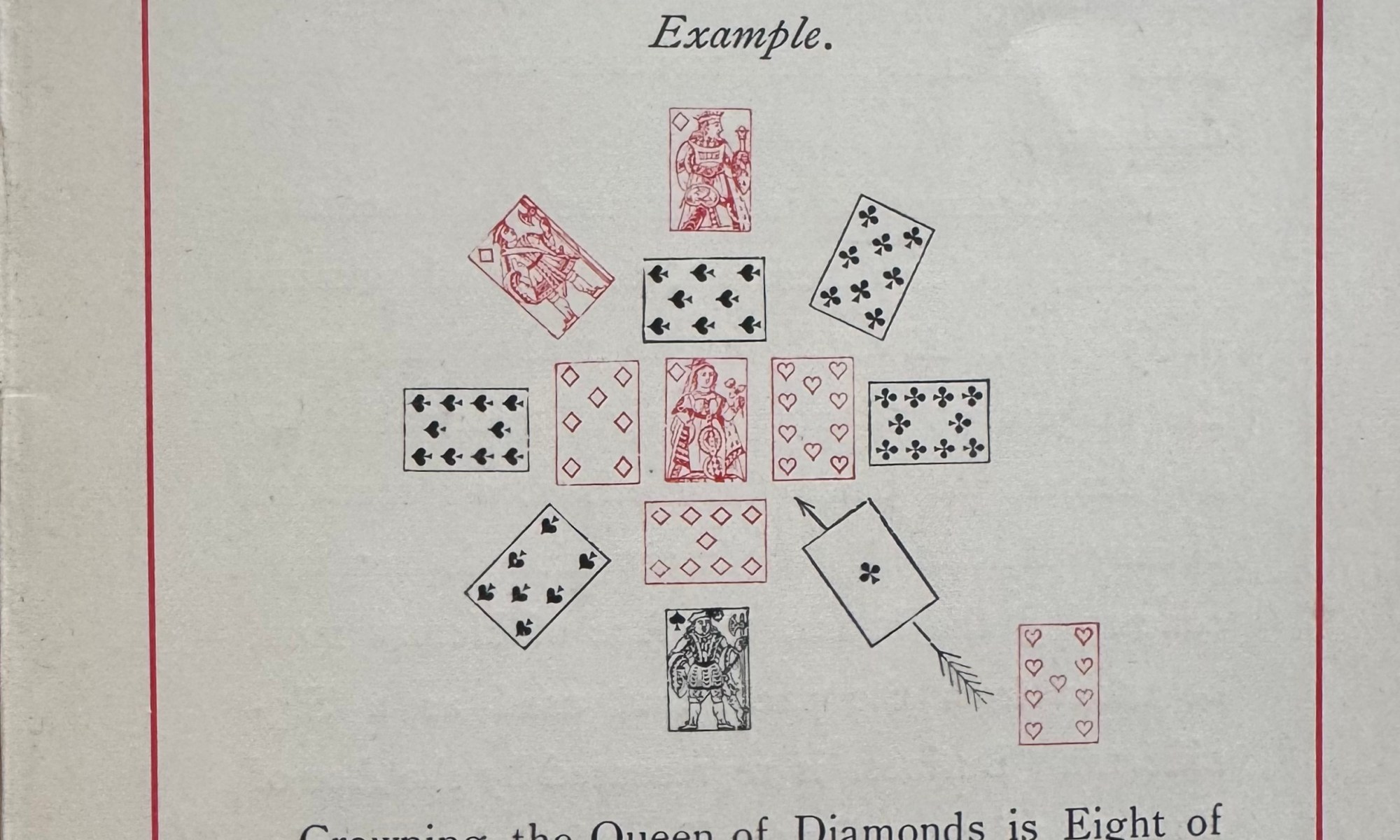
Minetta’s Method II
In her 1896 text, Minetta states to:
Place two at the head of the significator, two at the feet, two on the right, two on the left, one in each corner, and one on the significator, making in all thirteen cards.
What The Cards Tell (p. 26)
In Card Reading, Minetta states the specific order, as indicated in the diagram below.
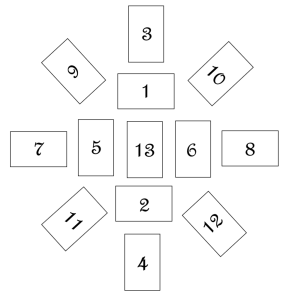
Both Cicely Kent and Sepharial adhere to this order.
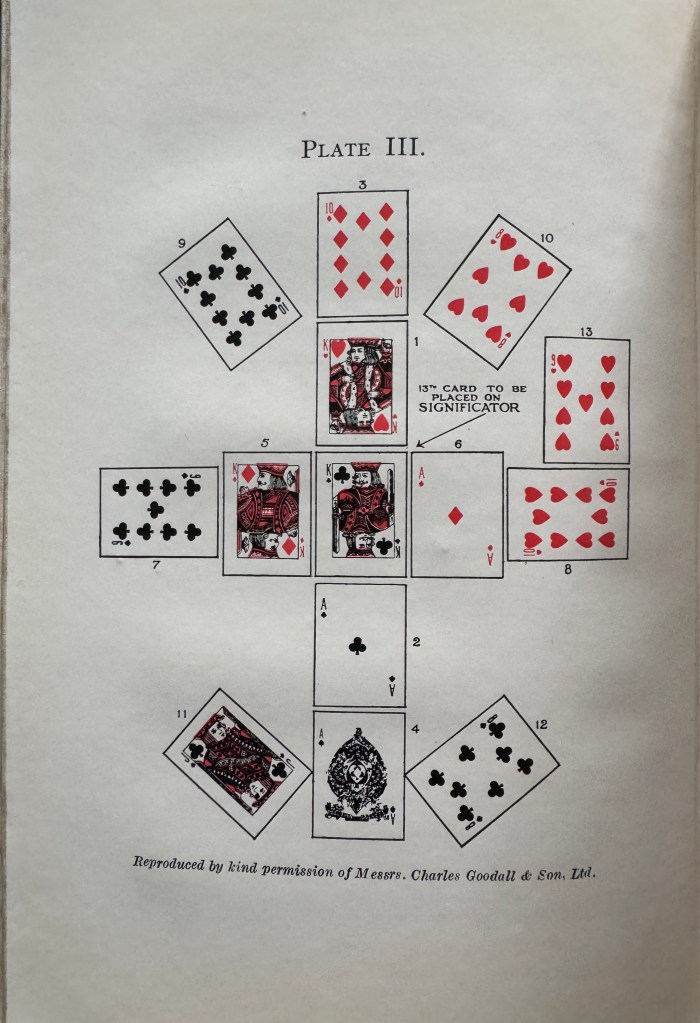
Cecily Kent’s Star of Fortune
Minetta’s instruction for reading the spread is:
Those cards which crown the significator predict the near future; those at the feet, the past; those to the left, obstacles; those to the right, the distant future; the top corners, present details; those at the feet, the past details; the card on the top of the significator, the consolation.
What The Cards Tell (p. 26 – 27)
Minetta removes the significator before shuffling. It is placed centrally, with the thirteenth card placed upon it.
Adhering to standard sinister (left) and dexter (right) conventions, Minetta sees cards to the left as challenging and problematic. Those to the right can advise on remedy and assistance. These become more pronounced in her 1913 text which includes a table diagram.
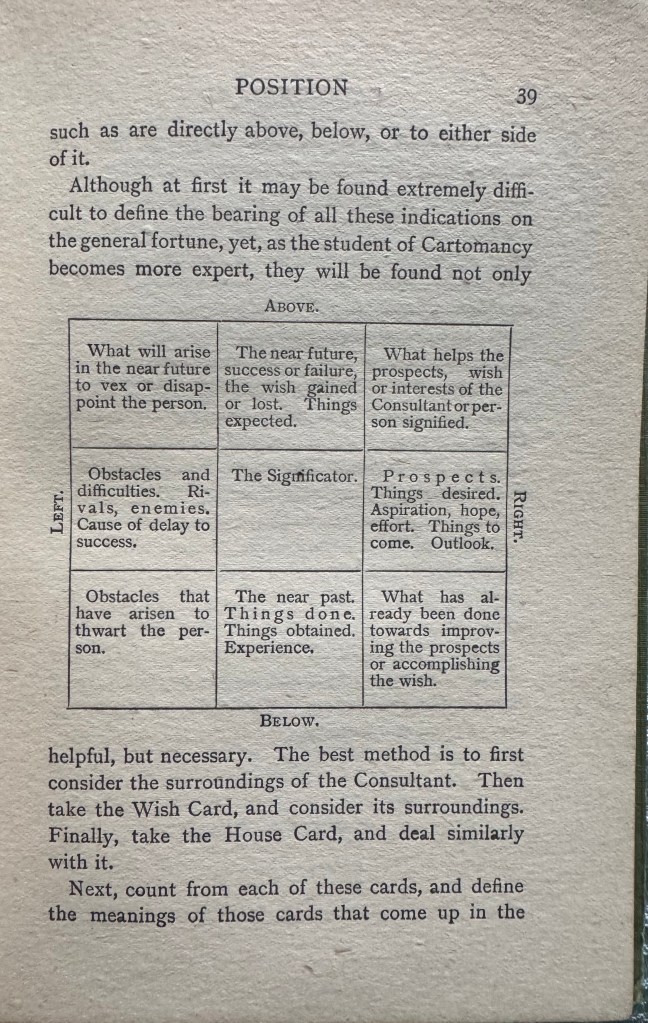
Minetta’s Table
Following the Nowl: Stacey’s Reading
Let us look at a reading with the Petit Lenormand. This reading was done just before Christmas 2019. Stacey is a young woman and wanted a general look at where her life was going. For general readings, spreads such as the Coven of Thirteen or the Astrological Wheel are often preferred. However, Stacey seemed quite unhappy, so I thought it was best to ascertain both her background and challenges.
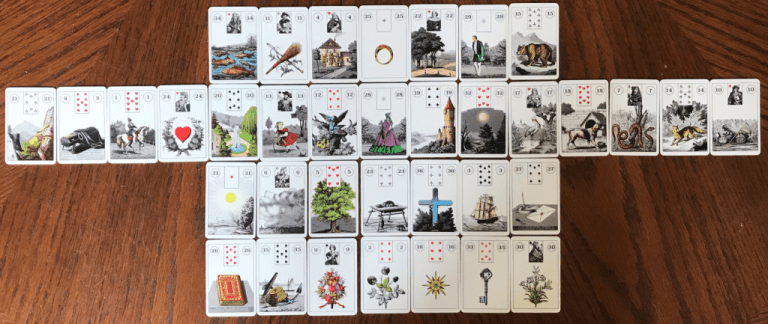
The cards as they fell:
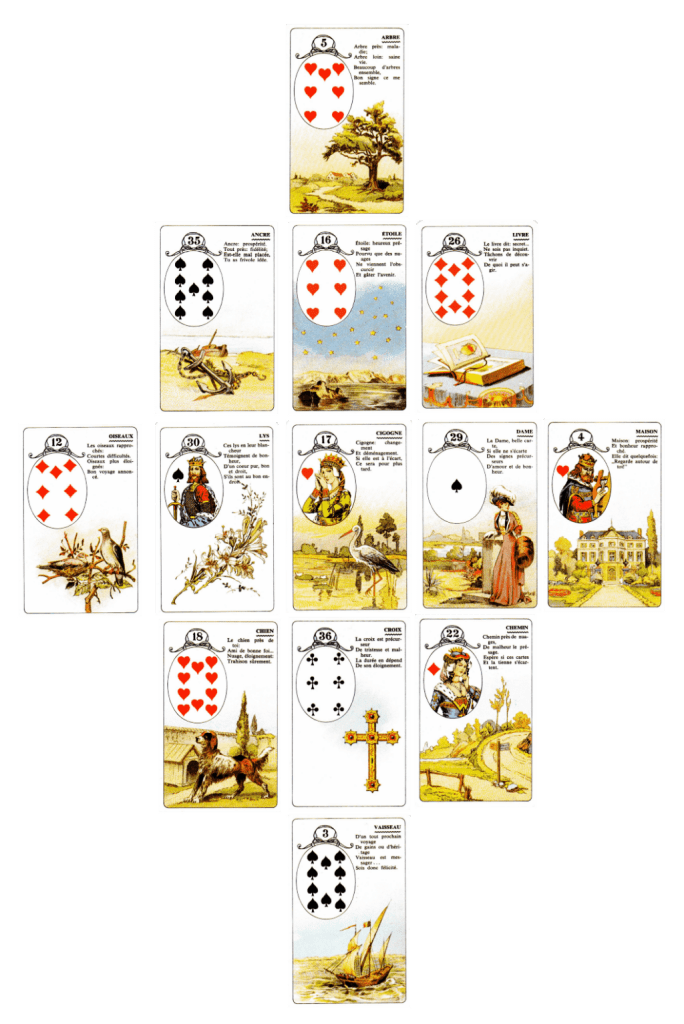
At the heart of the star, we find the Stork. Change is afoot. We will bear this in mind as we examine the cards’ different combinations.
We will start with the bottom section as these describe the past circumstances. Keeping the Stork card at the forefront of our mind, we see that there has been a difficult transition (Cross – Boat) in Stacey’s life.
With the Cross crowning the Boat card, we know that this will have been a significant shift in Stacey’s circumstance and marked a milestone.
Looking to the left and right of the Cross, we see the Hound and Path cards which sheds more light. Stacey’s decisions (Path) has seen her relocate (Cross – Boat), which has meant that she has lost her familiar surroundings (Hound – Cross). The presence of three tens further emphasises that.
Unfortunately, this has left Stacey feeling out in the cold, and a period of disquiet has ensued (Birds – Lilies). With the Lilies on the left and the Cross and Boat at the star’s feet, one was sure that Stacey had moved away from her family.
Both the Birds and Hound cards are near enough to the Lilies to be read as persons, but one was not seized to interpret them as specific individuals. However, the two queens and two kings do denote male and female acquaintance. With the Hound on the sinister side of the star, and the presence of two sixes in the spread, it is clear Stacey has struggled to form new relationships, and this has magnified her discomfort.
Moving upward, the Anchor’s orientation poses a dichotomy. Stacey’s attempts to find a sense of place will continue to prove difficult and keep her moored to her present feelings. Fortunately, the Tree and the Stars bring a soothing solution.
Over the coming weeks, she will take some time out (Tree) and focus on herself and where she feels she needs to be in life (Tree – Book). We note the Stars are the Tree’s roots in this spread, and they seem to be guiding Stacey back home. But the Book falls adjacent to the Stars and crowns the significator. Stacey is urged not to rush into any decisions, which seem to have been the case in the past (Path).
Further into the future, Stacey will find herself moving into more comfortable times (Lady and the House). With the presence of both the Tree and the Lilies cards, it is likely this is a move back to familiar surroundings. Coming back to the Stork, we remember that it is a migratory picture: Stacey will go back home.
Stacey was in her first year at university but was not enjoying her surroundings and her course.
After some reflection, Stacey decided to transfer to a new university in her hometown. Due to the lockdown, Stacey returned home in the Spring. That fits with the Lady looking to the House card (last week of Spring).
Fate has decreed for each person the immutable working out of events, reinforcing this decree with many opportunities for good or bad consequences…
– Vettius Valens, The Anthology (Riley Trans.)
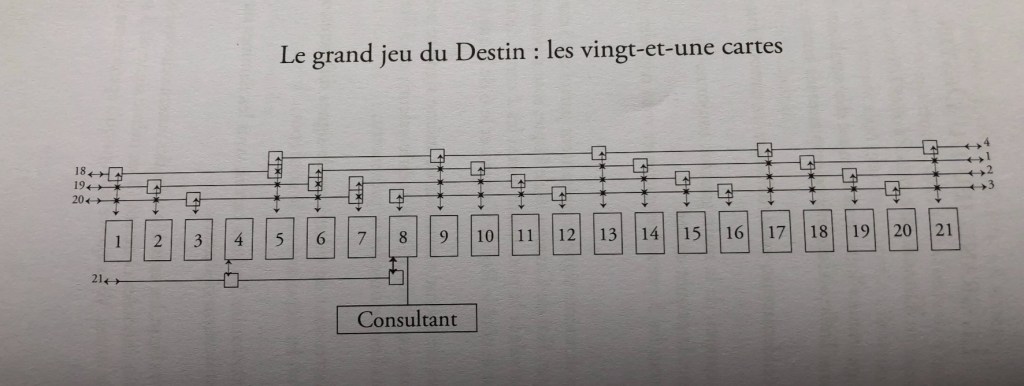
Le grand jeu du Destin — the great game of destiny — piqued my interest from the right from the start. As a young cartomante, I used it extensively and still do. It has featured in my courses and blogs. The spread, however, never caught on among my English-readers. However, I find it the best alternative to the Grand Tableau to review someone’s life in general over the coming three or four months.
The Great Game of Destiny
In addition to asking for the name and sun sign of the Querent, Mary Marco recommends shuffling the cards seven times in honour of the seven lights (planets). I feel that this is a personal preference.
Once shuffled, the cards should be cut in two. The cartomantes reads the cut, which will offer some insight into the tone of the reading, reconstituting the cards.
The First Reading: The 21 Cards
1) In this draw, we use the playing cards to select our 21 cards. From the top of the deck, deal three cards.
a) Firstly, look and see if any of the three cards are from the same suit. For example, you deal the following three cards: the Boat (10 of Spades), the Cloverleaf (6 of Diamonds) and the Tree (7 of Hearts). All three are from different suits. For this reason, you put them aside.
b) Deal three more cards. This time you have the Letter (7 of Spades), the Moon (8 of Hearts) and the Anchor (9 of Spades). We have two spades. Of the two that originate from the same suit, we retain the card with the highest value. For us, the is the Anchor.
c) If you see three cards from the same suit (such as the Stars, the Stork, and the Cavalier which are all hearts), you retain all three cards.
d) Similarly, if you see three cards of the same value (the Serpent, the Flowers, the Path which are all queens), you retain all three.
2) You continue to deal cards by three, always looking for cards that carry the same suit and retaining the card with the highest value. Knaves, queens, kings and aces are considered to be 11, 12, 13 and 14, respectively.
Once you have exhausted your cards, you take the eliminated cards and shuffle them and begin to deal them in threes.
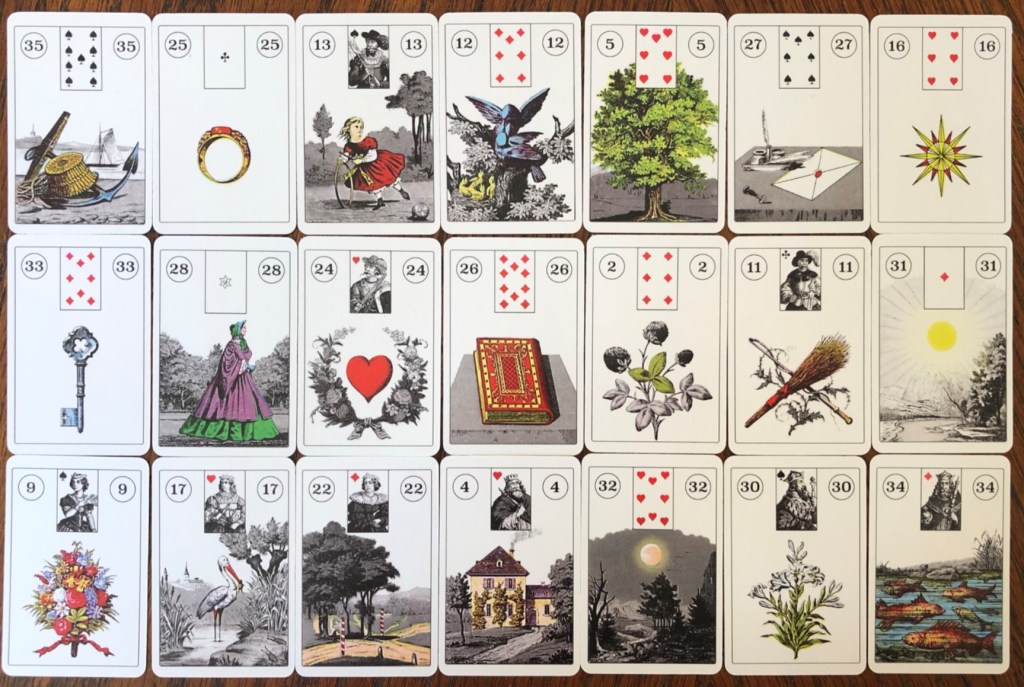
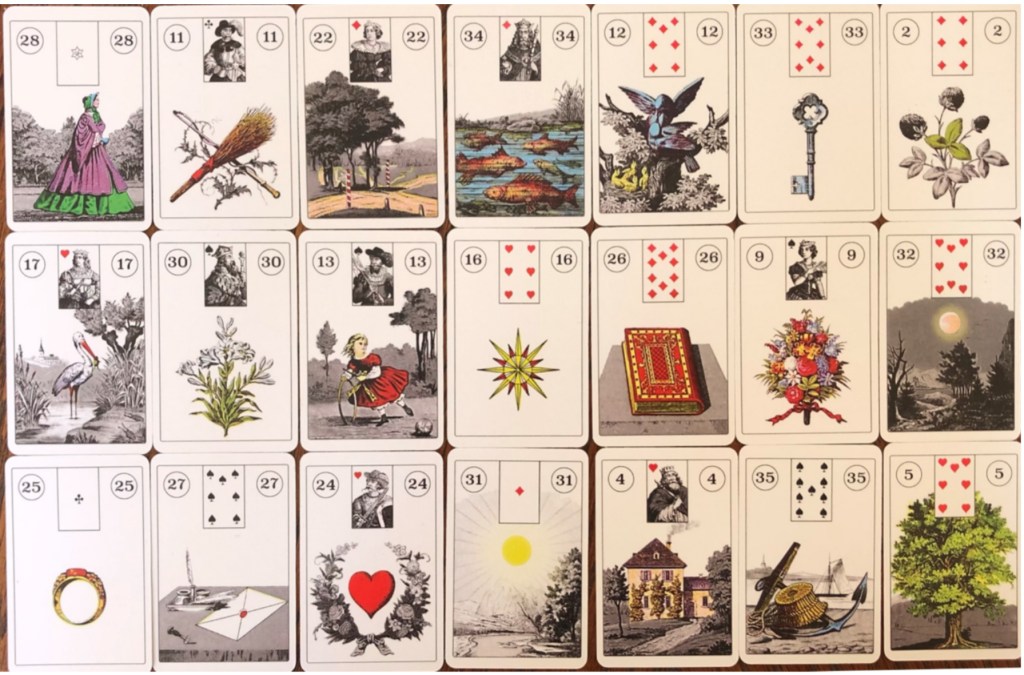
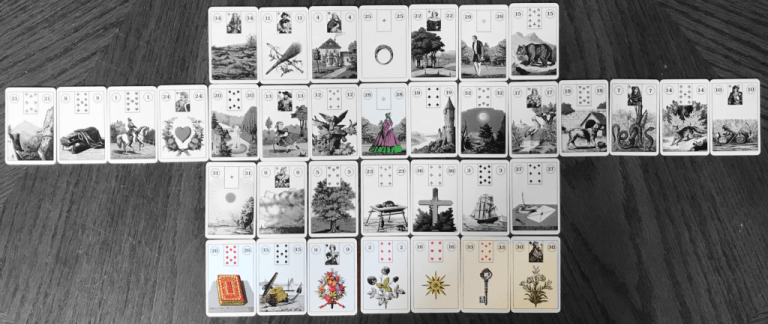
3) You continue this until you have 21 cards arranged in front of you. We are supposed to lay them in a line, as above. However I prefer a 3 x 7 (+ 2). Here is the reading:
4) Look at the 21 cards in front of you. Is the significator (the Child, the Lady or the Gentleman) present? If the Querent’s card is present, you may proceed to step 5.
If the significator not been selected during preliminary steps, you must shuffle the remaining fifteen cards, cut them and then deal them in twos.
Keep the pair that contains the significator and add them to the 21 cards.
5) The first reading is done using a count of five commencing from the significator.
For example, our Querent is signified by the Lady card. We count as follows:
The Lady (1), the Heart (2), the Book (3), the Cloverleaf (4) and the Birch Rod (5).
The Birch Road becomes card 1, and we count along to the next fifth card: the Paths.
You continue the count, threading together a story. The presence of the master cards can often guide the reading, and the shift from one to another, such as the House (homelife) to the Ring (relationships), might indicate a change in focus.
This is your first reading.
Below is the reading arranged according to the count. However, do not rearrange your cards! The cards need to be in the order that they were dealt for the Second Reading.
The First Reading: Elisabeth’s Reading
Currently, Elisabeth feels tired and quite battered and bruised by life, which could undermine her health (Birch Rod). Circumstances are set to force her into an important financial decision (Birch Rod — Path — Fishes). However, her options will seem unfair and limited (Birch Rod — Path), leaving her deeply nervous (Fishes — Birds). Nevertheless, resolving these financial worries (Fishes — Birds) will be crucial to improving her life (Key). Discussing her choices with an advisor (King of Diamonds/Fishes — Birds) will clarify her options and alleviate her worries (Birds — Key). Thus armed, she will have not just a better understanding but will find an opportune moment (Key — Cloverleaf) to turn her situation around (Stork), bringing in the sense of peace (Stork — Lilies) and renewed optimism for the future (Lilies — Child).
Elisabeth will find that her daughter* (Lilies — Child) thrives in the coming weeks (Child — Stars). In particular, she will find considerable success in her education (Child — Stars — Book), highlighting a natural gift or ability hitherto unrecognised (Stars — Book). It will be found that this increased recognition brings more educational options or avenues (Book — Flowers — Moon).
There are professional opportunities for Elisabeth, too. Her talents are set to be recognised in an interview (Flowers — Moon), leading to a job offer or promotion (Flowers —Moon — Ring). She will sign a contract (Ring — Letter), bringing her much satisfaction and joy (Heart — Sun).
Elisabeth is currently single, but a new relationship is both on the horizon and in her mind (Ring, crowning the Lady). There will be an exchange of messages and telephone calls of a romantic nature (Letter — Heart). Although not too serious at first (Letter), strong chemistry and sincerity give the relationship strong potential in the future (Heart – Sun). The man is older than Elisabeth, successful, and has a good temperament and nature (King of Hearts) with whom Elisabeth will have a strong rapport (Sun – House).
At home, Elisabeth is assured of support and affection (Sun – House). Her support network is solid and stable (Sun – House – Anchor), and she can rely on this continuing undisturbed (House – Anchor – Tree).
Elisabeth’s health will also improve going forward. The malaise triggered by the Birch Rod will pass, and her constitution will hold out (House – Anchor) will remain strong (Anchor –Tree).
Thus concludes the first reading of the 21 cards.
Second Reading: Pairing
Mary Marco refers to the second step as confirmation and proof by two. However, it is essentially pairing or mirroring, which was a common technique in classical cartomancy. When Mlle Le Normand refers to examining the “extremities” she is discussing pairing.
1) Read the first, and the last card dealt together, e.g. card 1 + card 21 (or card 1 + 23). In the reading below, that is the Anchor and the Fishes.
2) Now, you read the second card, the twentieth. In the reading below, that is the Ring and the Lilies cards.
3) You continue to pair the cards. You will find, with 21 cards, card 11 cannot be paired. It offers a conclusion and can help determine the condition of the fortune.
The Second Reading: Elisabeth’s Reading
We will now pair the 21 cards.
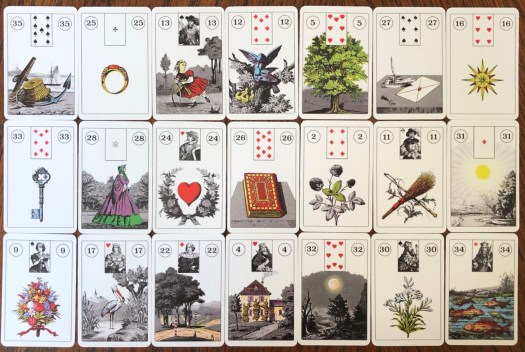
The cards as they fell:
Anchor – Fishes: Elisabeth will find her financial situation stabilises with a secure income to balance her outgoings.
Ring – Lilies: The situation is helped by a contract or agreement through an advocate or charity.
Child – Moon: Elisabeth will continue to be held in high esteem. Her daughter will also find it is her time to be in the spotlight.
Birds – House: There will be much excitement in the home about this latest development…
Tree – Path: …as it signals crucial decisions that need to be made about her daughter’s future.
Letter – Stork: All of which will be followed up in several telephone discussions and messages going back-and-forth with previous plans changed…
Stars – Flowers: …due to the arrival of a new offer. Elisabeth will also find that her skills are recognised with the benefit accorded to her as a result.
Key – Sun: Bringing her particular success and renewed energy.
Lady – Birch Rod: That will undoubtedly help alleviate a brief dip in her energy or health issue.
Heart – Cloverleaf: She might find that her lethargy is caused by anaemia. However, this will be rectified. Elisabeth will also welcome an opportune development in her love life.
Book: This will come as an unexpected and surprising development for Elisabeth. However, with her shrewd and measured approach, she will meet her challenges.
This concludes the second step of the reading.
Third Reading: The Four Stacks
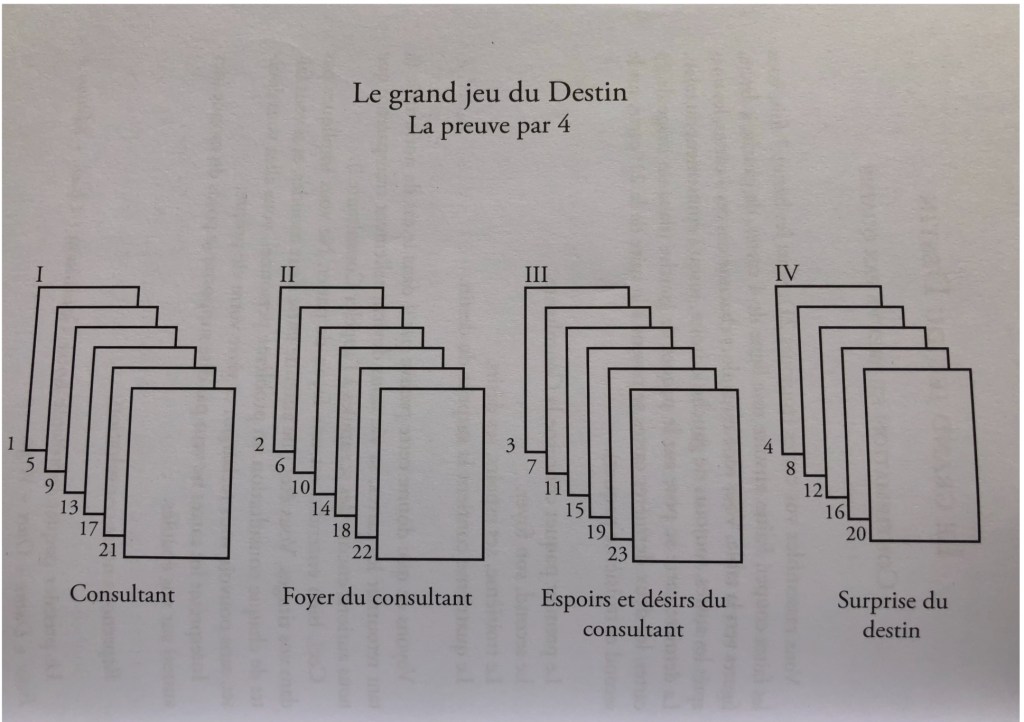
The third and final stage of the reading is described as being confirmation and proof by four.
1) Gather the 21 (or 23) cards and shuffle and cut them. Then deal four cards face down in a row.
2) Deal four more cards on top of the first four. You continue to do this until all the cards are dealt.
If you were using 21 cards, you would find that you end up with six cards in the first column and five in the second, third and fourth packet.
3) The four packets provide the final confirmation and explanation of your reading.
The first packet relates to the client herself.
The second concerns the Querent’s home and family.
The third describes her hopes and desires.
The fourth set of cards is the surprise of destiny.
The Third Reading: Elisabeth’s Reading
Elisabeth’s cards were gathered, shuffled and cut before dealing them out into four stacks.
The cards as they fell:
Group 1:
The first packet refers to Elisabeth herself. Here we find: the Tree, the Birch Rod, the Lilies, the Book, the Key, and the House.
Elisabeth will find that her constitution (Tree) is tested (Birch Rod) for a time, leaving her lethargic and in some discomfort (Tree – Birch Rod). Easing this will involve consulting a professional (King of Spades) who will perform some investigations (Lilies – Book – Key). Once completed, a solution will be found (Key) that restores Elisabeth to her usual good health after rest (House).
Group 2:
The second packet refers to Elisabeth’s home. Here we find: the Birds, the Letter, the Child, the Path and the Cloverleaf.
There will be a brief period of stress and worry in the home, but it will pass (Birds). This stems from messages received (Birds – Letter). The packet confirms that there will be some news regarding Elisabeth’s daughters (Letter – Child). Her daughter will find this an uncertain time (Child – Path) as she considers what options confront her. However, with careful consideration, she will find the right one (Cloverleaf).
Group 3:
The third packet refers to Elisabeth’s hopes and wishes. Here we find the Lady, the Stork, the Ring, the Flowers and the Stars.
Elisabeth is hoping to see a change in her relationship status (Lady – Stork – Ring). She desires someone to date (Ring – Flowers) but who truly appreciates and respects her (Flowers – Stars).
Group 4:
The final packet is the surprise of fate. Here we dealt: the Sun, the Moon, the Heart, the Fishes and the Anchor.
To Elisabeth’s surprise, she will find herself successful in her career with opportunities (either a new job or promotion) that recognise her talents appearing (Sun – Moon). This will boost her confidence and sense of self-worth (Moon – Heart – Fishes). As a result, her financial situation improves (Fishes – Anchor). She will also find this helps realise her wish for a new relationship (Heart – Fishes – Anchor).
This concludes the reading. Often, if there is one or two follow-up questions, these can be answered with the French Cross or lines of three or five.
So, there you have, the Great Game of Destiny. Unlike the Grand Tableau or the Astrological Wheel, the Great Game does not offer us an overview of all areas of life. It focuses on two or three areas at the most. These are current strands of Fate intersecting in the Querent’s life at this time. However, the addition of the second and third steps mean these are explored in detail and the predictions refined or elaborated on.
Please give it a go. Once you’ve done it once or twice, you will find it is quite flowing and intuitive.