The Dailies: Daily Draws with the Petit Lenormand

“Dear, dear! How queer everything is to-day! And yesterday things went on just as usual. I wonder if I’ve been changed in the night? Let me think: was I the same when I got up this morning? I almost think I can remember feeling a little different. But if I’m not the same, the next question is, Who in the world am I? Ah, that’s the great puzzle!”

Lewis Carroll, Alice’s Adventures in Wonderland

Daily draws are a common practice recommended for and used by the apprentice Petit Lenormand cartomante. It does make sense: regular manipulation of the game keeps the cards hot and helps familiarity. Nevertheless, daily draws have their complexities which can be particularly challenging for a neophyte: phrasing, significator in or out, when to perform, retrofitting, &c.

It is for this reason one no longer recommends them for the absolute beginner.  Instead, I encourage students to incorporate them after the line of three and 3×3.  

One particular issue an apprentice is confronted with is the need to use “light” meanings.  It is a term used liberally.  But what does that mean?  All too often, it is interpreted as dilution.  However, that is incorrect.  Cards are never diluted.  You are not applying some magical thinner to the cards’ signification.  

The so-called light meanings are the cards’ signification in everyday parlance.  We call them light because of their familiar presence in day-to-day life.  So ‘light’ is nothing more than essence read in terms of function vis-à-vis context.  You are looking at where you experience them on a day-to-day basis.  No different to when you interpret the Heart (Kn♥), the Fishes (K♦) and the Anchor (9♠) as deep and lasting feelings in a love reading.   

So, in day-to-day terms, the Coffin (9♦) can be a bin.  Whereas the undertaker puts a cadaver in the casket, you put refuse.  The Coffin can also indicate a headache, cold or bug.  The Book (10♦) can be your iPad or Kindle.  The Cavalier (9♥) the post or your car or bike, and so on.  

The exact mechanics of daily draws differ from reader to reader.  Some prefer five cards; however, most favour two or three.  I hold with the latter.  Some readers remove the significator (the Child (Kn♠) , the Lady (A♠) or the Gentleman (A♥)) and deal two (or three) cards in front of it.  Others leave the significator within the pack.  

For myself, I never learned with daily draws.  So how I perform them is based on other experience:

Perform the reading at the start of the day, not the night before.  Doing the reading at the beginning of your day helps you focus your intention.  The cards will better respond.

Phrase the question precisely, including yourself in the question, e.g. what is the most significant event in my life today?  Just asking what will happen today can often result in a reading that has no bearing on you.  You might get a spoiler for the chapter in that novel you read on your commute.

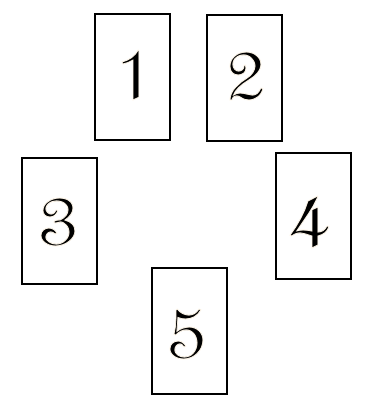
Deal out the three cards in a line as shown below. 

A — B — C

Once laid out, I take the trigger card (that is the first card, card A) as identifying the topic. So, if the House (K♥) card falls here, the event concerns our home or someone we live with. Your wider family would be the Lilies (K♠). The Park (8♠) is out of the house. The Clouds (K♣) is often the weather, especially rain or fog. Warning cards, such as the Scythe (Kn♦) or the Fox (9♣), do not become benign, but you might get a papercut (Scythe) or be short-changed by the cashier (9♣).

Cards two and three (cards B and C) reveal the precise circumstance. So once you have pinpointed the main topic (trigger card), you then delineate the event (the pairing).

Quite often, people spread the cards but do not read them until the end of the day. That is both lazy and pointless. If you lay the cards, you read them. What is more, I encourage you to record the cards and write down your prediction. You can review your prognostication at the end of the day, and if you are wrong, try and see where you went wrong. That is how you learn.

So, for this article, I did a run of daily draws. Such readings are not part of my praxis. But I wanted some to share with you.

So for the first draw, the cards as they fell:

The cards are the Cavalier (9♥), the Scythe (Kn♦) and the Letter (7♠).

The Cavalier, as the trigger card, points to either the mail carrier or my car. Due to “shielding,” I was not going out, so the former made more sense. The pairing comprises the Scythe and the Letter cards, damaged or open (the Scythe cuts) mail.

On that day, Royal Mail delivered an item which was too big for the envelope. It had split, and Royal Mail had placed it in a cellophane “damaged post” bag.

The second draw had the cards as follows:

The House (K♥), the Bouquet (Q♠) and the Birch Rod (Kn♣).

As I live alone, the House represents my home. Will I have a burst pipe? No, that would be the Scythe (Kn♦) and the Serpent (Q♣). Here I have the Bouquet + Birch Rod: cleaning. As we know, the Flowers are ornamental and decorative, which on a day-to-day basis is keeping things clean. The Birch Rod is the corrective action (cleaning) taken to keep everything spick and span.

As you can see, at no point have I diluted the cards’ signification. All I have done is read them on a very mundane, everyday level. Doing so requires a good understanding of the cards’ essence and functional behaviour. For someone completely new, that can be a challenge. So if you are a total beginner, do not lose heart. Focus, instead, on short questions and build from there.

§

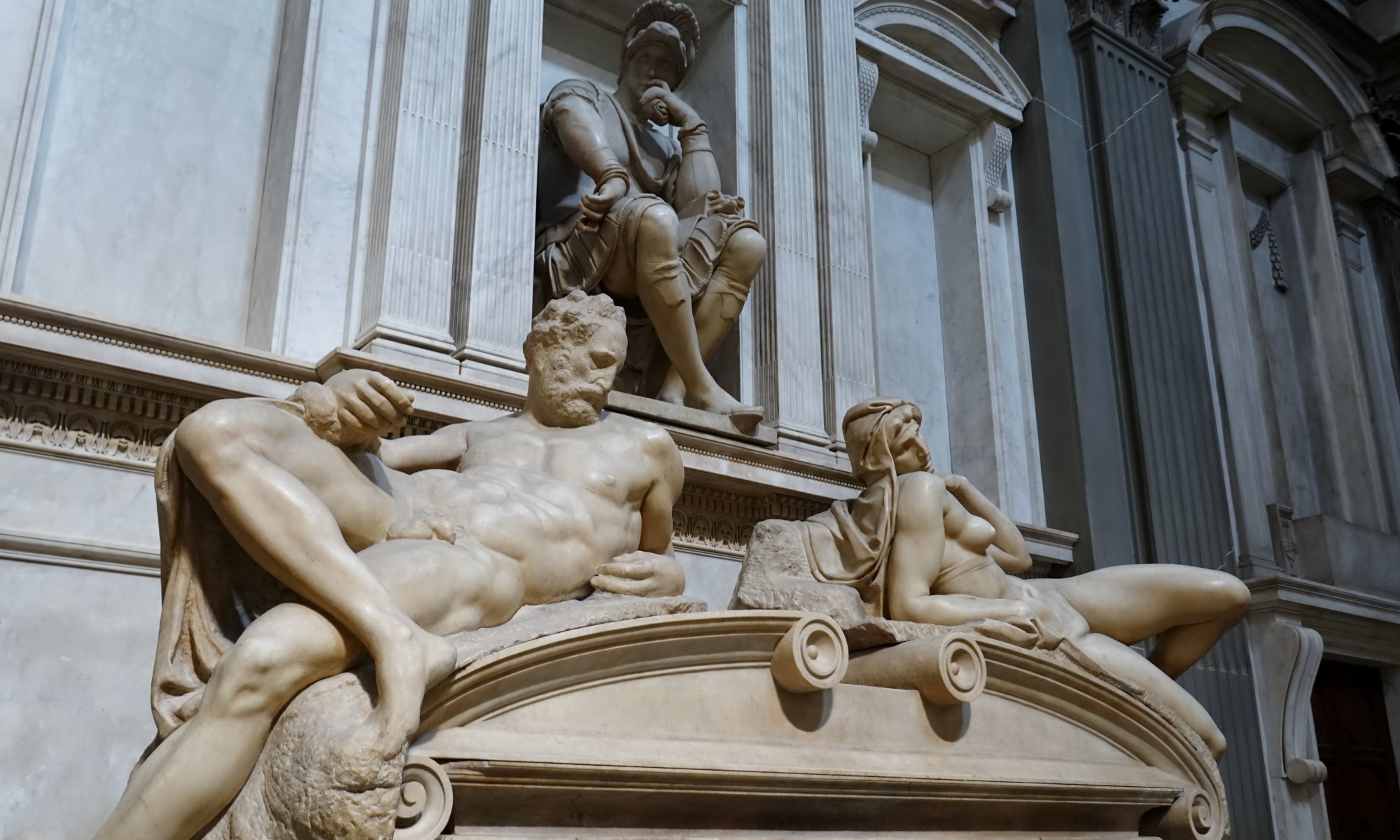
Featured Image: Michelangelo, Dusk, 1524-34; New Sacristy (Medici Chapel), San Lorenzo, Florence. Via Wiki Commons/ Richard Mortel from Riyadh, Saudi Arabia

Gliding the Glorious Light

One from the vaults….

Earlier this week (August 2019), one of my friends was offered a promotion. The job, however, was becoming a manager over a team known for being difficult. So tricky she will be the fourth manager in eighteen months. The team had to be split between three offices, due to extreme interpersonal issues.

Should she take it? Would she be able to make a success? What could she do? I went for cards not seen on my blogs for some time: le tarot persan de Madame Indira.

Containing just 55-cards, these cards blur the much-loved boundaries of what is allowed to call itself a tarot.

I fell in love with these cards around 1998. It is like a peacock with its iridescent colours. I remember shuffling it for the first time, and la Chouette and la main de Fatma falling out. I knew it was something special.

Le tirage des messages

Traditional cartomancy draws heavily on binaries: sinister and dexter, above and below, near and far, past and future, you and them, help and hindrance, red and black, and so on. One of the most useful is what to do and what not to do. Le tirage des messages will provide such advice, which is one of its strength. The other is that it contains information on the querent and their situation.

The nineteen trumps and la Chouette (the Owl) are shuffled, cut, and five cards are drawn and disposed of as follows:

  • The first card reveals the state of mind of the querent facing her question
  • The second card describes the present situation
  • The third card is the behaviour she should adopt
  • The fourth card is where she should forbear
  • The fifth card is the answer


Reading

For this draw, although one uses just the nineteen majors and la Chouette, the minors can be employed for clarification or any follow-up questions. For this reason, I still assign a significator. La reine trèfle was the most appropriate, considering both her job and her hair-colouring.

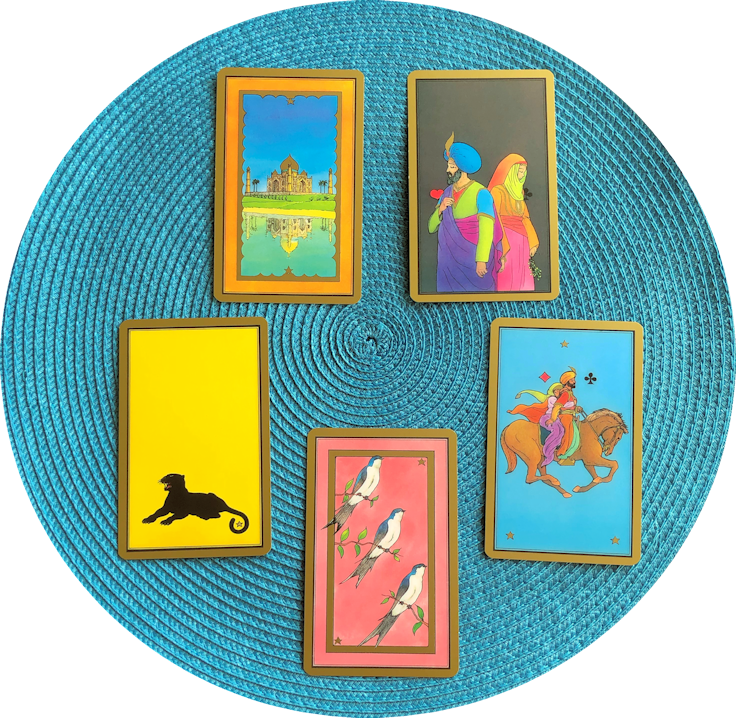
The cards as they fell:

  • La maison (the house)
  • La rupture (rupture)
  • La panthère noire (the black panther)
  • Le mariage (the wedding)
  • Les hirondelles (the swallows)


The House advises on the state of mind of la reine de trèfle. We can tell immediately that la reine priorities a sense of belonging, but also security. La reine does not wish to be propelled too far from the environment she feels at home in, or amongst those, she does not incline to let in.

Looking at the second card, we find the Rupture card which discloses the present situation. On the one hand, it references that by accepting the role, la reine is breaking from her entourage. But one suspects it describes the various divides and interpersonal issues within the new department.

Cards three and four, the Panther and the Wedding cards, describe the attitude to adopt and what to avoid. We must consider these together.

A powerful and intelligent animal, the melanistic feline also fosters a sense of something concealed (the leopard’s spots). If la reine wishes to make a success of her new opportunity, it is essential to define boundaries and keep a neutral composure in the face of hostility and difficulties.

The worse thing la reine can do is be drawn into complicated dynamics and cliques. If she does so, she will lose important ground and the necessary distinction in her role. It will be tempting to try and soothe and befriend, but it is not the path needed in this situation.

Our answer comes in the form of the Swallows. We all know swallows are migratory, but also excellent flyers and communicative. It shows that la reine will be able to navigate her way and negotiate the sphere she finds herself in. Following the advice above, she can successfully communicate in a manner that earns respect but importantly pays a dividend in the long run.

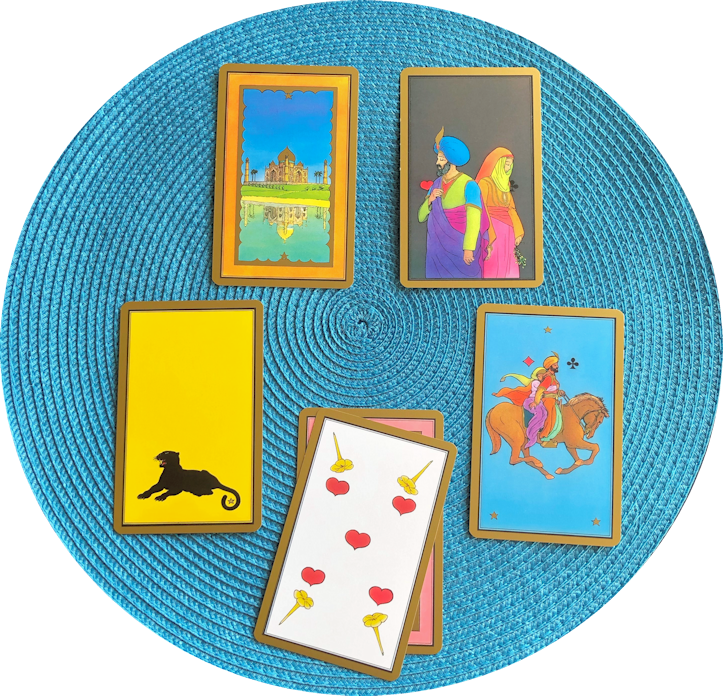
As the Swallows have a migratory quality, I shuffled the pip cards and covered it. Here we have the Cinq de Cœur.

Such a combination portends the emergence of calmer waters, but also a sense of personal satisfaction in a job well-done.

It is only through refining the situation, and understanding how fortuitous energies and circumstances are, that we can offer any guidance. Even then, all we are doing is reading the emblematic pattern as an optical dialect.

§

References:

Tarot Persan de Madame Indira © Grimaud, 1981.

Les tirage des messages taken from L’ABC du Tarot Person de Madame Indira by Colette Silvestre.

Featured Image: Montasim Jawar, CC BY-SA 4.0 https://creativecommons.org/licenses/by-sa/4.0, via Wikimedia Commons

The Lives We Lived in Each Day

BELIEF in reincarnation and karma have become extremely popular in the West. Of course, the belief in karma and reincarnation are ancient; they have been part of the teachings of Hinduism, Jainism, Sikhism and Buddhism for over a millennia. Interest in the West is relatively new beginning with the rise of theosophy.

Since the late 1990s, readers have often been consulted about issues related to past lives, karma and incarnated purposes. Quite often, these seekers are looking for an explanation for problems that are firmly of this life. However, others have more interesting queries.

The cartomante was consultanted by such a seeker in the summer. In her question, the client had explained that she had been involved in a whirlwind relationship. Within less than four months, they had become engaged and were living together. There were plans to start a family. Her friends and family felt it was all too soon. Our querent, however, said it was as if they had done it all before. Did she and her fiancé share a past connection?

Different opinions exist on reincarnation; various methods of analysis are also endorsed. On the subject itself, my own opinions are irrelevant. My preferred method is one outlined by Teresa Michelsen in Designing Your Own Tarot Spreads. Having worked with the spread over some time, one has observed that it often explains connections or trends – through the lens of reincarnation – in a manner that is intelligible and relatable. It does not, however, prove such links exist.

The Spread

To perform this reading, first remove the Fool card and then shuffle the remaining 77-cards. Once done, you deal nine-cards face down. The cartomante must now shuffle the Fool into these nine-cards and then deal them in a classical 3×3 or carré :

01 – 02 – 03

04 – 05 – 06

07 – 08 – 09

When the Fool card appears, the next card is dealt on it. Should the Fool appear last, one can (in my experience) be sure there is no such “connection.”

Cards 1 – 3 describe the present incarnation, with the first card being the circumstances of the end of this life. The remaining six cards are past incarnations with card nine being the oldest incarnation. The carré thus moves – left to right, top to bottom – backwards in time.

For this spread, one always utilises either the Ancestral Path Tarot or the Tarot of the Ages. The former is used here. Created by the extremely talented artist, Julie Cuccia-Watts, the lesser arcana is divided into the four continents: Africa, America, Asia and Europe. There is an inherent quality and balance that lends itself to such readings.

The Reading

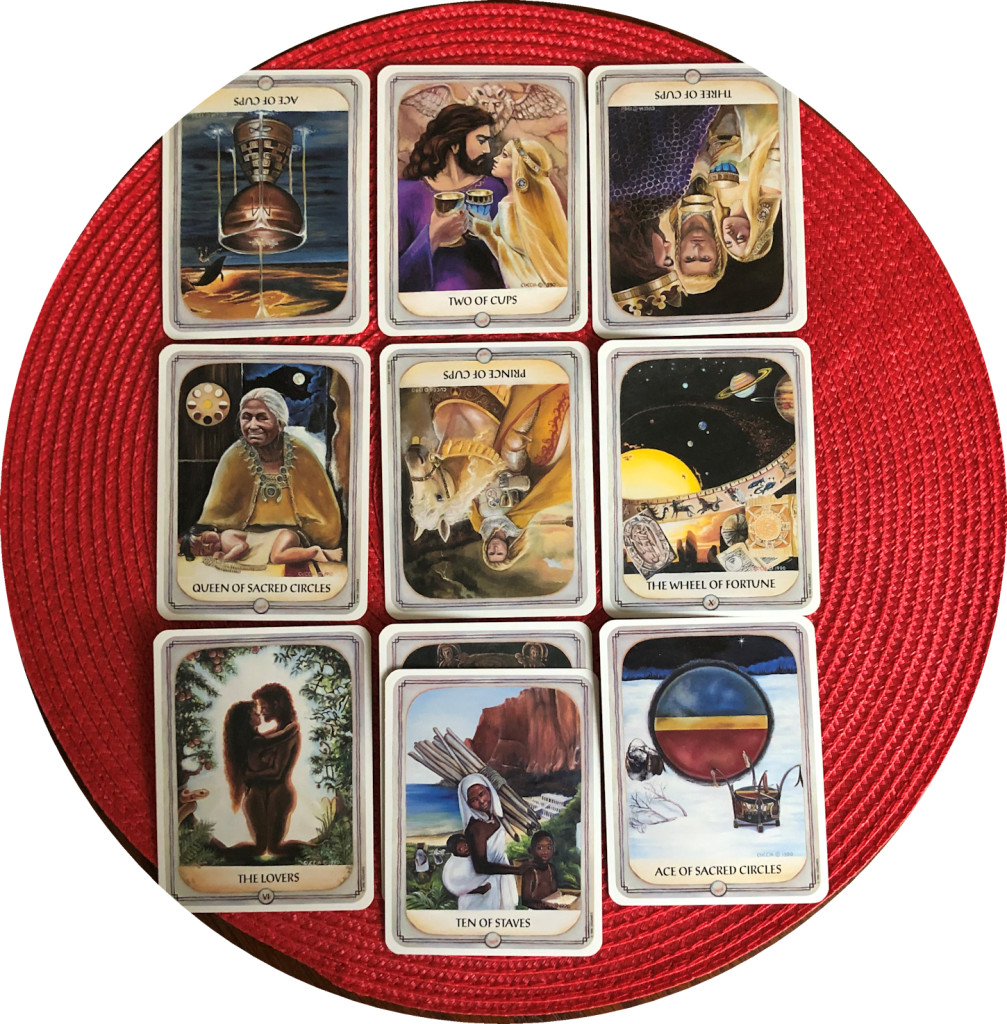
The cards as they fell:

The Fool was the eighth card dealt indicating that the seeker and her fiancé had spent several lifetimes together. Cards to the Fool’s right can be ignored. We start with the card that covers the Fool then proceed upwards, moving right to the left.

The Fool/Ten of Staves: In the Ancestral Path, staves depict the continent of Africa, and we see, on this card, a mother with two children. In this lifetime, the seeker and fiancé share a parent-child bond and learned lessons connected to shared responsibility, support and the importance of family. It was not an easy life, but as it is upright, it is not one that necessarily proved difficult for the souls.

VI – The Lovers: Next, the souls incarnated as a couple. If we consider the card, there was a strong bond built on a foundation of mutual respect, understanding and love. As a trump, this is a life that proved significant in the souls’ development and a happy one.

X – The Wheel of Fortune: The Wheel of Fortune illustrates the zodiac and helical phases of the planets. Here, the souls incarnate together one more time. At this point, they have completed a specific series of lessons and move on to new a cycle.

Prince of Cups, reversed: In a more recent lifetime, the fiancé incarnates in Europe. He sets out on his quest with idealism and vigour. However, the lifetime proves challenging, and answers allude him, with the reversal pointing towards unresolved issues.

Queen of Sacred Circles: In contrast, the querent finds herself in the Americas, where she lived a long, happy life taking on the role of matriarch within her family. There was a relative comfort here with the soul finding the lifetime rewarding. Interestingly, within the Ancestral Path Tarot system, this is the card associated with the seeker’s current birthdate.

Three of Cups, reversed: We now enter the present lifetime. The card portrays Arthur, Gwenhwyfar, and Lancelot. It is clear that this is a moment of reconnection; however, the reversal shows that this was fuelled by a sense of being lost, being misunderstood and isolated or lonely.

Two of Cups: Looking at the cards, it is clear that this is the present moment. The seeker and her fiancé are drawn together due to their bond, with eyes only for each other. There is a mirroring between this card and the Lovers as the souls become lost in each other.

Ace of Cups, reversed: Aces in this system are the culmination points. Traditionally, this is the home. Reversed, it shows that the souls are unlikely to realise their lessons and places when the current incarnations close. It cannot be stressed this in itself does not necessarily occur to their reconnection; however, their current preoccupation with each other may be detracting from different areas of their development.

There we have the past life connection reading. Generally, one can use it as a springboard to probe more deeply into specific events and incarnations and their current effect on the present incarnation. Here, that would be the Wheel of Fortune; it being the cusp of one cycle and the next.

How one does this is dependent on the cartomante.

§

References:

Cards, Ancestral Path Tarot © Julie Cuccia-Watts, US Games, 1995.
Michelsen, T. (2003). Designing Your Own Tarot Spreads. 1st ed. St. Paul, Minn.: Llewellyn Publications.

Title, taken from BedShaped by Keane.