A Pretty Bouquet

These three persons stood together on the hearth-rug, their eyes fixed on an extraordinarily large bouquet of crimson roses, with a knot of purple pansies at their base, that lay on the sofa where Madame Olenska usually sat.

Edith Wharton, The Age of Innocence

Oracle cards* have never been a big draw for me. Consequently, I have owned less than ten that I can remember. In contrast, I know several gifted-diviners who employ only these decks. I say this as I want to stress I do not see such cards as inferior to the Tarot and other cards.

If you are a long-term reader of my work, you will know the L’Oracle de Belline is a firm favourite and a deck with which I would not part. The Oracle de la Triade is a favourite, too. However, today, we turn our attention to the Victorian Flower Oracle.

Part of my praxis has seen a reduction in spreads utilised. Rather than cultivating an extensive library of spreads focusing on a small pool of layouts does seem beneficial to me. As such I tend to stick to five but have a couple of others in reserve.

Recently, one of these was pressed into use.

La « petit question »

Colette Silvestre includes la « petit question » in several texts, but I first discovered it in Les Tarots. It is a simple three-card draw, designed to give a rapid answer – a yes or no draw, or le tirage du tarot oui non. Despite its genesis with the Tarot cards, the pattern works well with both l’Oracle de Belline and the Victorian Flower Oracle. In fact, it is with these two packs that I use this small draw.

Once the cards are shuffled and cut (however you prefer), you draw three cards. I lay them out as below. Madame Silvestre, however, chooses to place the third card between (and slightly lower) the first and second cards. It is up to you.

Although I use triples a lot (in lines, squares, &c), this differs to my normal practice as each position carries a signification. Ordinarily, I am not keen on positional spreads with less than seven-cards. But this is one I do recommend for its clarity and directness.

The positions signify the following:

  • The first card shows how the Querent faces the question.
  • The second card indicates the subject or question and how it stands.
  • The third card indicates the answer or outcome.

The Victorian Flower Oracle:

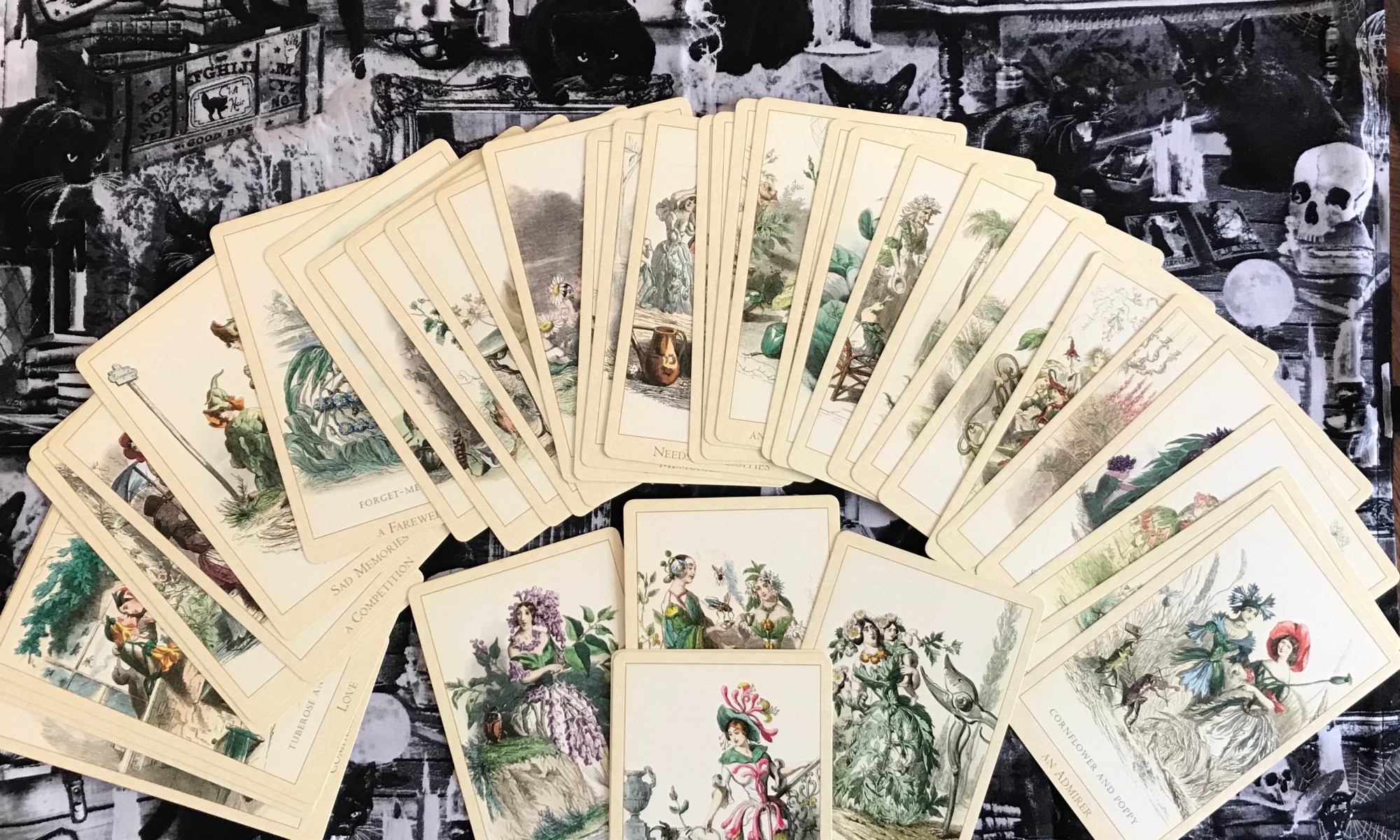
The Victorian Flower Oracle comes from the brilliant husband-and-wife team Alex Ukolov and Karen Mahony. I love their work (Victorian Romantic Tarot, the Bohemian Gothic, &c). The designs for this pack came from J.J. Grandville’s Les Fleurs Animées. Sadly, it is out-of-print, and I will not part with it.

The langage des fleurs is ancient, but at the time Grandville completed his work it had seen a resurgence, especially in the form of tussie-mussies. Floriography allowed senders to encode messages into the arrangements. The Victorian Flower Oracle does tend to focus more on the illustrations rather than the traditional floral significations.

Eileen is a regular client of mine. She had worked for the same insurance company for 30 odd years. It is a job she said she loved. However, due to changes she had seen her role lost in a restructure and she was miserable. It had all changed. Her question was: Would things go back to how they were?

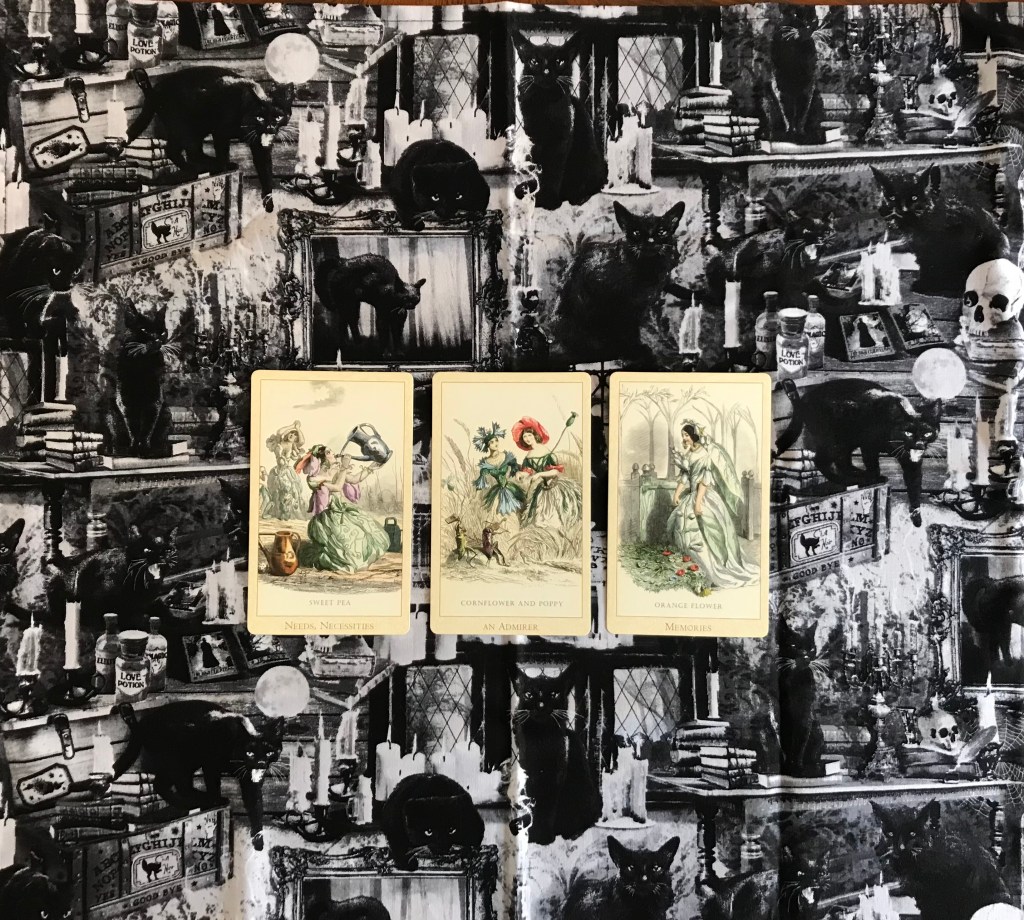
I shuffled, cut and draw three cards from the Victorian Flower Oracle.

The cards as they fell:

The first card is the Sweet Pea which leaves no doubt that Eileen does not feel sustained in her current role and working environment.

Interesting, the second card — Cornflower and Poppy — tells us once upon a time Eileen loved her role and workplace. Now, she no longer feels one of the team or valued. Something the Cornflower and Poppy tells us is essential for Eileen.

The answer comes in the form of the Orange Flower card. Eileen cannot reconcile her happy memories and the unsatisfying present; it is time to go. The Orange Flowers seems to sigh: “At least you have your memories.”

So the cards respond with a no. I text my response: No, that place exists now only in your memories.

As I went to turn over the final card, I had the strong sense Eileen had her resignation letter ready. It transpired that Eileen had. She just wanted confirmation that things would not go back to the way they were.

If we look at the cards as a line, we have a surreal tableau.

Cornflower and Poppy watch Sweet Pea wilting, desperately search for water as the Orange Flower looks on. It is almost farcical rather than sinister. In time Eileen might look back and see it. But for now, she must look for something else.

Thankfully, she had. The reading was done just before the autumn lockdown and Eileen is now happy in her new role.

When I first started writing in 2010, the dominant view was that the Tarot cards were for “higher” practice and spiritual and psychological in their pronouncements. Cards such as the Petit Lenormand or Cigány Kártya was for fortune-telling only. They could not be used for “higher” practice or in magickal practice. That view has softened in the last decade but it remains prominent in Anglo-Saxon communities.

It is not for the present author to pronounce judgement upon such stances. However, my view has always been that a deck’s usage and limitations rest solely with the reader. The Petit Lenormand can be spiritual, and the Tarot cards can and do predict future events. Oracle cards, such as the Victorian Flower Oracle, can give yes and no answers, too.

Stay well.

§

Cards: The Victorian Flower Oracle © Magic Realist Press 2006.

Featured Image: J. J. Grandville, Public domain, via Wikimedia Commons.

*Oracle cards in the current vernacular seem to encompass all non-suited or Playing Card-derived (Tarot, Petit Lenormand, Sibilla, &c) decks. This is the definition used here. However, it is one the present author finds lacking. Technically, the oracle is the diviner and any cards in her hands are oracular.

Burning Like a Silver Flame

She that fain would fly, she shall quickly follow,
She that now rejects, yet with gifts shall woo thee,
She that heeds thee not, soon shall love to madness,
Love thee, the loth one! 

Sappho, Ode to Aphrodite.

Long-term readers will know that I have a preference for linear and classical carrés and stars over positional draws. However, from time to time, the cards will fall on my table in crosses, horoscopes, horseshoes and CCs.

Below I use two medium sized spreads that can be utilised for looking for love questions. Credit for the patterns go to Colette Silvestre[1] and Teresa Michelsen[2].

L’étoile de Vénus

This draw is designed purely for relationship development questions. The five cards are as follows:

1
2    3
4        5

  • The first card represents the consultant.
  • The second card represents the present influences.
  • The third card represents influences that can either support or oppose the consultant.
  • The fourth card is the consultant’s hopes.
  • The fifth card is the outcome.

In her many books, ranging from TdM to L’oracle de Belline and both the petit Lenormand and grand jeu de Mademoiselle Lenormand, Mme Silvestre focuses on giving concise answers and emphasises cards’ behaviour. In this reading, great weight is thus given to passivity versus activeness and help versus hindrance.

Reading:

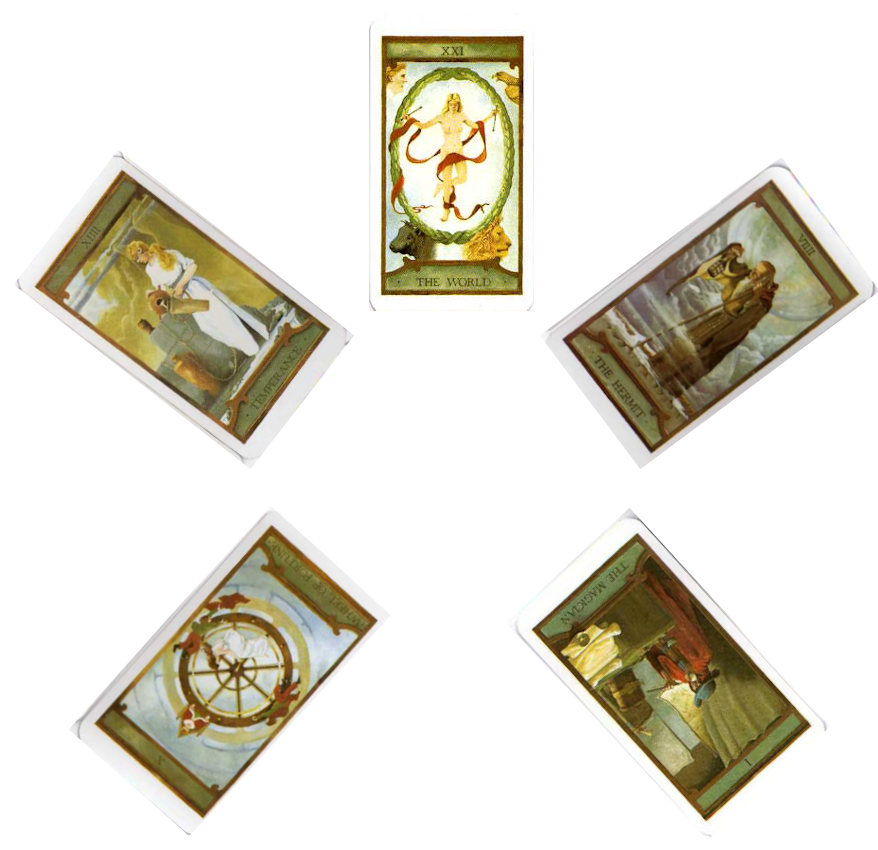
The first question comes from a young man, in his early twenties, referred hereafter to as the cavalier d’épée. He is currently single, having parted way with a young woman recently, and wanted to know if he would meet someone ‘new’ soon.

The cards as they fell:

I replied: ‘Yes, if you’re prepared to be a gambler.’

The cavalier d’épée loftily stands to survey his domain (le monde), calm and collected (tempérance), but hesitant (l’ermite). He hopes for change and new encounters (the la roue de fortune). He can have this, but only if he takes a risk and seizes his opportunities (the le bateleur).

I often see the le bateleur card as ‘yes, but.’[3] Le bateleur knows success occurs when opportunity meets preparation. He is prepared to seize any opportunity, to take a risk. Is the cavalier limiting his opportunities in some way? The L’ermite says yes. Some cards, such as tempérance, are actively passive. To achieve perfect measure or understanding, and thus peace the the fruit of the virtue, she must actively engage in passivity. That helps, here. The l’érmite, however, challenges tempérance on whether she has found the right measure or moment.

We lay two pip cards over the l’érmite, to see what he’s contemplating: dix de denier and deux d’épée. failure, or the loss of success and he runs from this. But philosophers have always said abstinence is easier than temperance. I don’t think the Hermit knows there is no contingencies in affairs of the heart. You take a risk. Or you stop alone.

I think the cavalier d’épée will find himself surprised at the possibility that presents itself.

Looking for Love:

Teresa Michelsen outlined this spread in her book, Designing Your Own Tarot Spreads.

  • The first card describes why you have not yet found your ideal partner.
  • The second card tells you how to overcome issues expressed in the previous card.
  • The third card advises you on the most positive action you can take to find your partner.
  • The fourth card describes who will be the right person for you.
  • The fifth card tells you where you will find this person.
  • The sixth card tells you when you will find your partner.

Reading:

This question was posed by a divorcée hereafter referred to as the Queen of Coins. The Queen had a two-parted question, why she was unsuccessful in finding a partner and when this would change. You will see Teresa Michelsen’s layout beautifully addresses these factors.

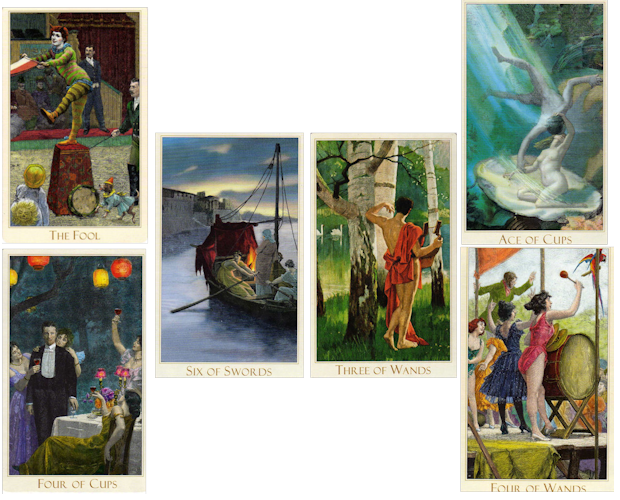
The cards as they fell:

My answer is: her social circle is not conducive to a new relationship and this will change when she relocates and meets new people.

Despite her emotional stability, the Queen finds herself with indifferent and listless men (4 of Cups) and will need to destabilise and breakout from the status quo (the Fool). The most positive thing she can do is leave her coterie and cut ties with a crowd that does not serve her needs (6 of Swords).

She will find her ideal partner in a festive and lively crowd (4 of Wands) when she builds a new home for herself and feels revitalised (Ace of Cups).

Traditionally, when we see the 4 of Cups, we often talk about feeling secure, real emotional intelligence and fairness (being the sanguine, air suit). It’s also the home of friends. However, here, we see a man so secure that he is apathetic and inert and unresponsive to the Queen’s needs. In the face of this, the 6 of Swords tells the Queen to leave the party and sail away to the troubadours’ party in the 4 of Wands.

If we look at the 3 of Wands, as who will be right for the Queen, we say a man who has forsaken his white-tie for a red toga. He’s imaginative, probably musical, but keeps his bare feet on the ground. He balances reliability with inscrutability (both earth qualities), creativity and dint of effort. Whatta man, in the words of Salt-n-Pepa.

The Ace of Cups, in timing, can be read as the first week of autumn, that is the week commencing September 24. A change of residence is supported by both the 6 of Swords and 4 of Wands, and to a lesser extent the Fool. I thus favour a literal move rather than a figurative fresh-start. The Queen told me, after the reading, all her friends were attached. She is due to be rehoused by the local authorities in the summer. I wish her well.

§

Cards: The Prediction Tarot (Peter Richardson), Aquarian Press 1985; The Victorian Romantic Tarot (Alex Ukolov & Karen Mahony), Magic Realist Press 2006.

Featured Image: Fresco from Pompei, Casa dei Venus, 1st century AD. Unknown ancient Rome artist, photo of Stephen Haynes [Public domain], via Wikimedia Commons.

Title: Venus, by Shocking Blue.

Notes:

[1] Silvestre-Haéberlé, C. (2001). Les 12 meilleures méthodes pour tirer les tarots. 1st ed. Paris: Grancher.
[2]Michelsen, T. (2003). Designing your own tarot spreads. 1st ed. St. Paul, Minn.: Llewellyn Publications.
[3]Of note, he takes this precise meaning in the different versions of le tirage immediat sometimes called the rapid response.

Horseshoe

Programme two of my one-to-one tuition course with the Marseille tarots focuses on helping deliver the same precise and succinct answers, delivered with the linear draws, with spreads and positional draws of various sizes. The plan was developed in response to numerous e-mails and comments from readers, and my earliest students. Often students find themselves becoming hesitant or losing focus when reading cards in patterns, especially those with positional contexts. Here we prevent such habits, building proficiency and incisiveness.

Quite often students tell me how surprised they are that a Celtic Cross or the Widdershins’ Star can be read as a snappy sentence, just as one can a line of five or nine cards. But the reality is they can be. It is all just a matter of orientation.

The linear draws flow from the first card to the last card. Leaving aside reflection, cards relate solely through progressive attendance. Thus, there is no question of a positional relationship found in a draw such as Astrological Wheel or Celtic Cross. The challenge for the cartomante, therefore, is to cultivate the same sense of directional ease through knowing where each place falls in the course of the narrative.

The Horseshoe

« Le fer a cheval » or horseshoe spread is cartomantic standard. In addition to providing clear answers to precise questions – including yes or no – it offers useful advice on how to solve problems or situations.

It is the first draw covered in the second programme.

Although we focus on the Marseille tarot, here, it can be employed with the l’oracle de Belline, the Petit Lenormand, l’oracle de la Triade and le tarot persan de Madame Indira, et cetera. It is thus extremely versatile and, therefore, a useful addition to the cartomante’s repertoire.

The Basics

The draw is composed of seven cards, which are to be arranged as shown below. As with numerous spreads, there are variations to be found. The one described, here, has served me well. I also use a second variation which can be seen in a later article.

    • Card one determines the consultant in the face of her question giving insight into her attitude and position.
    • Card two defines the present situation in relation to the question which can either aid or hinder or shed let on external influences or individuals.
    • Card three represents the future and how matters will play out.
    • Cards four and five advise on the direction the consultant should take, what to do and how best to act.
    • Card six is the main obstacle to be overcome and can provide guidance on where to forbear.
  • Card seven is the response.

Relating the Cards

Although the reader can advance through the cards in numerical order one can then struggle to formulate the core answer. The core answer is a succinct pronunciation that summarises the cards’ response taking into consideration how the cards relate to and engage with each other.

A sequential stroll through the cards will thus provide a disjointed and pedestrian answer. One also runs the risk of turning the reading into seven one-card readings, rather than a seven-card reading. Unfortunately, the majority of Anglo-Saxon cartomantes fall into this trap and have made the latter a virtue of necessity.

Narration

The first card advises the cartomante on the temperament and position the client occupies in relation to her question. It is thus the point of departure and also can be seen as a significator.

Both card two (the present state of affairs) and card six are connected with the latter describing the main obstacle arising out of the present situation.

Now that the cartomante is appraised of both the situation and difficulties he turns to the fourth and fifth cards. These two cards advise the seeker on how she can best proceed to resolve the challenges she faces. Thus, both cards are key to offsetting card six.

Naturally, card seven and card three are closely connected. The cartomante will need weigh these two cards against each other and see if there are signs of dissonance.

For example, the cartomante finds himself reading for a client who wants to know if she will reconcile with an ex-partner: the seventh card is le soleil and the third card is le diable. The disparity between these cards indicates that although the two will reconcile (le soleil) she will find herself in hellfire (le diable). Transpose the two cards then the answer is negative, but le soleil would, as occupying the future position, foretell warmer times and love in the near future.

Example Reading

At the end of January one of my mother’s friends asked if someone could read for her daughter. After 52-weeks’ maternity leave, the daughter had returned to the employment to discover her role (secretarial) had changed and was somewhat unhappy to find herself working for a different person. Due to the complex laws surrounding maternity leave, the seeker felt that there were grounds for complaint, although was somewhat wary of initiating a grievance.

Her question was: “Will I be able to resolve this to my advantage?”

The cards as they fell:

Answer:

Yes, but with the aid of a steward or mediator; you can then cut through the mess and find yourself in a satisfying condition.

Delineation:

For clarity, we will breakdown the spread and delineation.

The client appears as l’Ermite which shows the client is searching for a solution and guidance, not being in a position where she can act autonomously.

Presently, her employer is undertaking some form of restructuring, that has come at the same time the seeker returns to work (Jugement), which has resulted in considerable confusion (la Lune).

With La Lune in mind, the client will need to solicit advice from one who can weigh the situation appropriately (la Justice) and, therefore, identify the right moment to act and deal the winning card (le Bateleur). It is important that she keeps her feet firmly on the ground (la Lune contrasted with la Justice and le Bateleur).

Thus, with the appropriate aid (le Pape), she will be in a strong position to resolve the situation to her satisfaction (la Force). We notice that both l’Ermite and le Pape are turned from each other – the seeker has not sort appropriate advice and would benefit from either union representation or some mediation (le Pape).

Despite the draw utilising positional contexts, we are able to retain the incisiveness of a linear draw. We just need to know how positions relate to each other in the same way attendance in lines flows. As with all of cartomancy, it comes down to looking.

§


Cards: Les Tarots Marseille de Jean Noblet, Paris, vers 1650 © Éditions Letarot.com (2001).