These three persons stood together on the hearth-rug, their eyes fixed on an extraordinarily large bouquet of crimson roses, with a knot of purple pansies at their base, that lay on the sofa where Madame Olenska usually sat.
Edith Wharton, The Age of Innocence
Oracle cards* have never been a big draw for me. Consequently, I have owned less than ten that I can remember. In contrast, I know several gifted-diviners who employ only these decks. I say this as I want to stress I do not see such cards as inferior to the Tarot and other cards.
If you are a long-term reader of my work, you will know the L’Oracle de Belline is a firm favourite and a deck with which I would not part. The Oracle de la Triade is a favourite, too. However, today, we turn our attention to the Victorian Flower Oracle.
Part of my praxis has seen a reduction in spreads utilised. Rather than cultivating an extensive library of spreads focusing on a small pool of layouts does seem beneficial to me. As such I tend to stick to five but have a couple of others in reserve.
Recently, one of these was pressed into use.
La « petit question »
Colette Silvestre includes la « petit question » in several texts, but I first discovered it in Les Tarots. It is a simple three-card draw, designed to give a rapid answer – a yes or no draw, or le tirage du tarot oui non. Despite its genesis with the Tarot cards, the pattern works well with both l’Oracle de Belline and the Victorian Flower Oracle. In fact, it is with these two packs that I use this small draw.
Once the cards are shuffled and cut (however you prefer), you draw three cards. I lay them out as below. Madame Silvestre, however, chooses to place the third card between (and slightly lower) the first and second cards. It is up to you.
Although I use triples a lot (in lines, squares, &c), this differs to my normal practice as each position carries a signification. Ordinarily, I am not keen on positional spreads with less than seven-cards. But this is one I do recommend for its clarity and directness.
The positions signify the following:
- The first card shows how the Querent faces the question.
- The second card indicates the subject or question and how it stands.
- The third card indicates the answer or outcome.
The Victorian Flower Oracle:
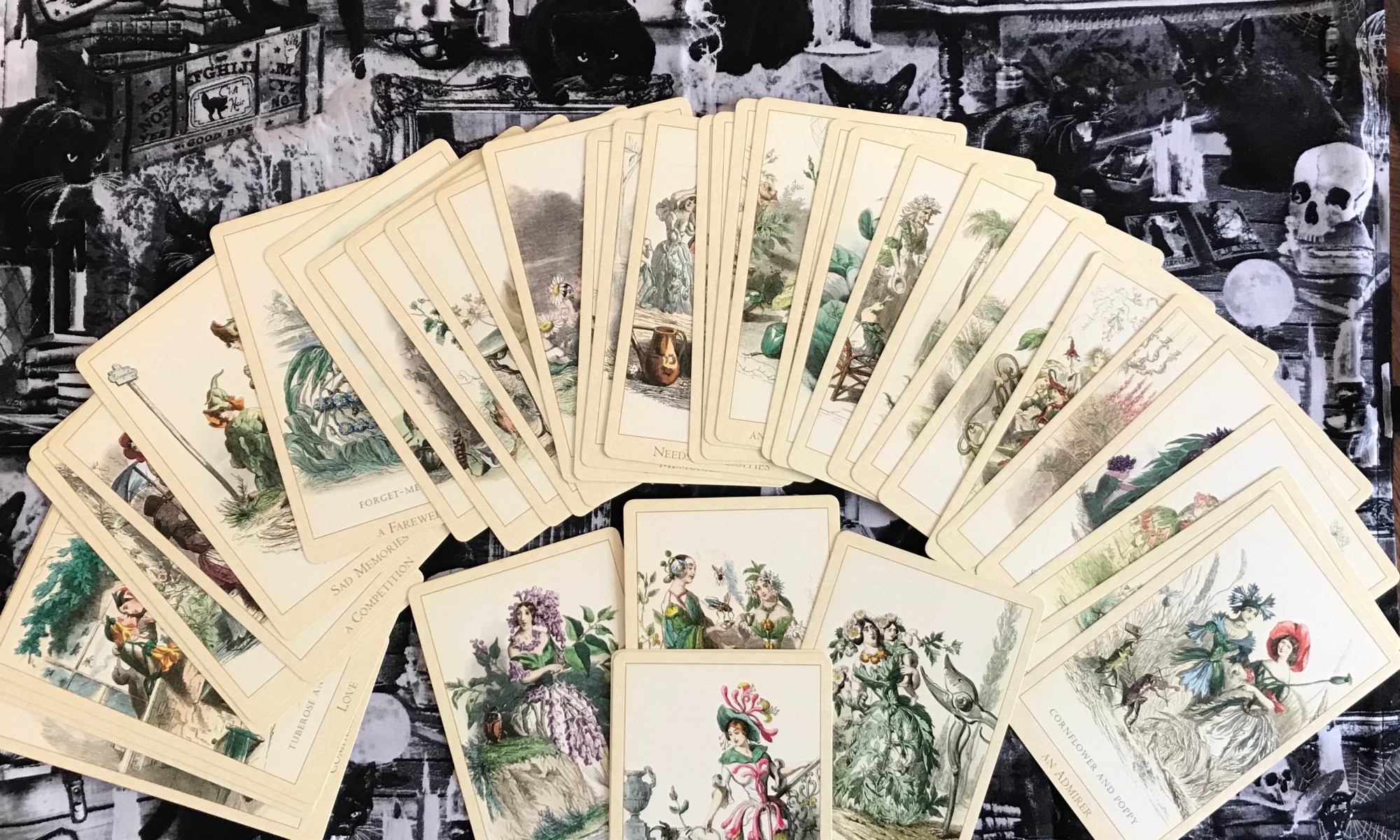
The Victorian Flower Oracle comes from the brilliant husband-and-wife team Alex Ukolov and Karen Mahony. I love their work (Victorian Romantic Tarot, the Bohemian Gothic, &c). The designs for this pack came from J.J. Grandville’s Les Fleurs Animées. Sadly, it is out-of-print, and I will not part with it.
The langage des fleurs is ancient, but at the time Grandville completed his work it had seen a resurgence, especially in the form of tussie-mussies. Floriography allowed senders to encode messages into the arrangements. The Victorian Flower Oracle does tend to focus more on the illustrations rather than the traditional floral significations.
Eileen is a regular client of mine. She had worked for the same insurance company for 30 odd years. It is a job she said she loved. However, due to changes she had seen her role lost in a restructure and she was miserable. It had all changed. Her question was: Would things go back to how they were?
I shuffled, cut and draw three cards from the Victorian Flower Oracle.
The cards as they fell:
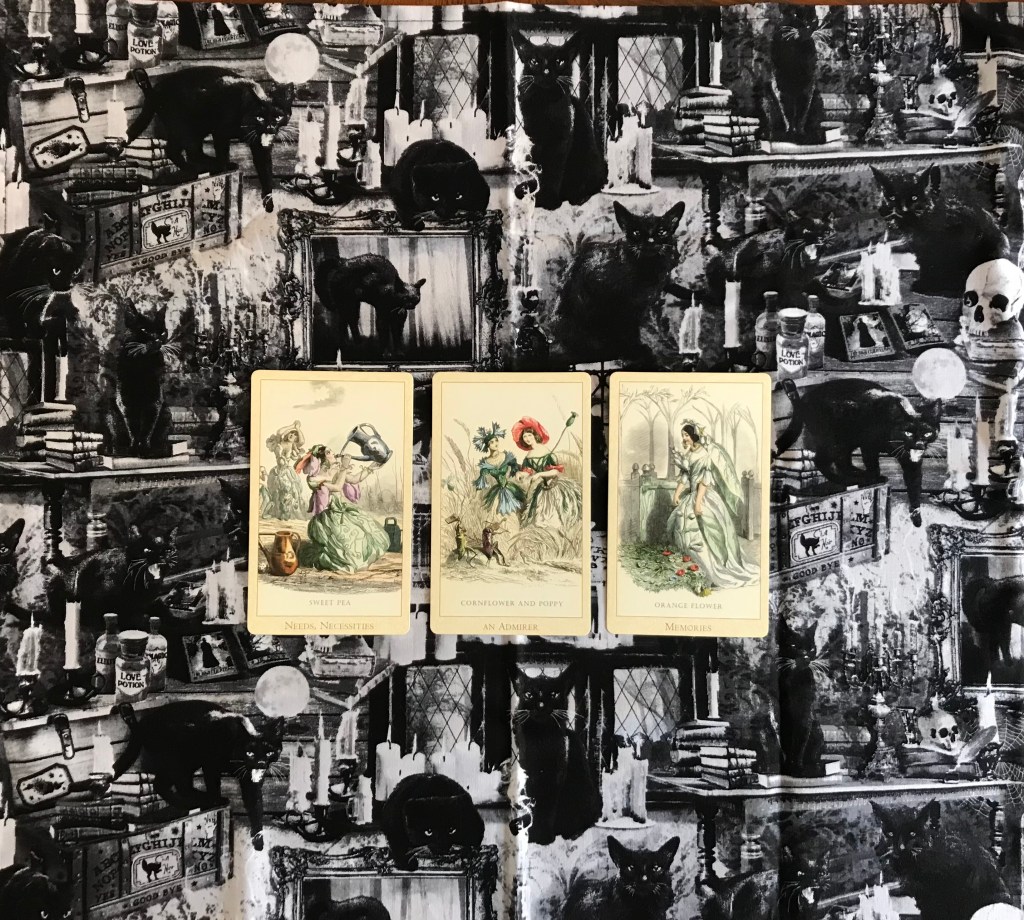
The first card is the Sweet Pea which leaves no doubt that Eileen does not feel sustained in her current role and working environment.
Interesting, the second card — Cornflower and Poppy — tells us once upon a time Eileen loved her role and workplace. Now, she no longer feels one of the team or valued. Something the Cornflower and Poppy tells us is essential for Eileen.
The answer comes in the form of the Orange Flower card. Eileen cannot reconcile her happy memories and the unsatisfying present; it is time to go. The Orange Flowers seems to sigh: “At least you have your memories.”
So the cards respond with a no. I text my response: No, that place exists now only in your memories.
As I went to turn over the final card, I had the strong sense Eileen had her resignation letter ready. It transpired that Eileen had. She just wanted confirmation that things would not go back to the way they were.
If we look at the cards as a line, we have a surreal tableau.
Cornflower and Poppy watch Sweet Pea wilting, desperately search for water as the Orange Flower looks on. It is almost farcical rather than sinister. In time Eileen might look back and see it. But for now, she must look for something else.
Thankfully, she had. The reading was done just before the autumn lockdown and Eileen is now happy in her new role.
When I first started writing in 2010, the dominant view was that the Tarot cards were for “higher” practice and spiritual and psychological in their pronouncements. Cards such as the Petit Lenormand or Cigány Kártya was for fortune-telling only. They could not be used for “higher” practice or in magickal practice. That view has softened in the last decade but it remains prominent in Anglo-Saxon communities.
It is not for the present author to pronounce judgement upon such stances. However, my view has always been that a deck’s usage and limitations rest solely with the reader. The Petit Lenormand can be spiritual, and the Tarot cards can and do predict future events. Oracle cards, such as the Victorian Flower Oracle, can give yes and no answers, too.
Stay well.
§
Cards: The Victorian Flower Oracle © Magic Realist Press 2006.
Featured Image: J. J. Grandville, Public domain, via Wikimedia Commons.
*Oracle cards in the current vernacular seem to encompass all non-suited or Playing Card-derived (Tarot, Petit Lenormand, Sibilla, &c) decks. This is the definition used here. However, it is one the present author finds lacking. Technically, the oracle is the diviner and any cards in her hands are oracular.
 Journal of a Cartomante