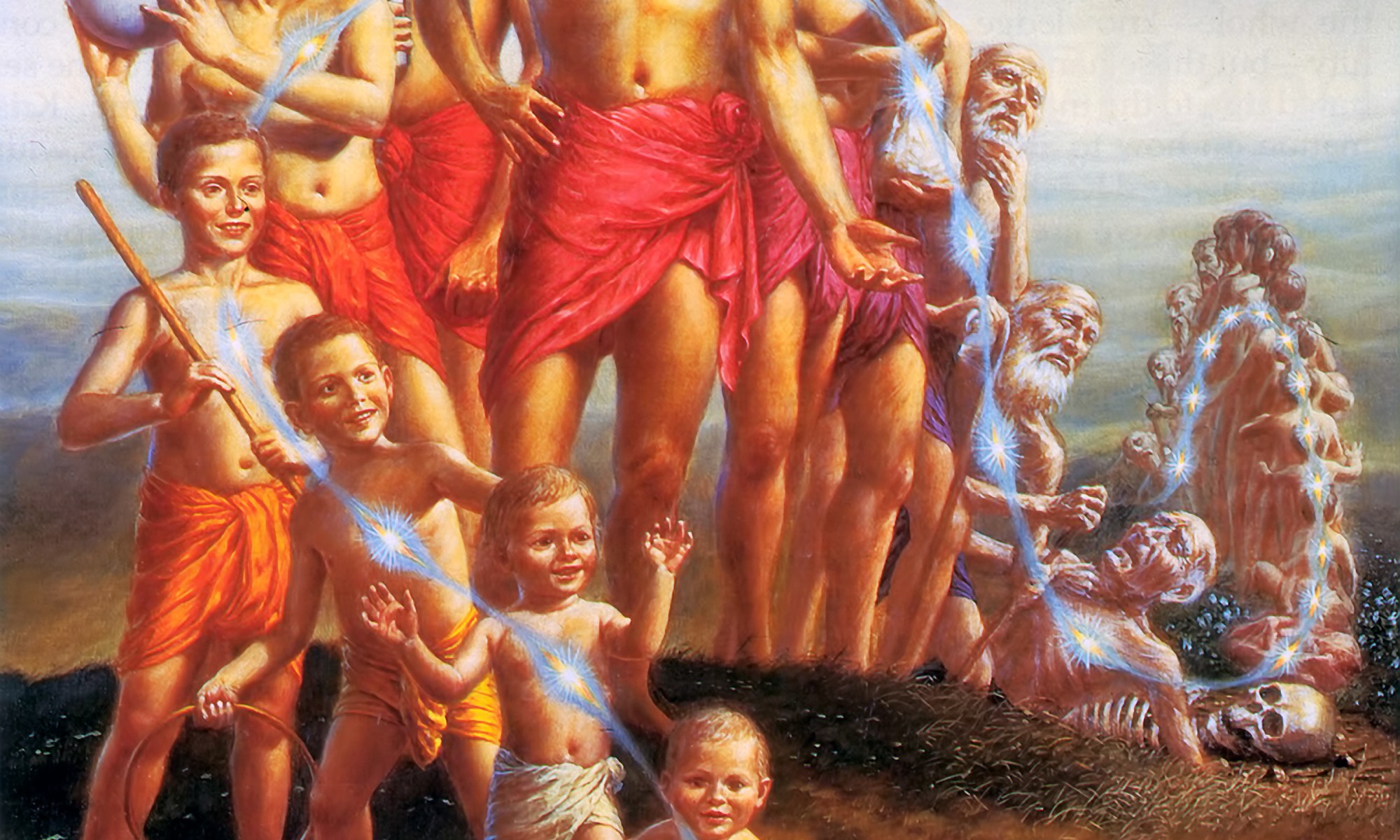
BELIEF in reincarnation and karma have become extremely popular in the West. Of course, the belief in karma and reincarnation are ancient; they have been part of the teachings of Hinduism, Jainism, Sikhism and Buddhism for over a millennia. Interest in the West is relatively new beginning with the rise of theosophy.
Since the late 1990s, readers have often been consulted about issues related to past lives, karma and incarnated purposes. Quite often, these seekers are looking for an explanation for problems that are firmly of this life. However, others have more interesting queries.
The cartomante was consultanted by such a seeker in the summer. In her question, the client had explained that she had been involved in a whirlwind relationship. Within less than four months, they had become engaged and were living together. There were plans to start a family. Her friends and family felt it was all too soon. Our querent, however, said it was as if they had done it all before. Did she and her fiancé share a past connection?
Different opinions exist on reincarnation; various methods of analysis are also endorsed. On the subject itself, my own opinions are irrelevant. My preferred method is one outlined by Teresa Michelsen in Designing Your Own Tarot Spreads. Having worked with the spread over some time, one has observed that it often explains connections or trends – through the lens of reincarnation – in a manner that is intelligible and relatable. It does not, however, prove such links exist.
The Spread
To perform this reading, first remove the Fool card and then shuffle the remaining 77-cards. Once done, you deal nine-cards face down. The cartomante must now shuffle the Fool into these nine-cards and then deal them in a classical 3×3 or carré :
01 – 02 – 03
04 – 05 – 06
07 – 08 – 09
When the Fool card appears, the next card is dealt on it. Should the Fool appear last, one can (in my experience) be sure there is no such “connection.”
Cards 1 – 3 describe the present incarnation, with the first card being the circumstances of the end of this life. The remaining six cards are past incarnations with card nine being the oldest incarnation. The carré thus moves – left to right, top to bottom – backwards in time.
For this spread, one always utilises either the Ancestral Path Tarot or the Tarot of the Ages. The former is used here. Created by the extremely talented artist, Julie Cuccia-Watts, the lesser arcana is divided into the four continents: Africa, America, Asia and Europe. There is an inherent quality and balance that lends itself to such readings.
The Reading
The cards as they fell:
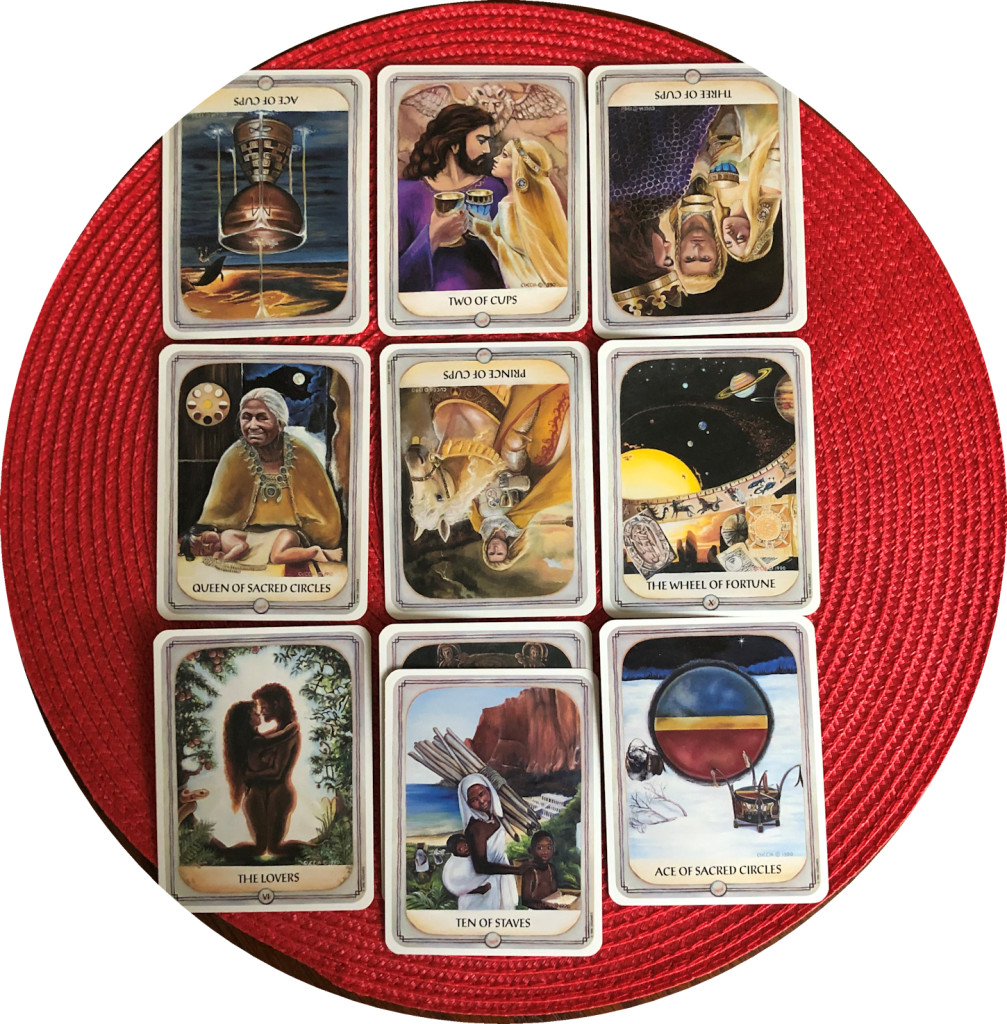
The Fool was the eighth card dealt indicating that the seeker and her fiancé had spent several lifetimes together. Cards to the Fool’s right can be ignored. We start with the card that covers the Fool then proceed upwards, moving right to the left.
The Fool/Ten of Staves: In the Ancestral Path, staves depict the continent of Africa, and we see, on this card, a mother with two children. In this lifetime, the seeker and fiancé share a parent-child bond and learned lessons connected to shared responsibility, support and the importance of family. It was not an easy life, but as it is upright, it is not one that necessarily proved difficult for the souls.
VI – The Lovers: Next, the souls incarnated as a couple. If we consider the card, there was a strong bond built on a foundation of mutual respect, understanding and love. As a trump, this is a life that proved significant in the souls’ development and a happy one.
X – The Wheel of Fortune: The Wheel of Fortune illustrates the zodiac and helical phases of the planets. Here, the souls incarnate together one more time. At this point, they have completed a specific series of lessons and move on to new a cycle.
Prince of Cups, reversed: In a more recent lifetime, the fiancé incarnates in Europe. He sets out on his quest with idealism and vigour. However, the lifetime proves challenging, and answers allude him, with the reversal pointing towards unresolved issues.
Queen of Sacred Circles: In contrast, the querent finds herself in the Americas, where she lived a long, happy life taking on the role of matriarch within her family. There was a relative comfort here with the soul finding the lifetime rewarding. Interestingly, within the Ancestral Path Tarot system, this is the card associated with the seeker’s current birthdate.
Three of Cups, reversed: We now enter the present lifetime. The card portrays Arthur, Gwenhwyfar, and Lancelot. It is clear that this is a moment of reconnection; however, the reversal shows that this was fuelled by a sense of being lost, being misunderstood and isolated or lonely.
Two of Cups: Looking at the cards, it is clear that this is the present moment. The seeker and her fiancé are drawn together due to their bond, with eyes only for each other. There is a mirroring between this card and the Lovers as the souls become lost in each other.
Ace of Cups, reversed: Aces in this system are the culmination points. Traditionally, this is the home. Reversed, it shows that the souls are unlikely to realise their lessons and places when the current incarnations close. It cannot be stressed this in itself does not necessarily occur to their reconnection; however, their current preoccupation with each other may be detracting from different areas of their development.
There we have the past life connection reading. Generally, one can use it as a springboard to probe more deeply into specific events and incarnations and their current effect on the present incarnation. Here, that would be the Wheel of Fortune; it being the cusp of one cycle and the next.
How one does this is dependent on the cartomante.
§
References:
Cards, Ancestral Path Tarot © Julie Cuccia-Watts, US Games, 1995.
Michelsen, T. (2003). Designing Your Own Tarot Spreads. 1st ed. St. Paul, Minn.: Llewellyn Publications.
Title, taken from BedShaped by Keane.
 Journal of a Cartomante