Tarot de Marseille: The Picturebook of Fate: The Ones Part 1

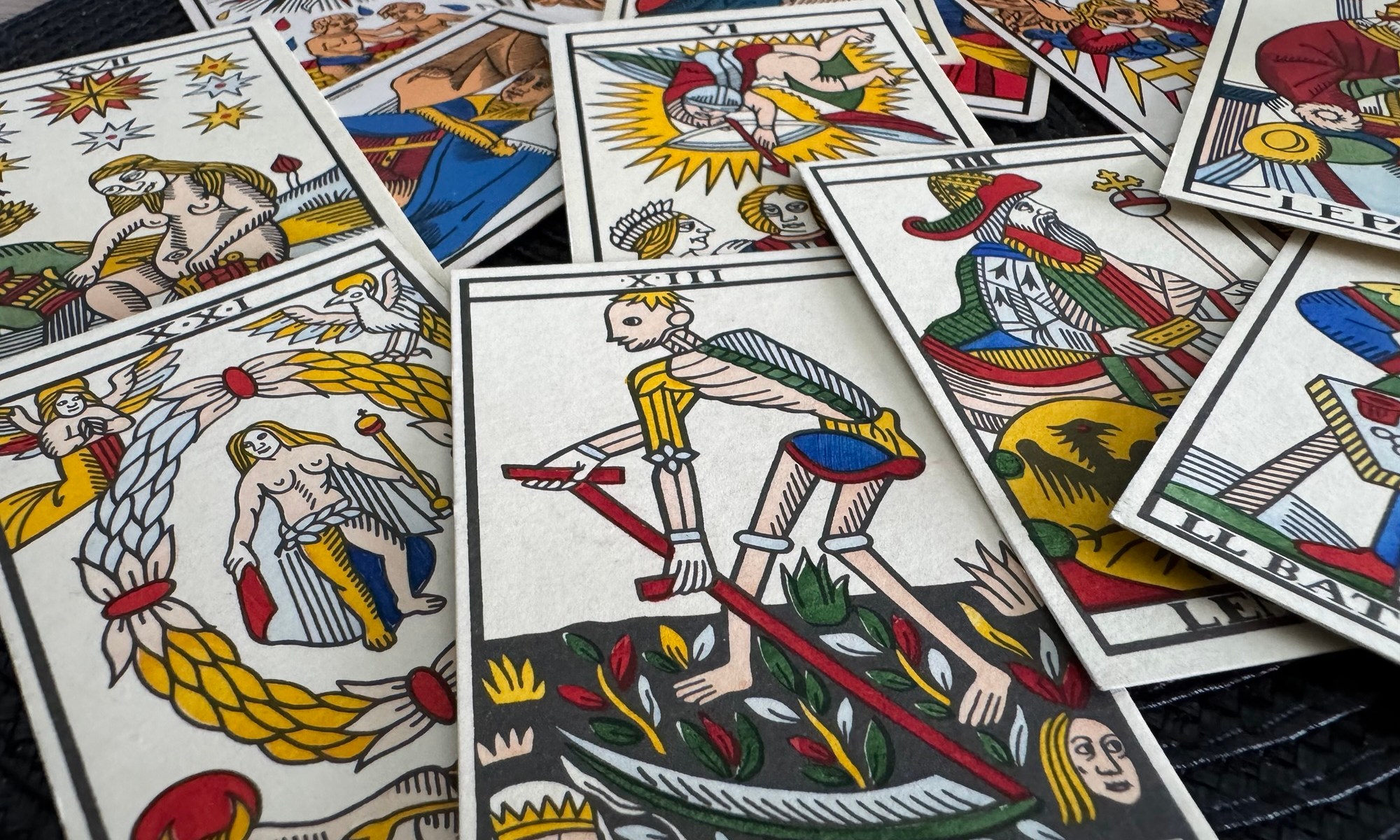
Between 2014 and 2016, I completed a manuscript entitled Tarot de Marseille: The Picturebook of Fate. Although never formally published, it represented the culmination of several years of study, practice, and reflection upon the Marseille Tarot and its unique symbolic language. At its heart was a simple proposition: that the Tarot de Marseille is best understood not as a repository of occult secrets, but as a sophisticated visual system whose images communicate meaning through their eikōnes, historical context, and recurring themes. Like a religious icon, each card has been “written” and we can read it just as we would an icon.
Unlike my earlier work on Lenormand, which was designed primarily as a reference text, The Picturebook of Fate was structured more as a course of instruction. Theoretical discussions were balanced with practical exercises intended to cultivate observation, interpretation, and independent thought. Rather than simply presenting conclusions, the manuscript sought to teach readers how to arrive at those conclusions for themselves.

The work also approached the Tarot unapologetically as a tool of divination and fortune-telling rather than as a vehicle for self-help, personal growth, or spiritual development. Whilst such approaches undoubtedly have their advocates, they were not my concern. Instead, the focus was placed upon the practical questions that have historically brought people to the cards: work, relationships, family, finances, and the countless other affairs of ordinary life. To that end, the manuscript introduced methods and techniques designed to obtain clear and useful answers regarding the mundane world and its circumstances.

The articles collected in this series are drawn from that unpublished work. What follows is not the manuscript itself, but a selection of adapted material consisting primarily of the original introductions to the trumps together with the concise card summaries that appeared in an appendix. Whilst certain passages have been revised, expanded, or refined in the years since they were first written, the underlying approach remains unchanged.

Readers familiar with modern Tarot literature may also notice that the trumps are not presented in their numerical sequence. Not being a great admirer of the so-called Fool’s Journey, I made a deliberate decision to examine the cards in an order that I believed better suited the educational aims of the manuscript. In hindsight, that may not have been the wisest choice, and a more conventional sequence would perhaps have been easier to follow. Nevertheless, I have retained the original arrangement here, both for the sake of consistency and as a reflection of the work from which these essays are drawn.

Finally, I should emphasise that what follows reflects my own practice, experience, and understanding of the Tarot de Marseille. It is not intended as a commentary upon, criticism of, or correction to any other author’s work, nor does it seek to establish a definitive system of interpretation. Tarot has always accommodated a variety of approaches, many of which have proven valuable to their practitioners. The methods and significations presented here are simply those which I have found to be reliable and effective through use. They should therefore be understood not as the right way, nor necessarily the best way, but merely as one way of working with the cards that has served me well over the years.

The Ones: The Juggler, the Wheel of Fortune and the Sun

Trump I, Le Bateleur, or the Magician or Juggler, is an intriguing and at times capricious card. Is he a charlatan or a magus? Can he mediate between worlds? Is he a symbol of the self-employed man, the entrepreneur, or merely a gifted trickster making his living by ingenuity and deception? The card refuses to provide a simple answer. Like the figure himself, it encourages us to look closely whilst simultaneously warning us that what we see may not be the whole truth.

The traditional eikōn is that of a fairground performer. He stands behind a portable table upon which his balls, cups, and various implements are displayed. Everything about his appearance is designed to attract attention. He is dressed in gaudy and conspicuous clothing, ensuring that he will not be overlooked amidst the bustle of the marketplace. One arm is raised in a theatrical gesture, while the other attends to the objects before him. He performs not merely with his hands but with his entire person. His clothing, posture, and gestures are all part of the act.
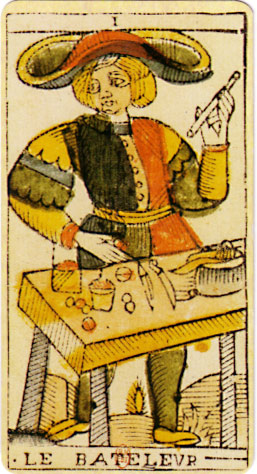
The essence of the Juggler is cunning, whilst his function is misdirection. These two principles define both the card and the figure depicted upon it. The Juggler succeeds because he understands how attention works. He knows where people are inclined to look and, more importantly, how to ensure that they look precisely where he wishes. Every movement is calculated. Every gesture has a purpose. The audience believes itself to be observing closely, yet it is seeing only that portion of the performance which the Juggler permits it to see.

For this reason, the Marseille figure is no esoteric magus. There is nothing in the image which requires us to imagine a master of hidden mysteries or a mediator between celestial and terrestrial realms. Here we find a performer skilled in sleight of hand. His art lies not in commanding supernatural forces but in directing perception. His bright clothing arrests the eye, his gestures hold our attention, and his movements guide our gaze. Yet when we follow his lead, we discover that we have been following a path laid out for us in advance. We witness what he wishes us to witness and overlook what he wishes us to overlook.

This does not diminish his accomplishment. On the contrary, the Juggler is a master of his craft. He possesses dexterity, skill, experience, and confidence. He has practised his art until it appears effortless. Can he make the ball appear and disappear with a flourish of his wand? Our eyes insist that he can, for that is exactly what we seem to observe. Yet the question remains unresolved. Is the event magical or merely illusory? We cannot say with certainty. The uncomfortable reality embodied by the Juggler is that our senses are persuasive but not infallible. What appears self-evident may nevertheless conceal an altogether different truth.

The card also conveys a state of perpetual readiness. The Juggler’s table is portable, his tools are arranged before him, and everything necessary for the performance is close at hand. He is not a figure of contemplation or withdrawal. He is a man prepared to act. Wherever a crowd gathers, wherever an opportunity presents itself, he is ready to unpack his table and begin. In this respect, the Juggler represents alertness, adaptability, and opportunism. He does not wait for favourable circumstances to arrive; he is prepared to make use of whatever circumstances come his way. His tools are ready, his wits are sharp, and he stands poised to turn possibility into action.

General: Success obtained through the careful manipulation of circumstances or events. Advancement through the meeting of preparation and opportunity. Control of conditions. Resourcefulness, initiative, adaptability, self-reliance, and the intelligent use of one’s skills.

Love: A person versed in the art of seduction; charming, persuasive, and adept at capturing both attention and affection. Attraction may develop swiftly and is often accompanied by an element of performance or game-playing. In an existing relationship, the Juggler frequently describes a partner who is rich in promises yet less dependable when action is required. The card invites us to ask whether we are seeing the person as they truly are, or merely as they wish to be seen. Equally, it raises an uncomfortable question: if we are being told precisely what we wish to hear, can we complain when we choose to believe it? At its best, the card denotes wit, charm, and romantic initiative; at its worst, manipulation and empty promises. The distinction between promise and fulfilment is paramount.

Career: The Juggler frequently points towards self-employment, consultancy, freelance work, or entrepreneurial ventures. Other associations include entertainment, media, advertising, sales, technology, and any profession requiring dexterity, communication, or the skilful presentation of ideas. Opportunities are available, but success depends upon the querent’s willingness to seize them. Carpe diem.

Finance: Opportunities to increase income through initiative, self-employment, or a secondary source of revenue. Success comes through ingenuity and acting quickly when opportunities arise. Caution is advised against schemes that appear too good to be true.

Health: Primary headache disorders, particularly migraines. To a lesser extent, conditions affecting the hands and fingers, including carpal tunnel syndrome, Raynaud’s phenomenon, Dupuytren’s disease, tremors, cramps, and muscular spasms. More generally, the card may point towards issues requiring dexterity, coordination, or fine motor control.

Essence: Cunning.
Function: Misdirection.
Polarity: Neutral.
Astrological Association: Mercury.
Timing: Wednesday. Within three months.

§

Tarot Cards: Jean Dodal Tarot via Wikipedia Commons. Public Domain.

Featured Image: Ancient Tarot Major Arcana © BP Grimaud/John Waddington Ltd, Leeds & London, Les Tarot de Marseille Jean Noblet, 1650 © Editions «letarot.com» (2001 [hand stencilled trumps]). Les Tarot de Marseille Jean Dodal, 1701 et 1715 © Editions «letarot.com» (2002 [hand stencilled trumps])

Main References:

Whilst this article reflects my own interpretations and experience of working with the cards, the principle sources and references that informed its development and the text are provided below for the interested reader.

Augustine and Pine-Coffin, R.S. (2003) Confessions. London, England: Penguin Books.
Saint Augustine of Hippo and Bettenson, H. (2004) City of God. Penguin Books.
Carvalho, H.A. de and Ribeiro, L. (2010) On the heavenly spheres: A treatise on traditional astrology. Tempe, AZ: American Federation of Astrologers.
Benedict et al. (1981) RB 1980: The Rule of St. Benedict. Collegeville, MN: Liturgical Press.
Catholic Truth Society, Catechism of the Catholic Church (2016). London: Catholic Truth Society.
Decker, R., Depaulis, T. and Dummett, M. (2002) A Wicked Pack of Cards: The Origins of the Occult Tarot. London: Duckworth.
Collins UK (2006) The Divine Office, volume I: Daily Prayer for Advent and Christmastide & Weeks 1-9. HarperCollins UK.
Collins UK (2006) The Divine Office, volume II: Daily Prayer for Lent and Eastertide. HarperCollins UK.
Collins UK (2006) The Divine Office, volume III: Daily Prayer for Weeks 6-34 of the Church Year. HarperCollins UK.
Farley, H. (2009) A cultural history of Tarot: From entertainment to esotericism. London: I.B. Tauris.
Frawley, J. (2001) The Real Astrology. London: Apprentice.
Frawley, J. (2002) The Real Astrology Applied: Teachings from the ‘Astrologer’s Apprentice’. London: Apprentice.
Frawley, J. (2011) The Horary textbook. London: Apprentice Books.
Giorgi, R., Zuffi, S. and Giammanco Frongia, R.M. (2005) Angels and Demons in Art. Los Angeles: J. Paul Getty Museum.
Jodorowsky, A., Costa, M. and Graham, J.E. (2009) The Way of Tarot: The Spiritual Teacher in the Cards. Rochester, Vt: Destiny Books.
Jones, A. (1974) The Jerusalem Bible. London: Darton, Longman and Todd.
Jones, M.D.W. (2008) The Counter Reformation: Religion and Society in Early Modern Europe. Cambridge England: Cambridge University Press.
McHugh, J.A., Callan, C.J. and Pius (2017) Catechism of the Council of Trent for Parish Priests: Issued by order of Pope Pius V. Charlotte, NC: TAN Books.
Nees, L. (2002) Early Medieval Art. Oxford: Oxford University Press.
Nouwen, H.J.M. (2007) Behold the beauty of the lord: Praying with icons. Notre Dame, Ind: Ave Maria Press.
Ptolemaeus, C. and Robbins, F.E. (2001) Tetrabiblos. Cambridge, MA: Harvard Univ. Press.
Silvestre, C.H. (1987) ABC des Tarots. Paris: Marabout.
Silvestre, C. (2004) Le Tarot Qui Guérit. Paris: Éd. Trajectoire.
Silvestre, C. (2013) La Roue Astrologique et le Tarot. Escalquens: Éd. Trajectoire.
Silvestre, C. (2016) Rencontre des Arcanes Majeurs et Mineurs du Tarot de Marseille: 1232 Associations Interprétées. Escalquens: Grancher éditions.
Silvestre, C. (2016a) Les 21 Portes des Arcanes du Tarot de Marseille et d’Oswald Wirth. Paris: Éditions Exergue.
Thomas (2018) Summa Theologica: Complete in a Single Volume. Claremont, CA: Coyote Canyon Press.
Unger, T. (1994) Le tarot, Jeu du Gouvernement du Monde: Éclairer votre regard, Choisir Votre partenaire, réussir l’entreprise. Paris: Montorgueil.
Valens, V. and Riley, M.T. (2022) The Anthology. Denver, CO: Amor Fati Publications.
Williams, B. (2003) A Renaissance Tarot: A Guide to the Renaissance Tarot. U.S. Games Systems.

Divining with the BOTA Tarot

In October 2024, Camille was referred to me by a longstanding client. When we arranged a date and time, she enquired whether I owned or used the Sharman‑Caselli Tarot. Regrettably, I could not oblige.

Her question, however, stirred a number of memories. When I first embarked upon my Tarot studies, books on the subject were not nearly as accessible as they are today. There was no Amazon, and the local bookshop did not stock anything that might be classed as “Occult” (late 1980s).

One of the earliest volumes I encountered was The Complete Book of Tarot1 by Juliet Sharman‑Burke. She later collaborated with Liz Greene on the Mythic Tarot—an old and trusted companion. Although I never adopted her card significations, I was intrigued by her preferred three‑part reading method outlined in The Complete Book of Tarot. For a time, I followed her structured approach, but I also experimented: three Stars, three Celtic Crosses, beginning with the Greater Arcana, then the Lesser, and finally a reading using both.

More than thirty years later, I still appreciate the loose structure this provides. I often begin a Tarot consultation with an astrological wheel using only the Greater Arcana, and I have long felt that the Celtic Cross reveals itself most elegantly when read solely with the Lesser Arcana.

With these recollections stirred, I elected to use Sharman‑Burke’s three‑stage method for Camille: first, a Celtic Cross with the Lesser Arcana; second, a Star spread with the Greater; and finally, a five‑card Horseshoe using the full deck.

I do not own many Tarot decks: the Noblet and Dodal tarots, a mini Grimaud TdM, the Tarocco Soprafino, Visconti-Sforza, the Albano‑Waite, the Thomson‑Leng, the Prediction Tarot, Renaissance Tarot (Brian Williams), and the Rolla Nordic Tarot. For clients, I generally favour either the Noblet, Grimaud (due to their size), Soprafino or the Albano‑Waite. On this occasion, however, I used my BOTA Tarot.

The BOTA Tarot

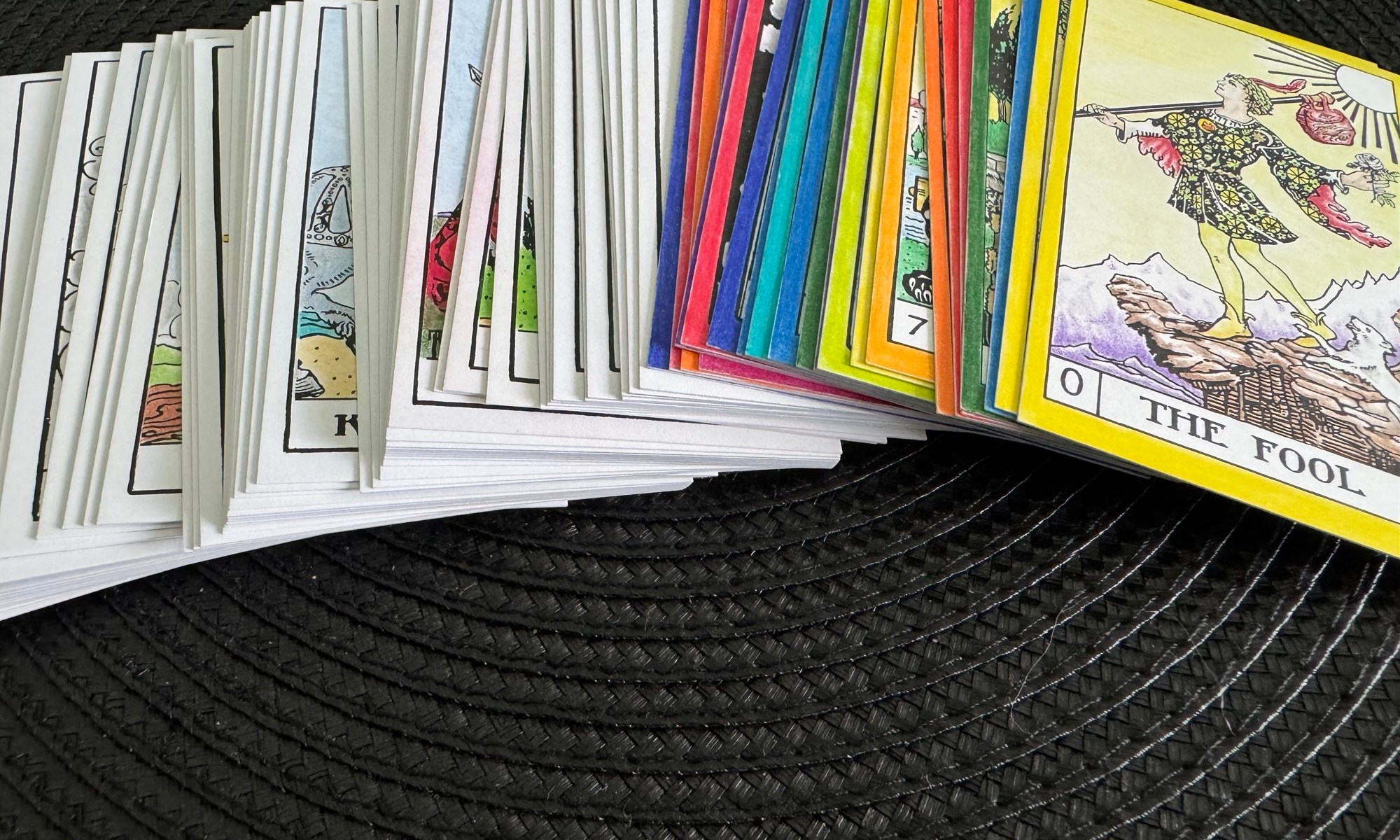
The Builders of the Adytum (BOTA) Tarot, designed under the direction of Paul Foster Case, is a lineal descendant of the Golden Dawn tradition and was created expressly as a vehicle for meditative and initiatory work. The deck is issued in black‑and‑white outline, intended to be coloured by the student according to Case’s precise attributions. My own copy is self‑coloured, following the traditional schema. When reading with it, I employ the significations for the Lesser Arcana given in Book T, which Case himself regarded as authoritative. This lends the deck a clarity and directness that I find particularly effective in structured readings such as the Celtic Cross.

I have, over recent years, coloured three BOTA decks. The version used for Camille’s reading adheres faithfully to Case’s prescribed colour scheme, which I have always found both coherent and aesthetically satisfying. The colouring itself proved a most pleasurable exercise; I completed the Greater Arcana at a pace of one card per week, allowing each image to settle, deepen, and reveal its character as the colours were applied.

Case’s work also provided the foundation for Frankie Albano’s re‑colouring of Pamela Colman‑Smith’s designs. Albano followed Case’s chromatic principles closely, producing a deck of remarkable vibrancy. I have always preferred the Albano‑Waite to the various other iterations of the Waite‑Smith tradition; its colours possess a coherence and luminosity that render the imagery far more intelligible in practice.

The Celtic Cross

The Celtic Cross exists in several variations. Over the years, I have experimented with different forms, but I find the version outlined by Waite perfectly serviceable. You will observe, however, that I do not read it sequentially.

Reading

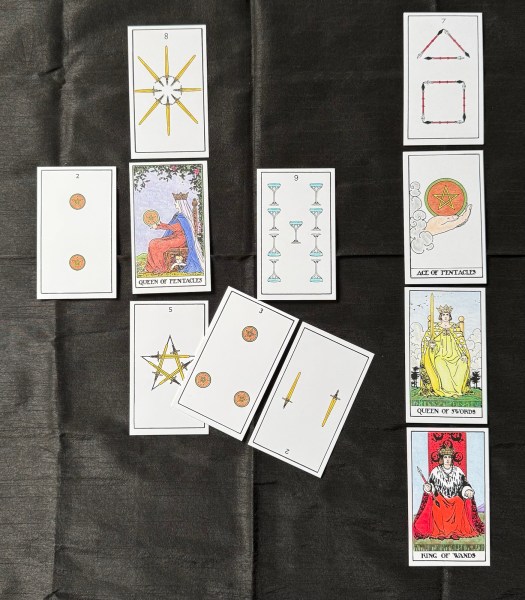
Camille has a classic earth (melancholic) temperament: short, lean, quiet, and reserved. For this reason, the Queen of Pentacles was used as the Questioner card. She faces left, and cards five and six of the Celtic Cross were dealt to the right and left respectively.

Camille posed no specific question. Experience has shown that when no question is asked, the first two cards will establish the topic. Here, we find the Three of Pentacles (card one, this covers you) and the Two of Swords (card two, this crosses you).

In the Golden Dawn system, these suits belong to opposing elements (earth and air). Followed by three Swords (air) cards, the Three of Pentacles (earth) is “undignified.”

Camille is eager to progress in her life and build upon the foundations she has laid (Three of Pentacles: building up, gain in commercial transactions, rank). Yet circumstances—being undignified—are currently frustrating, with little room for manoeuvre or support (Two of Swords).

From the cards, we may reasonably deduce that this pertains to Camille’s employment (Three of Pentacles: paid work). Traditionally, the Two of Swords indicates lingering tension after a quarrel, but more commonly it signifies a stalemate in which one must accept that one is neither influential nor likely to prevail. There is a strong indication that Camille is not in a position of advantage.

Turning to cards four (beneath) and five (behind), we see the cause of the tension.

Camille had previously been successful and took genuine pleasure in the satisfaction and material rewards her career afforded (Card 5: Nine of Cups). With the Nine of Cups, matters often come easily.

More recently, however, she was unsuccessful in securing advancement or a salary increase (Card 4: Five of Swords). Book T2 gives both “defeat” and “failure” for the Five of Swords, but also “a contest finished and decided against the person.” Looking across the spread, I felt Camille had applied for a higher position—the contest—and had been rejected as too inexperienced or insufficiently performing.

Card three (this crowns you) is the Eight of Swords. As matters stand, Camille will not find it easy to break out of her current position, with no immediate options on the horizon.

Yet all is not lost. In the future position, the Two of Pentacles promises an agreeable change in her circumstances.

The seventh card signifies the Questioner and how she influences the situation. Here we find the King of Wands. A Royal Arcana card may be read in two ways: as traits the Questioner possesses or requires, or as a person who may guide her. Both apply. Camille is a strong, independent, and capable woman; although her confidence has been dented, she must not lose sight of her abilities. These are qualities admired by the King, who is a just and generous benefactor to those he believes in. He will be able to guide Camille towards the best opportunities. In light of the Two of Pentacles, this is a friend of hers.

Card eight is the Queen of Swords, a woman in Camille’s environment. A keen observer, she will assess Camille’s performance and manner swiftly and decisively. Camille will not be granted the luxury of a second impression; she must be at her best from the outset.

The ninth card, the Ace of Pentacles, reveals Camille’s hopes and fears. Some Tarot readers interpret a negative card here as the Questioner’s fears and a positive card as their hopes. I read the card as both: what we hope for, we fear being denied; what we fear, we hope to avert. Camille hopes to advance in her career, securing her financial stability and material aspirations. She fears that failure to do so will leave her without the options and protection she desires.

The Seven of Wands is an interesting outcome card: it promises possible success, but not without challenge. Camille needs to dig deep and show her mettle.

If Camille can regain her footing, she will discover that the restrictions and obstacles (Eight of Swords) can be overcome with effort and tenacity. The Seven is never an effortless victory, but with the proper mindset and support (King of Wands, Two of Pentacles), her goals may indeed be realised.

In summary, I told Camille that she had suffered a setback in her career progression, and that this had left her confidence rather bruised. The cards showed that a positive change would come—the Two of Pentacles indicating an eventual shift in circumstances—but that it would not be immediate. Her present challenge lay in not appearing defeated or a poor loser (Eight of Swords, Five of Swords). If she can dust herself off and apply herself wholeheartedly to an upcoming project, the Seven of Wands shows that success is well within reach.

As we concluded, Camille confided that she had recently applied for the team‑leader position on her current assignment. The role had been awarded to a more experienced external candidate, and Camille felt acutely embarrassed—particularly as the successful applicant would now be her manager. This had prompted her to search, rather desperately, for a new position elsewhere. I reiterated the message of the cards and drew her attention once more to the Queen of Swords: the new manager would, in fact, prove a valuable ally, but she is a woman who forms her judgements swiftly and tends to keep to them. First impressions, therefore, would matter greatly.

Pointing to the Two of Pentacles, I advised Camille that matters would begin to improve around Christmas. The Queen of Pentacles—her significator—faces the Two of Pentacles, a card traditionally associated with the first decan of Capricorn, and thus with that period of the year. It suggested that the shift she longed for would emerge as the year turned, provided she maintained her composure and prepared herself to meet the opportunity when it arrived.

§

  1. Sharman-Burke, J. (1985) The Complete Book of Tarot. London: Pan. ↩︎
  2. Regardie, I. (1989) The Golden Dawn: An account of the teachings, rites, and ceremonies of the Hermetic Order of the Golden Dawn (Stella Matutina): A complete course in practical ceremonial magic. Saint Paul, MN: Llewellyn Publications. ↩︎

Fortunes With The Colman Smith and Waite Pack

Lilias is an energetic 80-year-old whose favorite pastimes include rambling, horse riding, and salsa! I have had the good fortune to read for Lilias for over a decade and look forward to seeing her. I also read for her daughters and several friends.

Lilias strongly prefers palmistry and Tarot — specifically the Colman Smith and Waite Tarot pack. Unlike many, this was neither my first Tarot nor one I have a long connection to. However, I keep a copy for Lilias and a few others who prefer the familiar drawings of Pamela Colman Smith.

Due to coronavirus, I read for Lilias remotely. After a general reading (using the temple and pyramid spreads) and follow-up questions, Lilias asked me to read about her granddaughter’s work situation.

Lilias is a retired teacher, and her two daughters pursued this vocation, as did a granddaughter, Mina.

Mina started work last September but has now resigned. Lilias is concerned Mina is throwing in the towel as Mina has no other role and doesn’t seem keen on teaching. So Lilias wanted to know if Mina was giving up teaching and making a big mistake? Would she be OK?

Due to time constraints, I used the Horseshoe spread.

Based on Lilias’s description, and as Mina is a woman under 35, I chose the Page of Wands as the Questioner card.

Here are Mina’s cards:

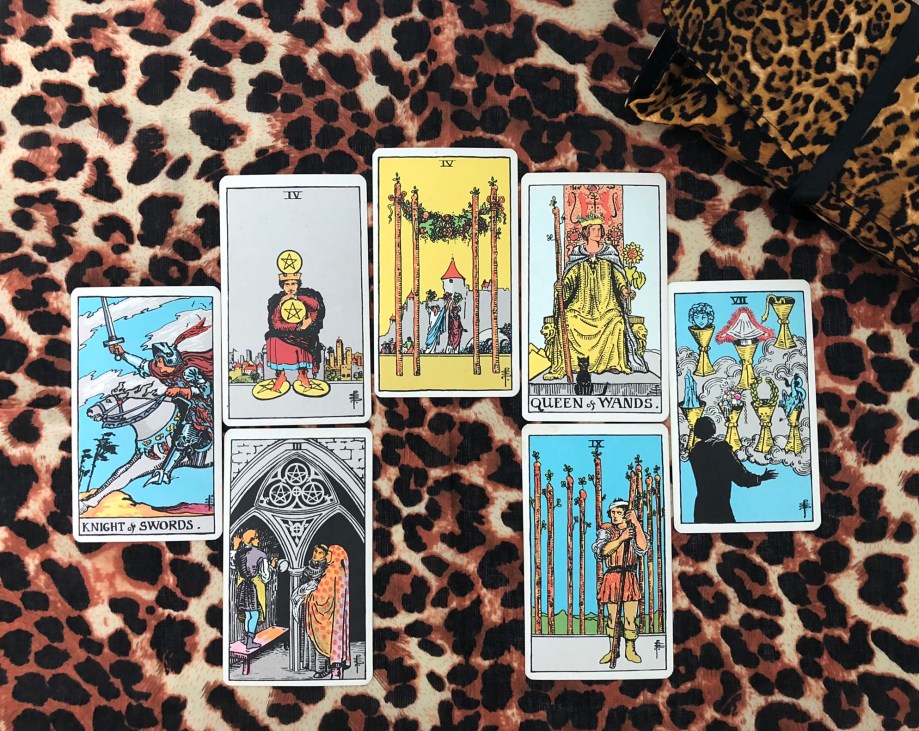
In Mina’s past, we find the Three of Pentacles, which has several meanings. First, Mina has qualified as a teacher (gain in rank) and enjoyed the benefits of a salary (paid employment). Another of the traditional significations of the Three of Pentacles is the “commencement of matters to be established later.” The qualifications she possesses will not go away. It would be possible to return to the profession after a break.

When I saw the Knight of Swords, I knew immediately that Mina was working in an all-boys’ school. Lilias confirmed this. The Knight falls between two Pentacles’ cards and is therefore undignified, bringing his more difficult qualities: obstinance, aggression, and unreliability. It’s a pressurized environment, and Mina is taxed.

The Seven of Cups, signifying the obstacle, supports that. Although often read as choices and imagination, it is more a card of false hope, deception, error, and “slight success at outset, not retained.” Between two fire cards, this is exacerbated. Mina feels cheated as her dream job has not surpassed the ideal in her head. She is jaded.

Consequently, as shown by the Four of Wands, she has decided to leave and take time for herself. This is not a card of walking away but a respite. It would seem that her decision has partly been influenced by the Queen of Wands, a woman who is quite kind and supportive. I felt that this was Mina’s supervisor and a sign that Mina had taken advice rather than just acting of her own volition.

Certainly, Mina’s financial future appears secure, as shown by the Four of Pentacles. Combined with the Nine of Wands as the outcome, it is pretty clear Mina will return to teaching after a break. The Nine of Wands emphasizes Mina has the strength to make a success despite this poor start (“Victory, preceded by apprehension and fear”). At the same time, the Four of Pentacles doesn’t support a career change (“little enterprise or originality”).

Taken together, she is entirely okay, despite a shaky start. Lilias was relieved.

A week after the reading Lilias called me to say Mina was planning to travel but has full intentions to return to teaching.

§

Deck: Tarot Cards, published by Rider/Waddingtons.