Between 2014 and 2016, I completed a manuscript entitled Tarot de Marseille: The Picturebook of Fate. Although never formally published, it represented the culmination of several years of study, practice, and reflection upon the Marseille Tarot and its unique symbolic language. At its heart was a simple proposition: that the Tarot de Marseille is best understood not as a repository of occult secrets, but as a sophisticated visual system whose images communicate meaning through their eikōnes, historical context, and recurring themes. Like a religious icon, each card has been “written” and we can read it just as we would an icon.
Unlike my earlier work on Lenormand, which was designed primarily as a reference text, The Picturebook of Fate was structured more as a course of instruction. Theoretical discussions were balanced with practical exercises intended to cultivate observation, interpretation, and independent thought. Rather than simply presenting conclusions, the manuscript sought to teach readers how to arrive at those conclusions for themselves.
The work also approached the Tarot unapologetically as a tool of divination and fortune-telling rather than as a vehicle for self-help, personal growth, or spiritual development. Whilst such approaches undoubtedly have their advocates, they were not my concern. Instead, the focus was placed upon the practical questions that have historically brought people to the cards: work, relationships, family, finances, and the countless other affairs of ordinary life. To that end, the manuscript introduced methods and techniques designed to obtain clear and useful answers regarding the mundane world and its circumstances.
The articles collected in this series are drawn from that unpublished work. What follows is not the manuscript itself, but a selection of adapted material consisting primarily of the original introductions to the trumps together with the concise card summaries that appeared in an appendix. Whilst certain passages have been revised, expanded, or refined in the years since they were first written, the underlying approach remains unchanged.
Readers familiar with modern Tarot literature may also notice that the trumps are not presented in their numerical sequence. Not being a great admirer of the so-called Fool’s Journey, I made a deliberate decision to examine the cards in an order that I believed better suited the educational aims of the manuscript. In hindsight, that may not have been the wisest choice, and a more conventional sequence would perhaps have been easier to follow. Nevertheless, I have retained the original arrangement here, both for the sake of consistency and as a reflection of the work from which these essays are drawn.
Finally, I should emphasise that what follows reflects my own practice, experience, and understanding of the Tarot de Marseille. It is not intended as a commentary upon, criticism of, or correction to any other author’s work, nor does it seek to establish a definitive system of interpretation. Tarot has always accommodated a variety of approaches, many of which have proven valuable to their practitioners. The methods and significations presented here are simply those which I have found to be reliable and effective through use. They should therefore be understood not as the right way, nor necessarily the best way, but merely as one way of working with the cards that has served me well over the years.
The Ones: The Juggler, the Wheel of Fortune and the Sun
Trump I, Le Bateleur, or the Magician or Juggler, is an intriguing and at times capricious card. Is he a charlatan or a magus? Can he mediate between worlds? Is he a symbol of the self-employed man, the entrepreneur, or merely a gifted trickster making his living by ingenuity and deception? The card refuses to provide a simple answer. Like the figure himself, it encourages us to look closely whilst simultaneously warning us that what we see may not be the whole truth.
The traditional eikōn is that of a fairground performer. He stands behind a portable table upon which his balls, cups, and various implements are displayed. Everything about his appearance is designed to attract attention. He is dressed in gaudy and conspicuous clothing, ensuring that he will not be overlooked amidst the bustle of the marketplace. One arm is raised in a theatrical gesture, while the other attends to the objects before him. He performs not merely with his hands but with his entire person. His clothing, posture, and gestures are all part of the act.
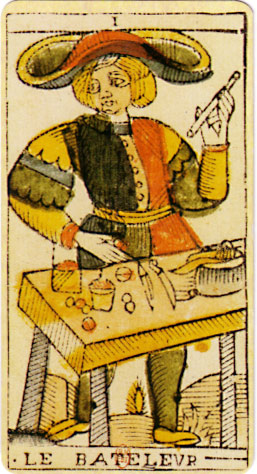
The essence of the Juggler is cunning, whilst his function is misdirection. These two principles define both the card and the figure depicted upon it. The Juggler succeeds because he understands how attention works. He knows where people are inclined to look and, more importantly, how to ensure that they look precisely where he wishes. Every movement is calculated. Every gesture has a purpose. The audience believes itself to be observing closely, yet it is seeing only that portion of the performance which the Juggler permits it to see.
For this reason, the Marseille figure is no esoteric magus. There is nothing in the image which requires us to imagine a master of hidden mysteries or a mediator between celestial and terrestrial realms. Here we find a performer skilled in sleight of hand. His art lies not in commanding supernatural forces but in directing perception. His bright clothing arrests the eye, his gestures hold our attention, and his movements guide our gaze. Yet when we follow his lead, we discover that we have been following a path laid out for us in advance. We witness what he wishes us to witness and overlook what he wishes us to overlook.
This does not diminish his accomplishment. On the contrary, the Juggler is a master of his craft. He possesses dexterity, skill, experience, and confidence. He has practised his art until it appears effortless. Can he make the ball appear and disappear with a flourish of his wand? Our eyes insist that he can, for that is exactly what we seem to observe. Yet the question remains unresolved. Is the event magical or merely illusory? We cannot say with certainty. The uncomfortable reality embodied by the Juggler is that our senses are persuasive but not infallible. What appears self-evident may nevertheless conceal an altogether different truth.
The card also conveys a state of perpetual readiness. The Juggler’s table is portable, his tools are arranged before him, and everything necessary for the performance is close at hand. He is not a figure of contemplation or withdrawal. He is a man prepared to act. Wherever a crowd gathers, wherever an opportunity presents itself, he is ready to unpack his table and begin. In this respect, the Juggler represents alertness, adaptability, and opportunism. He does not wait for favourable circumstances to arrive; he is prepared to make use of whatever circumstances come his way. His tools are ready, his wits are sharp, and he stands poised to turn possibility into action.
General: Success obtained through the careful manipulation of circumstances or events. Advancement through the meeting of preparation and opportunity. Control of conditions. Resourcefulness, initiative, adaptability, self-reliance, and the intelligent use of one’s skills.
Love: A person versed in the art of seduction; charming, persuasive, and adept at capturing both attention and affection. Attraction may develop swiftly and is often accompanied by an element of performance or game-playing. In an existing relationship, the Juggler frequently describes a partner who is rich in promises yet less dependable when action is required. The card invites us to ask whether we are seeing the person as they truly are, or merely as they wish to be seen. Equally, it raises an uncomfortable question: if we are being told precisely what we wish to hear, can we complain when we choose to believe it? At its best, the card denotes wit, charm, and romantic initiative; at its worst, manipulation and empty promises. The distinction between promise and fulfilment is paramount.
Career: The Juggler frequently points towards self-employment, consultancy, freelance work, or entrepreneurial ventures. Other associations include entertainment, media, advertising, sales, technology, and any profession requiring dexterity, communication, or the skilful presentation of ideas. Opportunities are available, but success depends upon the querent’s willingness to seize them. Carpe diem.
Finance: Opportunities to increase income through initiative, self-employment, or a secondary source of revenue. Success comes through ingenuity and acting quickly when opportunities arise. Caution is advised against schemes that appear too good to be true.
Health: Primary headache disorders, particularly migraines. To a lesser extent, conditions affecting the hands and fingers, including carpal tunnel syndrome, Raynaud’s phenomenon, Dupuytren’s disease, tremors, cramps, and muscular spasms. More generally, the card may point towards issues requiring dexterity, coordination, or fine motor control.
Essence: Cunning.
Function: Misdirection.
Polarity: Neutral.
Astrological Association: Mercury.
Timing: Wednesday. Within three months.
§
Tarot Cards: Jean Dodal Tarot via Wikipedia Commons. Public Domain.
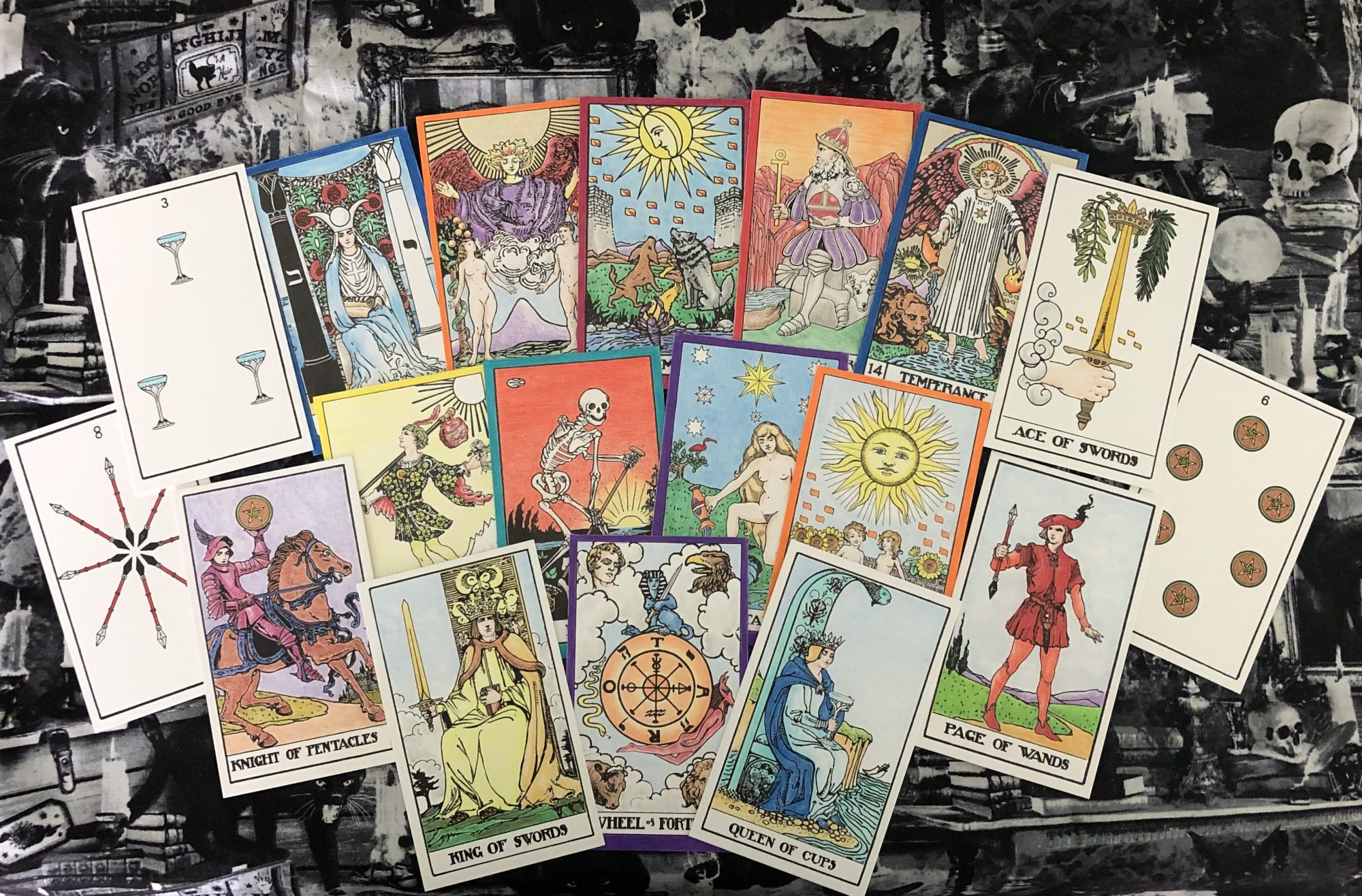
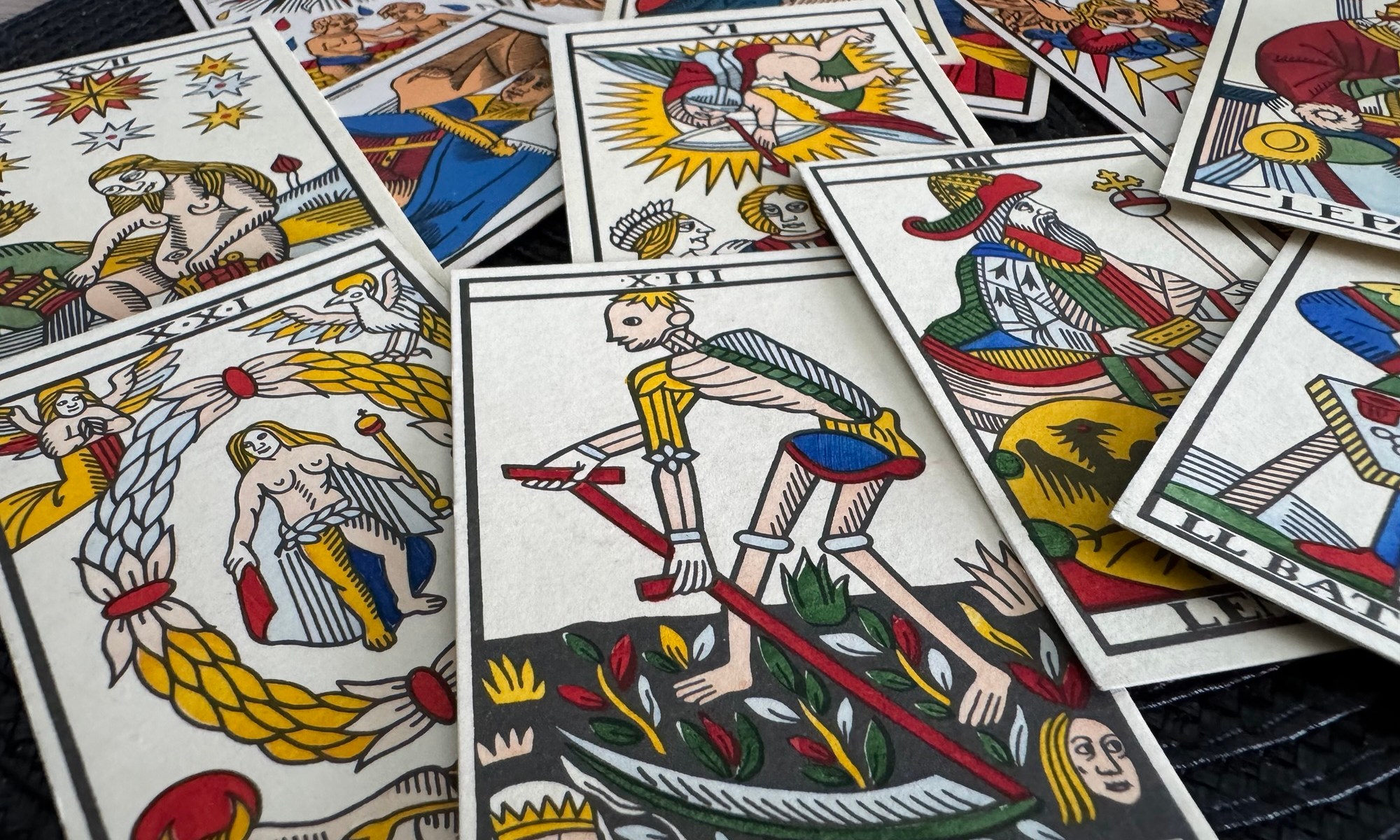
Featured Image: Ancient Tarot Major Arcana © BP Grimaud/John Waddington Ltd, Leeds & London, Les Tarot de Marseille Jean Noblet, 1650 © Editions «letarot.com» (2001 [hand stencilled trumps]). Les Tarot de Marseille Jean Dodal, 1701 et 1715 © Editions «letarot.com» (2002 [hand stencilled trumps])
Main References:
Whilst this article reflects my own interpretations and experience of working with the cards, the principle sources and references that informed its development and the text are provided below for the interested reader.
Augustine and Pine-Coffin, R.S. (2003) Confessions. London, England: Penguin Books.
Saint Augustine of Hippo and Bettenson, H. (2004) City of God. Penguin Books.
Carvalho, H.A. de and Ribeiro, L. (2010) On the heavenly spheres: A treatise on traditional astrology. Tempe, AZ: American Federation of Astrologers.
Benedict et al. (1981) RB 1980: The Rule of St. Benedict. Collegeville, MN: Liturgical Press.
Catholic Truth Society, Catechism of the Catholic Church (2016). London: Catholic Truth Society.
Decker, R., Depaulis, T. and Dummett, M. (2002) A Wicked Pack of Cards: The Origins of the Occult Tarot. London: Duckworth.
Collins UK (2006) The Divine Office, volume I: Daily Prayer for Advent and Christmastide & Weeks 1-9. HarperCollins UK.
Collins UK (2006) The Divine Office, volume II: Daily Prayer for Lent and Eastertide. HarperCollins UK.
Collins UK (2006) The Divine Office, volume III: Daily Prayer for Weeks 6-34 of the Church Year. HarperCollins UK.
Farley, H. (2009) A cultural history of Tarot: From entertainment to esotericism. London: I.B. Tauris.
Frawley, J. (2001) The Real Astrology. London: Apprentice.
Frawley, J. (2002) The Real Astrology Applied: Teachings from the ‘Astrologer’s Apprentice’. London: Apprentice.
Frawley, J. (2011) The Horary textbook. London: Apprentice Books.
Giorgi, R., Zuffi, S. and Giammanco Frongia, R.M. (2005) Angels and Demons in Art. Los Angeles: J. Paul Getty Museum.
Jodorowsky, A., Costa, M. and Graham, J.E. (2009) The Way of Tarot: The Spiritual Teacher in the Cards. Rochester, Vt: Destiny Books.
Jones, A. (1974) The Jerusalem Bible. London: Darton, Longman and Todd.
Jones, M.D.W. (2008) The Counter Reformation: Religion and Society in Early Modern Europe. Cambridge England: Cambridge University Press.
McHugh, J.A., Callan, C.J. and Pius (2017) Catechism of the Council of Trent for Parish Priests: Issued by order of Pope Pius V. Charlotte, NC: TAN Books.
Nees, L. (2002) Early Medieval Art. Oxford: Oxford University Press.
Nouwen, H.J.M. (2007) Behold the beauty of the lord: Praying with icons. Notre Dame, Ind: Ave Maria Press.
Ptolemaeus, C. and Robbins, F.E. (2001) Tetrabiblos. Cambridge, MA: Harvard Univ. Press.
Silvestre, C.H. (1987) ABC des Tarots. Paris: Marabout.
Silvestre, C. (2004) Le Tarot Qui Guérit. Paris: Éd. Trajectoire.
Silvestre, C. (2013) La Roue Astrologique et le Tarot. Escalquens: Éd. Trajectoire.
Silvestre, C. (2016) Rencontre des Arcanes Majeurs et Mineurs du Tarot de Marseille: 1232 Associations Interprétées. Escalquens: Grancher éditions.
Silvestre, C. (2016a) Les 21 Portes des Arcanes du Tarot de Marseille et d’Oswald Wirth. Paris: Éditions Exergue.
Thomas (2018) Summa Theologica: Complete in a Single Volume. Claremont, CA: Coyote Canyon Press.
Unger, T. (1994) Le tarot, Jeu du Gouvernement du Monde: Éclairer votre regard, Choisir Votre partenaire, réussir l’entreprise. Paris: Montorgueil.
Valens, V. and Riley, M.T. (2022) The Anthology. Denver, CO: Amor Fati Publications.
Williams, B. (2003) A Renaissance Tarot: A Guide to the Renaissance Tarot. U.S. Games Systems.
 Journal of a Cartomante