This article continues my series examining the trumps of the Tarot de Marseille, adapted from my unpublished manuscript, Tarot de Marseille: The Picturebook of Fate. As throughout this series, the emphasis is placed upon the traditional eikōn of the card, its historical context, and the practical significations I have found useful through divinatory practice. The interpretations presented here reflect my own experience of working with the Tarot de Marseille and should be understood as a working method rather than a definitive authority.
The Ones: The Juggler, the Wheel of Fortune and the Sun
Trump X, La Roue de Fortune, or the Wheel of Fortune, is a fascinating yet often overlooked trump. Is it a symbol of chance? Does it speak of luck, whether good or ill? Or does it simply refer to change itself? Like many of the Marseille trumps, the Wheel resists simplistic interpretation. It does not merely describe movement, but a particular kind of movement: cyclical, repetitive, and ultimately beyond our control.
The essence of the Wheel of Fortune is rotation; its function is to pivot. These two principles encapsulate the card’s operation within a reading. Rotation is the perpetual turning of circumstances, whilst pivot is the point at which one condition gives way to another. Nothing remains fixed. Positions alter, fortunes rise and fall, and situations develop according to forces that often lie beyond the power of any individual to command.
The traditional eikōn of the Wheel of Fortune is a familiar one. We see a great wooden wheel upon which three creatures ride. One ascends, another descends, whilst the creature at the top wears a crown. The image was commonplace throughout medieval and early modern art. It expresses the ancient formula: regnabo, regno, regnavi — ‘I shall reign, I reign, I have reigned’. The crowned creature occupies the summit only temporarily, for Fortuna’s wheel never ceases its turning. Those who prosper today will eventually decline, whilst those below may in time be elevated. The card reminds us that the capricious turning of Fortune’s wheel is something against which we are largely impotent. Fallow times must follow times of plenty.
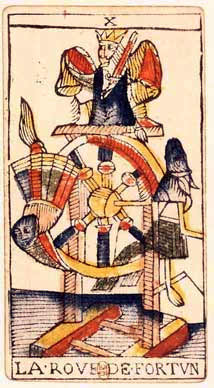
Many versions of the card also depict the wheel resting upon a wavy or uneven ground. This detail is easily overlooked, yet it serves an important purpose. The wheel stands upon uncertain foundations. Beneath all worldly affairs lies instability, unpredictability, and the possibility of sudden change. What appears secure today may prove transient tomorrow.
On a deeper level, the Wheel of Fortune signifies the sublunar sphere, the mutable realm of the physical world. It is the domain of generation and corruption, growth and decay, gain and loss. Here the four elements—fire, earth, air, and water—are in perpetual flux, endlessly combining, separating, and transforming. Nothing in this realm exists in a fixed state for long. Change is not an interruption of the natural order; it is the natural order.
For this reason, when the Wheel of Fortune appears in a reading, it often signifies the events and circumstances that have brought the querent to the cards. The accompanying cards describe the particular conditions, developments, and shifts that surround the matter at hand. These should not be confused with the underlying cause of events. In my system, the cause is revealed by Judgment, or the Angel card. The Wheel instead depicts the changing field of circumstances in which that cause manifests itself.
In practical divination, the Wheel of Fortune most commonly signifies circuitous change and repetition. Situations return, patterns recur, and familiar themes re-emerge in new forms. The card can indicate both favourable and unfavourable turns of fortune, although these qualities arise principally from the surrounding cards rather than from the Wheel itself. Fundamentally, the Wheel is neutral. It simply turns, raising some whilst lowering others, indifferent to both hope and fear. Its lesson is not luck, but change.
General: Circuitous change. Peaks and troughs, gain balanced by loss, and periods of advance followed by periods of decline. The card signifies the natural evolution of circumstances, recurring cycles, and the repetition of familiar patterns. Neither inherently fortunate nor unfortunate, it simply describes the turning of events.
Love: The Wheel of Fortune often signifies a relationship undergoing change as a result of external circumstances. A loss of employment, a relocation, financial pressures, illness, or altered family responsibilities may compel partners to adopt new roles and adjust established routines. Such changes can place a strain upon the relationship, particularly where one party struggles to adapt. In other cases, the card points towards monotony and recurring patterns which neither partner has yet addressed. For those who are single, the Wheel suggests that the present situation is likely to continue for the time being, although change is anticipated further down the road.
Career: The Wheel of Fortune is naturally associated with the gambling industry, but also with finance, investment, speculation, and the video games sector. It frequently appears in connection with seasonal employment, contract work, fixed-term appointments, and careers characterised by fluctuating fortunes. The card indicates changing circumstances rather than permanence.
Finance: Fluctuating income, changing financial circumstances, and cyclical patterns of gain and loss. The card may signify investments, speculation, gambling, or seasonal sources of income. Neither prosperity nor adversity should be assumed permanent.
Health: The Wheel of Fortune frequently points towards co-morbidity, whereby one or more conditions exist alongside a primary illness. With the Popess, it may indicate a condition concealed or masked by another. More generally, the card signifies illnesses characterised by cycles, periodic flare-ups, remission, recurrence, or seasonal variation.
Essence: Rotation.
Function: Pivot.
Polarity: Neutral.
Astrological Association: Gemini.
Timing: June. By the next equinox or solstice, whichever comes first.
§
Tarot Cards: Jean Dodal Tarot via Wikipedia Commons. Public Domain.
Featured Image: Ancient Tarot Major Arcana © BP Grimaud/John Waddington Ltd, Leeds & London, Les Tarot de Marseille Jean Noblet, 1650 © Editions «letarot.com» (2001 [hand stencilled trumps]). Les Tarot de Marseille Jean Dodal, 1701 et 1715 © Editions «letarot.com» (2002 [hand stencilled trumps])
 Journal of a Cartomante