Then the Lord God said, “It is not good that the man should be alone; I will make him a helper fit for him.” So out of the ground the Lord God formed every beast of the field and every bird of the air, and brought them to the man to see what he would call them; and whatever the man called every living creature, that was its name. The man gave names to all cattle, and to the birds of the air, and to every beast of the field; but for the man there was not found a helper fit for him. So the Lord God caused a deep sleep to fall upon the man, and while he slept took one of his ribs and closed up its place with flesh; and the rib which the Lord God had taken from the man he made into a woman and brought her to the man.
Genesis 2: 18 – 22 (RSV CE)
The fountains mingle with the river
And the rivers with the ocean,
The winds of heaven mix for ever
With a sweet emotion;
Nothing in the world is single;
All things by a law divine
In one spirit meet and mingle.
Why not I with thine?—
See the mountains kiss high heaven
And the waves clasp one another;
No sister-flower would be forgiven
If it disdained its brother;
And the sunlight clasps the earth
And the moonbeams kiss the sea:
What is all this sweet work worth
If thou kiss not me?
Love’s Philosophy, Percy Bysshe Shelley
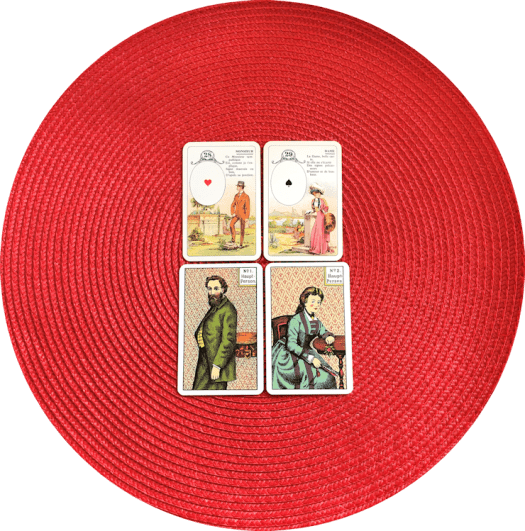
The Gentleman, is the dominant card in the game, along with card n. 29, and shows us the happiness or misery of the person consulting the cards.
The Lady, is of the same importance, as all is revealed according to its position in the game, despite the perspicacity of the person reading the cards
Original Instructions
Card Nos. 28 and 29 in the Petit Lenormand, the Lord and the Lady, are represented by the Ace of Hearts and the Ace of Spades respectively. Unlike the majority of cards within the deck, they are not primarily concerned with events, circumstances, or conditions. Instead, they identify the people around whom the reading revolves.
Essence and Function of the Lord and the Lady
The traditional eikōn depicts a well-dressed young man and woman respectively. Depending upon the deck, their attire reflects the artistic style of the period in which the cards were produced. The Brepols pattern, for example, places them in the late Belle Époque, whilst the Dondorf adopts a Biedermeier setting. It is also quite common for the Lord and Lady to share the same landscape, so that when placed together they appear to occupy the same location. Conventionally, they face towards one another, although some modern decks abandon this feature.
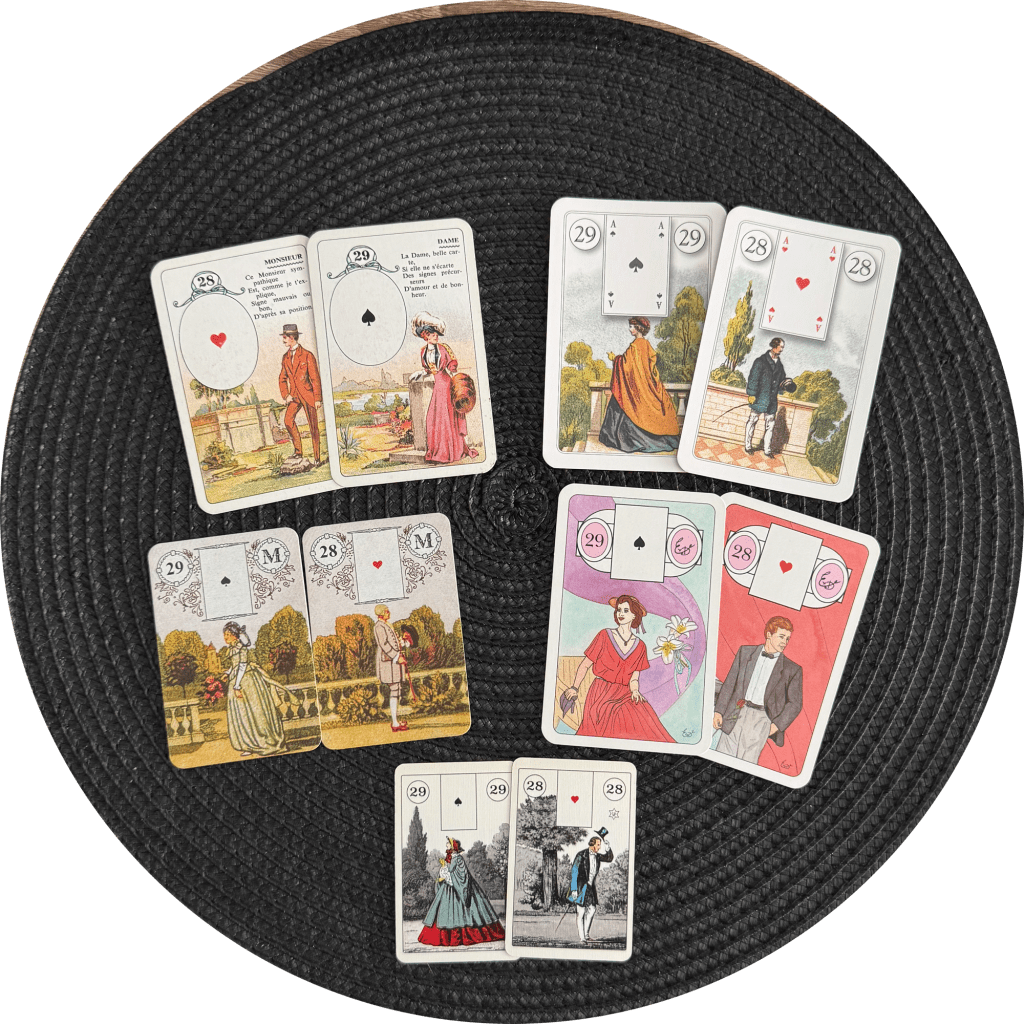
The essence of the Lord and Lady is identity and their function is to signify.
The Lord and Lady are the two principal significators of the deck and invariably identify the primary actors within the matter under consideration. In most readings, one of these cards will represent the querent because the querent is usually the central figure in the question being asked.
Significators
To understand the Lord and Lady properly, one must first understand the role of a significator.
A divinatory spread functions rather like a mirror or picture of the seeker’s circumstances. The cards reflect people, events, opportunities, challenges, and influences operating within their life. The significator acts as the seeker’s reflection within that picture. It identifies whose story is being told and provides a reference point from which the remainder of the reading may be interpreted.
For this reason, significators are traditionally chosen because they possess some degree of affinity or resemblance to the individual they represent.
Within the Petit Lenormand, this resemblance is ordinarily established through gender. The Lady is generally used for those who identify as women, whilst the Lord is used for those who identify as men.
Naturally, this approach presents certain challenges when working with clients who identify as non-binary or gender-fluid. In such circumstances, it is often best to discuss the matter directly with the client and agree upon an appropriate significator together. The purpose of a significator is identification rather than ideology.
Over the years, I have successfully employed alternative significators such as the Child, the Hound, or a specially created carte blanche. The specific choice is less important than ensuring that both reader and client readily recognise the card as representing the querent within the reading.
Ultimately, the Lord and Lady are less concerned with meaning than perspective. They tell us whose story we are reading.
Same-Sex Relationships
Many modern Petit Lenormand decks now include additional Lord and Lady cards intended specifically for same-sex relationships. A growing number of readers substitute one of these alternative cards when reading for gay or lesbian clients. If that approach works for you and your clients, there is no reason not to employ it.
The essential question, however, is not whether a card represents a man, a woman, or a particular type of relationship, but whether the card can naturally fulfil the function required of it within the reading. The purpose of a significator is not to satisfy a theoretical rule but to identify all the people involved clearly and consistently within the tableau.
When I first learnt the Petit Lenormand, the additional Lord and Lady cards now found in many modern decks simply did not exist. If one wished to read for same-sex relationships, one had little choice but to work with the cards already present in the deck.
For this reason, cartomancers developed their own approaches to interpreting the Lord and Lady cards for same-gender relationships.
Some readers retained both figures but interpreted them as the same gender. For example, when reading for a lesbian client, they might represent the Lord as female.
Others, including Malkiel Dietrich, would assign the Lord to the lesbian client, allowing the Lady to continue representing her love interest. This is reversed for gay men.
My approach arose partly from necessity and partly from observation.
As an LGBTQ+ reader, I spent a great deal of time reading for myself and for other LGBTQ+ friends and clients. Over time, certain patterns emerged with remarkable consistency. The Cavalier and King of Spades (Lilies) repeatedly appeared as male romantic interests and partners in readings concerning myself and other gay men. Likewise, the Queen of Clubs (Serpent) and Queen of Spades (Bouquet) appeared with similar regularity in readings for lesbian friends and clients.
What was striking about these observations was that they arose naturally within the readings themselves. I was not consciously assigning these cards to such roles. Rather, they repeatedly assumed them through practice. Eventually, the pattern became too consistent to ignore.
This should not be particularly surprising. The Cavalier has long signified a male admirer, suitor, romantic interest, or even a chevalier servant. The Lilies, as the King of Spades, likewise has a long-standing association with important male figures. In the same way, the Queen of Clubs or Serpent has traditionally represented a man’s lover, mistress, former partner, or another significant woman in his life, whilst the Queen of Spades or Bouquet card frequently appears as an attractive female admirer or romantic interest.
Indeed, it is perhaps more accurate to say that my use of these cards derives as much from its association with the playing card as from the symbol itself. They are one. Traditional cartomancy had already established the Queen of Clubs as a prominent female figure connected with romantic entanglements, lovers, rivals, and former partners. Extending that role to female partners therefore felt entirely consistent with existing practice.
In other words, the cards were already functioning as romantic significators. The context simply changed.
Likewise, the Hound can be an excellent significator where companionship, loyalty, shared experience, or an existing connection are more important than the romantic qualities emphasised by the Cavalier or Bouquet. Traditionally, the Hound often appears as a male romantic interest, particularly in readings for women. In recent years, however, I have also observed it signifying women on numerous occasions. Most commonly, it represents an ex-partner, former love interest, or someone already known to the seeker.
The Bear may likewise function as a romantic significator. Unlike the Hound, however, the Bear tends to be largely gender-neutral in practice. More often than not, it aligns itself with the seeker’s own preferences and circumstances. The card continues to signify a powerful, influential, protective, or established individual, but their sex is usually determined by context rather than by any intrinsic quality of the card itself.
I have therefore never found that using the Cavalier, Lilies, Bouquet, Serpent, Hound, or Bear in same-sex relationship readings meant somehow “losing” those cards. They are simply continuing to fulfil functions they already perform naturally within the system.
If the Serpent can signify a man’s lover or mistress in a traditional reading, it can just as naturally signify a female partner in a same-sex relationship. Likewise, if the Cavalier can signify a male admirer, the Hound an ex-partner, or the Bear a protective love interest, those functions remain intact regardless of the sexes or genders involved. The context changes, but the function does not.
A practical example may illustrate the point. In early 2025, I read for a woman whose same-sex relationship was clearly approaching its conclusion. The Grand Tableau confirmed that the relationship was nearing its end. The existing partner was represented quite naturally by the Queen of Clubs (Serpent), which had already assumed the role of a female romantic significator within the reading.
The tableau also revealed the arrival of a new love interest. What made the reading particularly interesting was that this individual appeared as the Lord rather than any of the female person cards.
Several months later, she met a man and the two began dating. The client was bisexual, and the Lord had accurately identified the sex of the incoming partner.
I found the reading particularly instructive because it demonstrated that the cards were performing different functions simultaneously. The Queen of Clubs represented the female partner already present in the client’s life, whilst the Lord signified a new male romantic interest entering it. Had I automatically reassigned the Lord to represent a female partner simply because the client happened to be in a same-sex relationship at the time, a useful layer of information would have been lost.
Experiences such as this reinforced my preference for allowing the cards to fulfil the functions they naturally assume within the reading rather than imposing a fixed interpretation upon them in advance.
There is also a practical consideration. Not everyone is exclusively attracted to one sex or gender. Some individuals are bisexual, gender-fluid, or gender-queer. If we remove all cards capable of signifying men and women separately, we can quickly create difficulties when reading for people whose attractions are not limited to one sex or gender. Preserving the traditional functions of the Lord and Lady often makes the tableau easier to interpret because those distinctions remain immediately recognisable.
One practical advantage of this method is that it allows the Lord and Lady to continue signifying the men and women who populate our lives more generally. The Lady did not cease being useful simply because I happened to be reading about a same-sex relationship. She continued to signify the women in my life: friends, lecturers, colleagues, neighbours, relatives, and countless others. The same principle naturally applies to the Lord.
That said, I would encourage readers to experiment with both approaches. Some will find the additional Lord and Lady cards immensely helpful, whilst others may prefer to work with the traditional person cards already present within the deck. The important thing is to discover what works best for you and your clients and to apply that method consistently.
Ultimately, the purpose of a significator is clarity. The method one adopts matters less than whether it allows the people within the tableau to be identified quickly, consistently, and without ambiguity. In my experience, the existing person cards of the Petit Lenormand already provide all the flexibility required to achieve that. Clarity and function should always take precedence over rigid rules.
Person and Description
Person
In most readings, the Lord and Lady will signify an actual person within the seeker’s life. The Lord ordinarily represents a man, and the Lady a woman.
When either card appears, the surrounding cards should be examined carefully. Unlike many other cards in the deck, the Lord and Lady contribute relatively little descriptive content of their own. Instead, the cards around them provide the physical characteristics, temperament, circumstances, and intentions needed to build a complete portrait of the individual.
Because they function primarily as significators, the Lord and Lady are often best understood as blank canvases upon which the surrounding cards paint the details.
Physical Description
Unlike the Bear, Hound, or Cross, the Lord and Lady rarely provide detailed physical descriptions. Their purpose is to identify a person rather than describe them.
When they do contribute descriptive value, the Lord tends to indicate a traditionally masculine presentation, whilst the Lady suggests a traditionally feminine one.
The Lady often points towards colourful attire, flowing garments, jewellery, and a degree of elegance or je ne sais quoi. The emphasis is not necessarily upon beauty itself, but upon presentation and refinement.
The Lord, by contrast, tends towards more restrained colours, simpler forms of dress, practical clothing, and a somewhat conservative appearance.
These descriptions are necessarily broad and should always be refined through the surrounding cards.
Temperament
The Lord and Lady contribute relatively little in terms of temperament compared with cards such as the Bear, Hound, or Stars.
Broadly speaking, the Lord tends towards qualities traditionally regarded as masculine, whilst the Lady tends towards qualities traditionally regarded as feminine. The exact manifestation, however, depends heavily upon the surrounding cards and the context of the reading.
For this reason, it is generally more productive to examine the adjacent cards rather than rely upon the Lord or Lady themselves for character assessment.
Special Features
When Not a Person
As a general rule, the Lord and Lady represent a man and a woman respectively. In the overwhelming majority of readings, this straightforward approach is the correct one and should not be abandoned merely for the sake of novelty. The traditional meanings exist for a reason and are ordinarily the best place to begin.
There are, however, circumstances in which these cards do not signify a particular man or woman but a wider body of people.
For example, if a woman enquires about the outcome of a job interview, the Lord might represent the interview panel itself. Such a panel may contain both men and women or be all female, yet be treated as a single entity within the reading.
In my experience, this tends to occur whenever the card is representing people collectively rather than individually. The card retains its role as a principal significator, but instead of identifying one person it comes to symbolise a group, organisation, institution, authority, or decision-making body. These are in such context the partner. If you are successful they offer you something and you accept or decline. It is a partnership.
The same principle applies in legal matters. If one significator represents the client, the remaining significator will ordinarily represent the opposing party regardless of gender. Thus, if a woman is involved in litigation and is represented by the Lady, the Lord naturally becomes her opponent even if that opponent is another woman, a company, a government agency, or some other legal entity. The card is not describing sex or gender in these circumstances. It is identifying the principal actors within the dispute.
A similar approach may be employed in mundane readings concerning elections, political parties, nations, wars, and other public matters.
Here, the Lord and Lady often become the principal sides within the matter being examined. The choice of which side receives which significator is generally determined by affinity. As the significator functions as a reflection of the querent, the card assigned to them should represent the party, nation, cause, or candidate with whom they most closely identify.
For example, if I were conducting a political reading, the Lord would ordinarily represent the party or candidate I support (Liberal), whilst the Lady would signify the principal opposition. Another reader might legitimately reverse this arrangement. If a woman who supports the Democratic Party were performing a reading, the Lady would naturally represent the Democrats because of its affinity with the reader, whilst the Lord would represent the Republican candidate regardless of that candidate’s gender.
The important principle is consistency. Once the significators have been assigned, they should be read in the ordinary manner. The cards surrounding them, the distance between them, and their position within the tableau will reveal the development of the matter just as they would in a personal reading.
Even in such situations, the underlying principle remains unchanged. The Lord and Lady continue to identify the principal actors within the matter being examined. Only the scale of representation has altered.
That said, these instances remain comparatively uncommon. Unless the context strongly suggests otherwise, the safer and more reliable assumption is that the Lord signifies a man and the Lady signifies a woman. Only when the question itself points clearly towards a collective rather than an individual should a broader interpretation be seriously considered.
The Lord and Lady in the Grand Tableau
The importance of the Lord and Lady becomes especially apparent within the Grand Tableau because they provide the reference point from which the entire tableau may be understood.
Most importantly, close attention should be paid to the cards surrounding the significator. The Grand Tableau functions as a reflection or picture of the seeker’s life. Consequently, cards positioned near the significator describe matters experienced directly and immediately by the seeker, whilst cards further away describe matters that are more distant, indirect, or less significant to their present circumstances.
Some modern readers regard the traditional distinction between near and far as archaic. I have never found this criticism particularly persuasive. The principle is simply a spatial understanding of human experience. We engage more directly with things that are close to us than with things that are distant.
If the Lady has the Mice immediately nearby, she is far more likely to notice losses, theft, waste, or inconvenience as they occur and therefore stands a better chance of addressing the problem quickly. The Mice remains troublesome when distant, but the effect is often less immediate and may be occurring beyond her direct awareness.
Likewise, the Sun provides a useful analogy. It is the same Sun regardless of distance, yet we experience its effects very differently depending upon our proximity to it. Nearness increases intensity; distance diminishes it. The same principle applies within the tableau.
For this reason, proximity1 is not merely a traditional convention but a practical interpretative tool. It helps the reader determine emphasis, relevance, and immediacy. A card lying beside the significator generally deserves greater attention than one situated on the opposite side of the tableau.
This principle allows the cartomante to move beyond broad generalisations and towards more precise observations. The cards reveal not only what is present in the seeker’s life, but also how directly it is being experienced and how important it is likely to be at the present time.
Relationship Dynamics
One of the most valuable applications of the Lord and Lady within the Grand Tableau is assessing relationship dynamics.
In decks where the significators face one another, attention should first be paid to whether they are looking towards or away from each other.
When the Lord and Lady face one another, their attention remains directed towards the relationship. This is not automatically a sign of harmony, but it does suggest that both individuals remain engaged with one another.
When they face away from each other, their attention is directed elsewhere. This does not necessarily indicate conflict or separation. More often, it suggests that other matters have taken precedence. Careers, children, finances, health concerns, or personal ambitions may currently occupy more of their attention than the relationship itself.
The key question is not whether they are looking at one another, but what they are looking at instead.
The cards lying between the Lord and Lady are of particular importance. These cards form a chain and often describe what is passing between the two individuals. They reveal the principal dynamics, concerns, influences, and issues operating within the relationship.
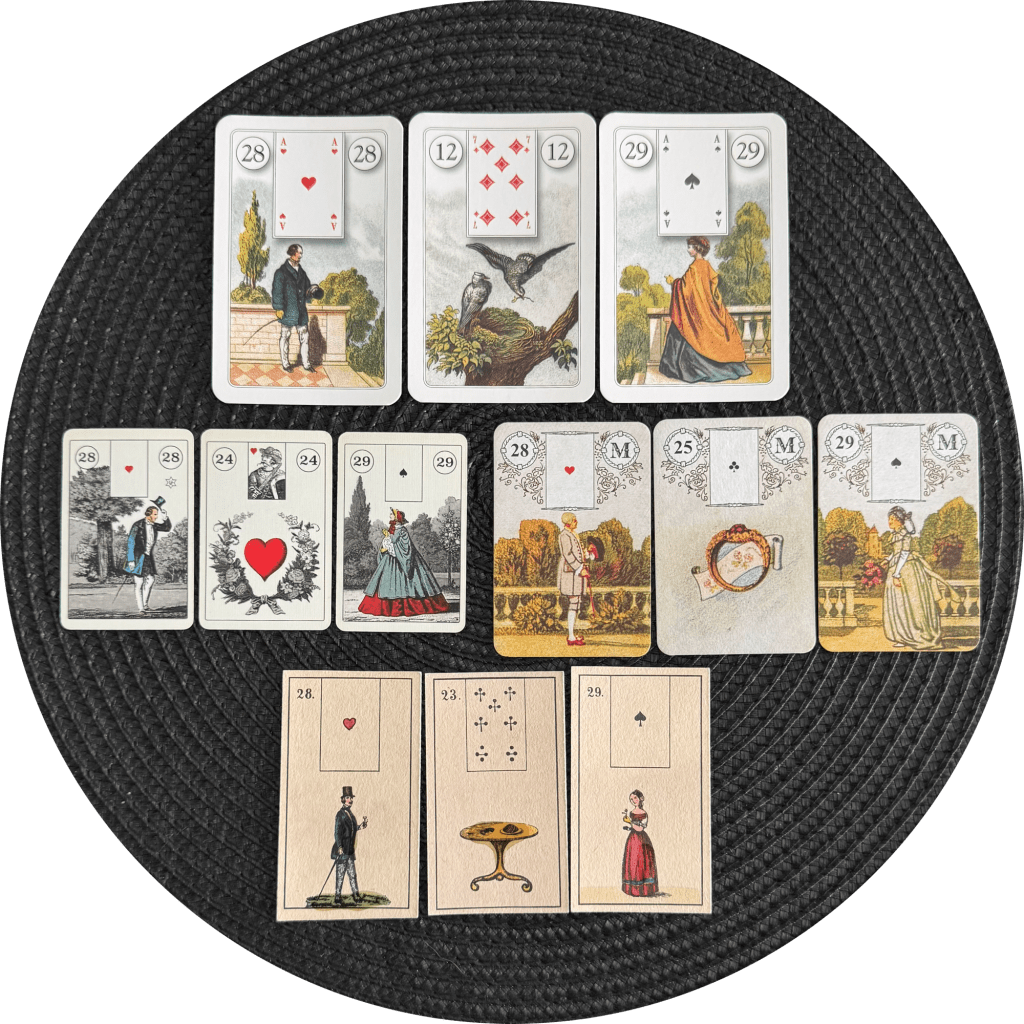
For example:
- Lord – Heart – Lady emphasises affection, emotional connection, and mutual feeling.
- Lord – Ring – Lady highlights commitment, promises, and shared obligations.
- Lord – Birds – Lady suggests excitement, commotion, anxiety, or an abundance of communication passing between them.
- Lord – Mice – Lady often indicates that the woman feels the man is gradually pulling away from her. The connection is not usually broken suddenly. Instead, intimacy, communication, or trust is slowly eroded, leaving one party feeling neglected or increasingly uncertain about the relationship.
Another useful technique involves examining intersection points.
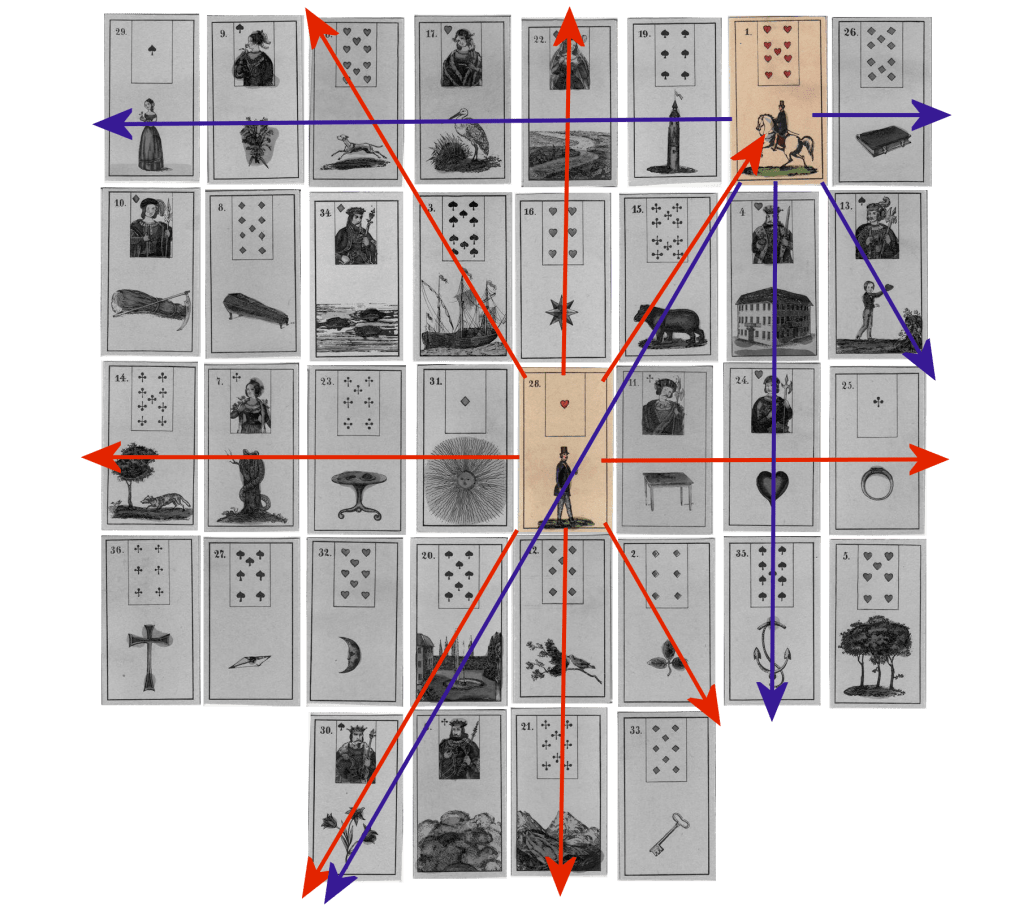
This is achieved by tracing horizontal, vertical, and diagonal lines from both significators and identifying cards shared by those lines. These shared cards often reveal areas where the Lord and Lady “meet.”
Such cards frequently indicate common interests, mutual concerns, shared experiences, or circumstances affecting both parties equally.
For example, if both significators intersect upon the House, domestic matters may occupy an important place in the relationship. Shared intersections upon the Child may draw attention to children or new beginnings, whilst intersections upon the Anchor may reveal common goals relating to security, work, or long-term stability.
Taken together, proximity, direction, chains, and intersections provide a remarkably detailed picture of a relationship. The Lord and Lady do not merely identify the people involved; they allow us to observe how those people relate to one another, where their attention is focused, what lies between them, and the interests and concerns they continue to hold in common.
Coda
At their heart, the Lord and Lady are cards of identity. They provide the reference point from which the entire reading is understood. Without them, we know what is happening; with them, we know to whom it is happening. Their true purpose is not to predict events, but to orient the reader within the living picture that is the Petit Lenormand.
§
Images:
Featured Image:
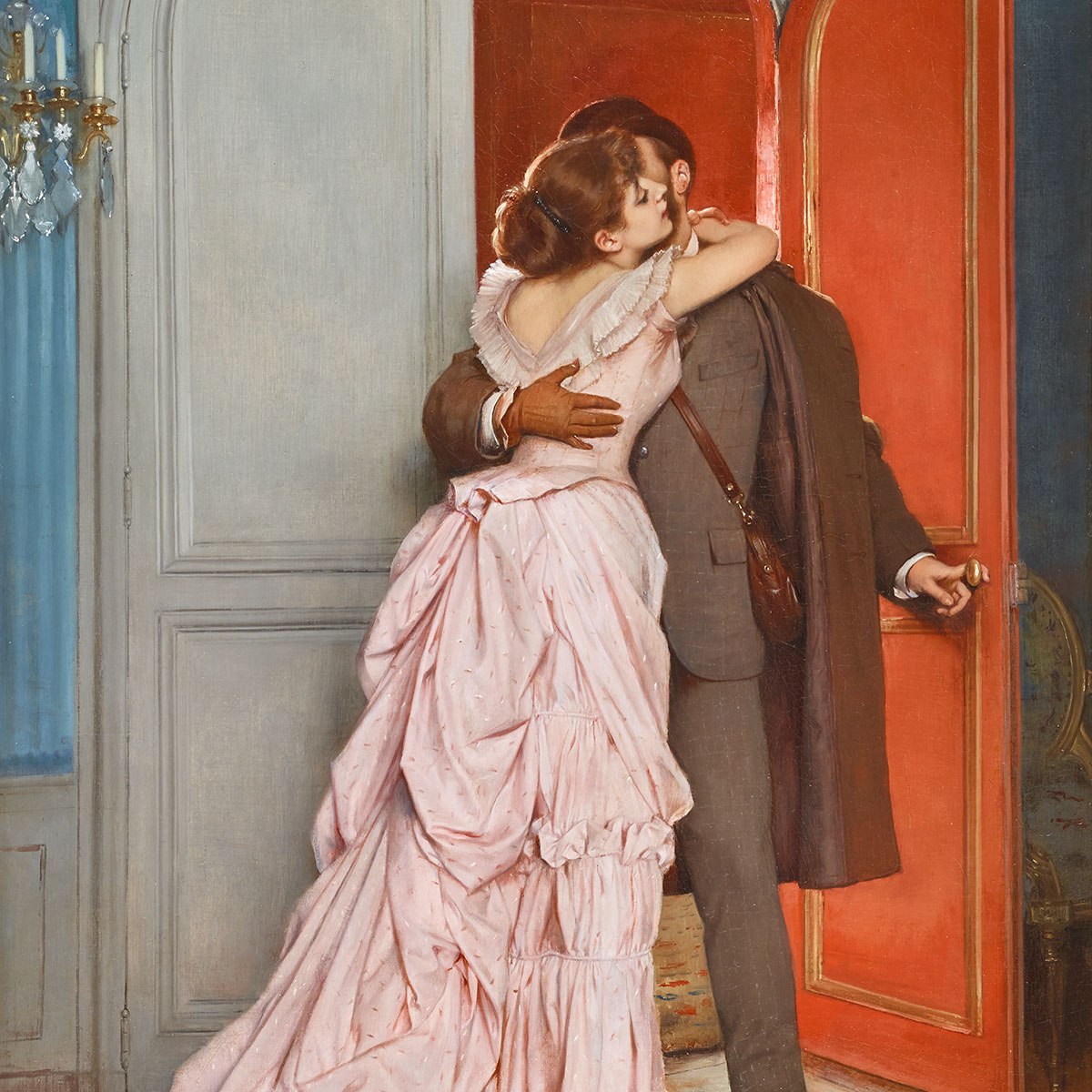
Auguste Toulmouche, Public domain, via Wikimedia Commons
Cards:
Lenormand Cards: Jeu Lenormand © Cartamundi, WanderWüst © Jorge/Wandering Oracle, Lenormand Fortune-Telling Cards © Zao-Gelli, The Lenormand Oracle © Verlag für die Frau, Leipzig, Nieuwe Lenormand © Amber Studio/Erna Droesbeke, Lenormand 36 Orakelspielkarten © Königsfurt-Urania,
References:
Boroveshengra, A., 2013. Cartomantes’ Cabinet: The Petit Lenormand Course.
Boroveshengra, A., 2015. Lenormand Thirty Six cards. 2nd ed. Create Space.
Matthews, C. 2014 The Complete Lenormand Oracle Handbook: Reading the Language and Symbols of the Cards. Rochester, VT: Destiny Books.
Silvestre, C., 2003. Le Petit Lenormand. [Montpellier]: Gange éd.
Footnotes:
- Note on Proximity and Tradition: The principle of proximity underpins both my understanding and use of the Petit Lenormand. In recent years, considerable debate has arisen concerning whether particular methods of applying proximity are “correct” or sufficiently “traditional.” Such discussions often overlook the nature of folk divination itself. The original instructions provide the foundation of the technique and illustrate its application, but they were never intended to be an exhaustive manual. Like every living divinatory tradition, cartomancy developed through practice, observation, and the transmission of experience from one generation of readers to the next. Readers refined methods, tested interpretations, discarded what proved unreliable, and preserved what consistently produced results. The tradition therefore evolved not through abandonment of its foundations, but through their continued application. No form of divination remains entirely static for centuries. I consider myself a traditionalist and regard the methods presented in this article and my book (both the published and unpublished Lenormand books [the card articles posted here are adapted from the latter]), including my approach to the Grand Tableau, as belonging firmly within the traditional current of the Petit Lenormand. However, I have little interest in preserving cartomancy merely as a historical curiosity frozen at a particular moment in time. Tradition is not a museum exhibit but a living art. It remains rooted in its origins whilst continuing to grow through practice and experience. For this reason, I would encourage readers to exercise caution when making pronouncements about what is or is not “traditional.” The term is broader, more nuanced, and more dynamic than is sometimes assumed. Much of what is now regarded as tradition was itself once innovation that proved useful enough to survive. ↩︎