Trigon Lords of the Sect Light: Lena Zavaroni

I inform you that every thing which is decided and indicated comes to be from the lords of the triplicities. And for every thing of tribulation and hardship which afflicts people of the world and generality of men, the lords of the triplicities decide it [1]

Carmen Astrologicum, Dorotheus of Sidon

Dorotheus of Sidon’s emphatic endorsement of triplicity underpins much of his monumental treatise on Hellenistic practice and he uses them extensively. One technique, the triplicity lords of the sect-light, also features prominently in Vettius Valens’ Anthology. It aims to provide an overview of one’s success and prosperity, and the ease and dis-ease of life over extended periods.

Triplicity, or trigons, refer to the division of the twelve signs into four groups of three, each being 120° from each other. Each triplicity was first associated with one of the four winds (Eurus, Notus, Zephyrus, and Boreas) and later still, one of the four elements.

Each triplicity is connected with three planets:

  • Aries, Leo and Sagittarius have, by day, the Sun, Jupiter, and Saturn, and by night, Jupiter, the Sun, and Saturn.
  • Taurus, Virgo and Capricorn have, by day, Venus, the Moon, and Mars ; and by night, the Moon, Venus, and Mars.
  • Gemini, Libra and Aquarius have, by day, Saturn, Mercury, and Jupiter ; and by night, Mercury, Saturn, and Jupiter.
  • Cancer, Scorpio and Pisces have, by day, Venus, Mars, and the Moon ; and by night, Mars, Venus, and the Moon.

As you can see, the order changes depending on whether the chart is diurnal (Sun above the horizon) or nocturnal (Sun below the horizon). The division between day (diurnal) and night (nocturnal) charts is known as sect.

For this technique, we note whether the chart is diurnal or nocturnal and then locate either the Sun (for day charts) or the Moon (for night charts). After considering its state, one moves to considering its triplicity lords. For example, if you have a day chart, we look at the Sun and its condition. If the Sun is in Cancer, we consider its lords which, by day, is Venus, Mars, and the Moon.

Both Dorotheus and Valens, and their early successors, divided life between the first two triplicity lords, and saw the third as participating throughout life as an assistant. I find dividing life between the three planets yields a better dividend, with the first ruling the first third, the second the next third and the final third is governed by the third lord.

Let us consider the chart of the late Scottish signer, Lena Zavaroni [2]:
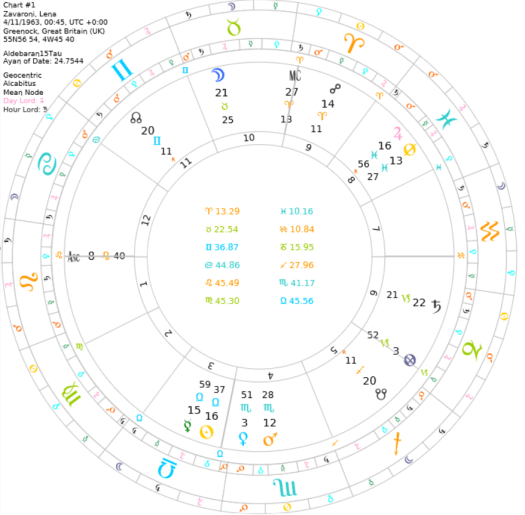
With the Sun in the third place, the chart is nocturnal, and we must turn to the Moon and then the three triplicity lords of the Moon. We find her in Taurus. The order is thus the Moon, Venus, and Mars, respectively.

Lena Zavaroni in 1974

On first glance, we see the Moon is quite strong. She is in the house of her exaltation, of the sect and in her triplicity, and occupies a pivot. Such conditions are favourable in keeping the Moon comfortable in her significations, as well as some prominence in the public eye [3]. However, she suffers a tight aspect with Saturn. As this is a night-chart, Saturn is the out-of-sect malefic and is in a dark place (the sixth house of illness). The Moon’s twelfth part also falls with Saturn, too. Valens emphasises the importance of the domicile lord. Sadly, that is Venus, who is not in great shape. Traversing Scorpio, her singular strength is angularity. Otherwise, she is the house and bound of Mars with whom she is in wide conjunction. The third ruler is Mars, also in Scorpio. Mars is in a loose aspect with the diurnal Jupiter, who is retrograde and in a dark house (house of death).

Having considered the triplicity lords of the sect-light, we now have a broad understanding of the flow or ease of success and prosperity throughout life. Here, we see a strong start, with some prominence, too, before a sudden downward turn with things evening out towards the end. It is not in itself a quantitive indicator. Strong sect-lights cannot overrule a weak financial promise, but they can soften the blow.

For determining the individual time-period of each lord, Vettius Valens [5] considers the ascension times [6], or the ‘cyclical return of the chronocractor (time-lord).’ Chris Brennan identifies the latter as the minor years of the planets [7] – an important, and underused, timing tool. For me, the latter has proven the more reliable.

Lena was born in November, 1963. The minor years of the Moon, Venus, and Mars are 25, 8, and 15, respectively. Thus, the Moon would rule until 1988 ; Venus until 1996 ; and Mars until 2011. The ascensional times of Taurus and Scorpio are 22.54 and 41.17, respectively. We convert these into years, saying Venus rules for 22-years, and Venus and Mars for 41 each. These time-frames are broad indicators and refined further through additional predictive techniques, such as releasing of the hyleg, profections and solar revolutions[8].

Zavaroni rose to fame at the age of ten, winning a talent show and becoming the youngest person to have a Top 10 UK album and hosted her own television shows in the late 1970s and early 80s. Sadly, at the age of 13, Zavaroni developed anorexia nervosa and never recovered. It is pertinent to note, that in addition to its aspect with Saturn (who brings illness), the Moon rules the twelfth sign.

Lena Zavaroni in later life

In 1989, she married but divorced eighteen months later. That year, her mother died of an overdose. Again, we can note that Venus and Mars are both in the house of family, but also rule the tenth (mother) and fourth (father) places, respectively. Also, Venus is inherently reliant on Mars and Zavaroni moved to live near her father, who was her primary support.

Zavaroni underwent a psychosurgical procedure in 1999. Despite initial signs of success, she developed pneumonia and died aged just 35. She had been living on benefits. Sadly, she is primarily remembered for her tragic career and death.

As you can see, one can tell much from such a simple technique. Try it. Since studying it frequently, after reading Abū’Ali al-Khayyāt [9], I’ve been consistently impressed.

§

References:
[1] Dykes, B. (2017). Carmen Astrologicum. Minneapolis, Minn.,: The Cazimi Press, pp. 61 – 62, and 98 – 106.
[2] Chart cast when using Sidereal system.
[3] Of course, not everyone who has their sect-light in the tenth place can expect celebrity or world fame. However, such placement is conducive to prominence within a chosen field, or social circle.
[4]The dark places are the second, sixth, eighth and twelfth. These four are all in aversion to the ascendant. As the joys of Mars and Saturn, the sixth and twelfth are considered the most malefic.
[5] Valens, V. (2010). Anthologies (Riley, Translation), PDF: http://www.csus.edu/indiv/r/rileymt/Vettius%20Valens%20entire.pdf
[6]Each sign takes a different length of time to rise over the horizon depending on location. The ascension times refers to the number of degrees that pass the midheaven in the time it takes for a sign to rise in the east.
[7] Brennan, C. (2017). Hellenistic Astrology: The Study of Fate and Fortune. 1st ed. Denver, Colorado: Amor Fati Publications, p.495 – 510.
[8]For the astrologer, the prediction is primarily concerned with timing events found in the birth chart. Nothing can ever be forecast if it is not promised in the nativity. Contrary to contemporary practice, transits themselves were never considered to either influence or cause events, and not all planets are active either at the same time or throughout life – hence the importance of the time-lords (chronocrators).
[9] Dykes, B. (2009). Persian Nativities Volume I: Māsha’allāh & Abū’Ali al-Khayyāt. 1st ed. Minneapolis, MN: Cazimi Press, pp. 240 – 256

Article was written in 2019
Timing in Lenormand

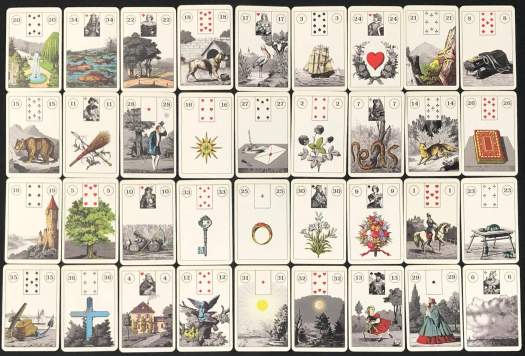
A subject on which one is consulted with some regularity is timing. What is the most effective method? Is there a traditional consensus? Is the pace or suit method the more dependable?

Regrettably, one must be candid: whether we are speaking of the Lenormand Oracle, the Belline Oracle, the Tarot, or any other system of cartomancy, there is no single “best” method. None possesses an inherent or naturally embedded timing system in the way that palmistry does. If I am entirely honest, palmistry remains the most reliable divinatory art for timing.

So, how does a reader who works with the Lenormand Oracle time a reading?

My clientele seldom sought guidance concerning matters two or three years ahead. Their interest was, almost invariably, the next two to six months — a year at most. Over time, I found that the Petit Lenormand suited this time frame remarkably well, possessing an inherent swiftness. For longer‑term enquiries, I relied upon palmistry or, where an accurate birth time was available, astrology, particularly time lords.

Proportion

In my experience, the Grand Tableau — the full thirty‑six cards — covers approximately six to twelve weeks. The cards may touch upon matters beyond this period, but the bulk of the reading tends to unfold within four to eight weeks.

Consequently, if thirty‑six cards encompass six to twelve weeks, eighteen cards will cover roughly three to six weeks. A line or square of nine cards will therefore play out over a week or two.

The Question

If we keep this principle firmly in mind and in practice, the cards respond with far greater reliability. The simplest way to achieve this is through focus and clarity of question. When shuffling, direct your attention to the next month or two. With regular handling of the cards, this becomes second nature.

Timing the Reading

Once this foundation is established, one may begin to incorporate techniques such as pace. When using fewer than eighteen cards — ideally nine or fewer — note whether the spread is dominated by fast or slow cards. Pacing is most effective when cards fall in clusters. For example, if the first row of five contains three or four slow cards, the matters described may unfold over the following week or two. If the second row consists entirely of fast cards, one knows that events begin slowly but conclude swiftly.

Certain combinations have traditional timing associations. For instance, Roads–Cloverleaf indicates a period within six weeks, while Fox–Stars suggests the wrong time — that whatever is under discussion is ill‑timed. In a timing reading, Fox–Stars is very much a sign that the cards are saying you are not meant to know at present. These associations may be employed with confidence.

Seasonal and Daily Associations

Some further timing correspondences:

Bouquet — spring
Sun — summer
Scythe — autumn
Lilies — winter

Coffin–Sun — sunrise
Sun — morning
Park — luncheon
Garden–Moon — afternoon tea
Sun–Coffin — sunset
Moon–Stars — after dusk
Moon — evening
Stars — night

Over time, I have also found the following associations effective in my own readings, though they are not traditional:

Monday — Birch Rod
Tuesday — Cavalier
Wednesday — Lilies
Thursday — Stars
Friday — Cross
Saturday — Heart
Sunday — Sun

With the above in mind, I tend to focus my readings on short time frames and then employ pace to refine the sequence of events. For final confirmation, I usually draw a specific line of five, asking directly when something will occur, and use the cards’ progressed meanings (Mountain = a delay, Moon = 28 days, et cetera) to determine the time frame — exactly as I taught in my earlier courses. This final line almost invariably aligns with the main reading.

§

Cards: Jeu Lenormand © Cartamundi

Carpe Diem: The Cavalier Card

In the moment of our talking, envious time has ebb’d away. Seize the present; trust tomorrow e’en as little as you may.

Carmina, Horace

Cavalier, indicates good news, but a little far away, it can relate to the person’s home or come from foreign countries. This card is a messenger of good fortune when it is not surrounded by cards of a sinister nature.

Original Instructions

Despite being card no. 1, the 9 of Hearts — the Cavalier — is often passed over or regarded as one of the least interesting of the thirty‑six cards in the pack. Does it simply mean *news*? Does it signify your car, motorcycle or bicycle, or would that be the Ship? And if it falls far away, does it refer to someone or somewhere abroad?

The Essence and Function of the Cavalier

The essence of the Cavalier is that of a herald; its function is that of a messenger.

When discussing the Cavalier’s significations, “news” usually tops the list. That is fair: it is a communication card, and the Cavalier brings tidings. But how does it differ from the Letter (or even the Book in some circumstances), which also conveys news? The answer lies in the image — the eikṓn.

The Cavalier in Traditional Decks

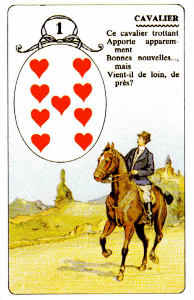
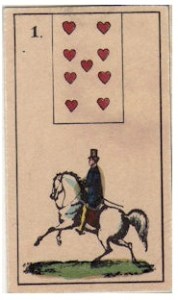
In the Carta Mundi, Dondorf, Wust and Blaue Eule pattern, the traditional picture shows a male figure riding a horse. In more detailed illustrations, he is riding out from a substantial chateau. The Cavalier is therefore “a man abroad” — literally out from home — indicating that he is on the move.

As such, it is often more accurate to say that he foretells the arrival of a visitor bearing news.

Even when combined with the Letter, one is far likelier to receive couriered parcels or documents requiring a signature, or items handed directly to you rather than pushed through the letterbox. The Cavalier adds a personal touch.

The card the Cavalier “rides away” from will often shed light on his tidings. For example, a carte maîtresse (or topic card) such as the Fishes or the Coffin would direct attention to finances or illness. If it is a person card, such as the Hound or the Bouquet (Queen of Spades), it is not uncommon for that person to be the visitor.

In spreads divided into past, present and future, the Cavalier’s gaze is significant. If he looks towards a past card, he may bring old news or an update on an ongoing matter. If he looks towards the future, the reverse is true.

The Cavalier is a fast card that adds celerity to the cards around him. Situations progress quickly. When he appears with cards forecasting opportunities or favourable circumstances, he stresses the need to act promptly. These chances will not linger.

Timing‑wise, the Cavalier is very short‑term. He usually arrives within a week at most — often the same day or the next.

The Cavalier also signifies horses and all members of the *Equidae* family. Paired with the Hound, it may indicate someone who keeps horses, donkeys and similar animals.

Coda

The Cavalier is the card of face‑to‑face communication, in contrast to the Letter. The reader must examine the surrounding cards to determine the nature of his tidings and whether they are welcome. He brings speed to the reading, both in terms of arrival and action — carpe diem.

Person and Description

Like the Birds and the Hound, the Cavalier is one of five cards read as people but not associated with a Court Card.

If read as a person, the Cavalier traditionally signifies a man — but only if the rider depicted is male. This is because the person‑function derives purely from the design; the Cavalier is not a court card but the 9♡. Consequently, in decks such as the Gilded Reverie Lenormand the Cavalier must be read as a woman if the rider shown is female. This is no different from the Birds card, which can signify a couple or “two of something” if two birds are shown. More birds, more people.

When read as a person, the attending cards reveal the individual’s character and appearance. The Cavalier sheds its own associations.

Physical Description and Temperament

The traditional eikṓn shows the Cavalier well‑dressed and not in livery or uniform. Artists may depict him in breeches, a justaucorps or a top hat, depending on the era — none of which were peasant attire. The Cavalier is therefore a dapper, well‑presented figure.

Physically, the card suggests someone fashionable, well‑kempt, up‑and‑coming and athletic. Equestrianism is a sport, and riding develops lean muscle. It is common for the Cavalier‑type person to enjoy sport and spend time exercising or in the gym.

If the card falls far away, it can sometimes indicate someone born in another country or of a different ethnicity to the querent. Caution is needed — it may refer to several generations back or simply an unusual name.

In terms of character, the Cavalier describes someone energetic, confident and always on the go — a person who knows what they want and is actively pursuing it. They are usually sociable, good communicators, and, in my experience, loyal and good friends.

Special Features

Traditionally, cartomancers paid attention to the Cavalier’s proximity to the significator.

If he falls far away, he may indeed signify news or a visitor from abroad. More often, however, the news he carries relates only indirectly to the querent — for example, someone calling at the querent’s home to see their spouse with gossip, or news concerning an extended family member or friend. Other times, the querent will hear some news when out-and-about or abroad (in nineteenth century parlance).

The closer the Cavalier falls, the more directly his news concerns the querent.

Over the years, the Cavalier has consistently signified a future love interest (in my readings and those of my clients). This often occurs when the Lord represents a current or former partner. Look for cards such as the Heart or the Ring near the Cavalier. Occasionally, he may appear as the Lady’s chevalier servente, especially with supporting cards such as the Serpent or the Lilies.

I have also found the Cavalier to be the primary significator for male same‑sex or same‑gender relationships. This emerged organically through working with the cards for myself and LGBTQ+ clients. Consequently, I have never found it necessary to replace the Lady with an extra Lord when reading for gay, bisexual or pansexual men. (For bisexual, omnisexual or pansexual clients, you will always need potential male, female and non‑binary cards.)

Transport and Movement

Another special feature of the Cavalier is his horse. When these cards were designed, horses were the primary means of personal transport. Today, the Cavalier’s horse corresponds to our cars, motorcycles and bicycles.

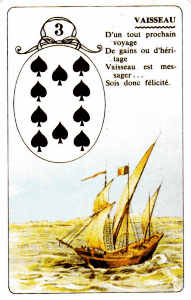
Some readers prefer the Ship for vehicles, but the traditional Ship eikṓn shows a large galleon, carrack or sea vessel — not a mode of everyday personal transport. I read the Ship as trains, buses, aeroplanes and ships. The Cavalier is the car.

Exercise and Sport

The Cavalier also signifies exercise and sport. Equestrianism requires skill and physical effort, whether eventing, endurance, carriage driving or dressage. The surrounding cards describe the specific exercise: 

  • Bear = weightlifting/bodybuilding 
  • Scythe = fencing or javelin 
  • Lilies = yoga 
  • Ship = rowing or sailing 
  • Birch Rod = boxing, combat sport, but also polo, cricket etc.

Some readers prefer the Birch Rod for exercise, but that has never made sense to me. Corporal punishment is not a sport.

Well‑Being

The Cavalier can be a welcome sign, indicating a return to form after illness. More commonly, he stresses the importance of diet, exercise and staying active. If accompanied by warning cards (such as the Scythe), he may indicate a sports injury or an accident involving a car or bicycle.

Anatomically, the Cavalier is associated with ligaments, as well as the legs, knees and ankles.

The Cavalier in Action

In 2022, a woman consulted me to ask whether she would be reconciled with an ex‑partner. Unfortunately, the cards indicated that this would not occur. However, the Grand Tableau revealed something far more promising: a new man on the horizon — someone entirely unknown to her.

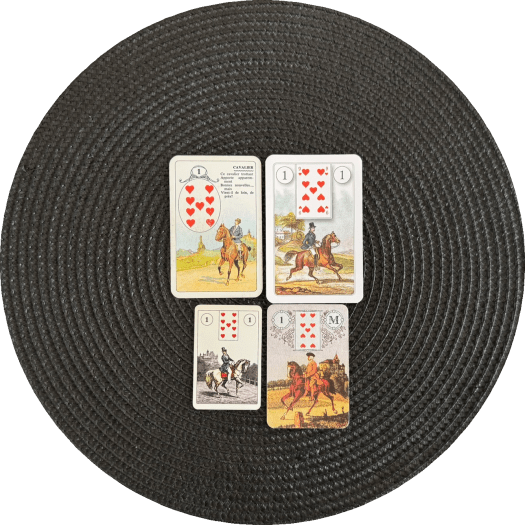
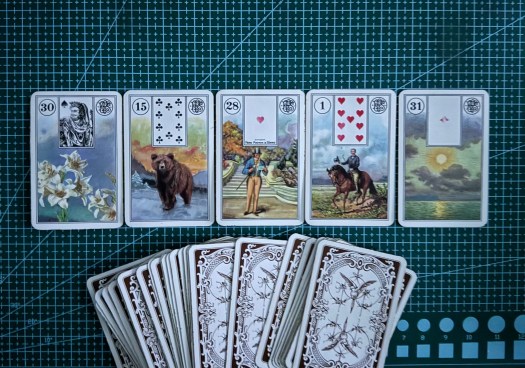
I conducted a follow‑up reading, employing the Lost Man spread to gather further detail. The cards fell as follows:

To begin with, we can see that he (Lord) is likely dark‑haired (Bear). Combined with the Cavalier card, we know he is physically fit; paired with the Bear, we are looking at someone deeply committed to resistance training and nutrition, intent on achieving maximum muscular development. The combination of the Cavalier and the Sun suggests a successful athlete — someone who almost certainly competes.

He will be well dressed and attentive to his appearance. The Bear, more often than not, points to facial hair. The pairing of the Bear with the Cavalier frequently indicates a slightly retro or vintage aesthetic — the sort of look one might associate with a modern hipster. This is reinforced by the Lilies, which lend a timeless elegance and a certain refinement.

In temperament, he is self‑reliant and assertive (Bear), with a strong drive for achievement (Cavalier and Sun). He is principled (Lilies) and emotionally stoic (Lilies and Bear).

The client subsequently met a personal trainer who looked as though he had stepped straight off the set of Peaky Blinders. He competed in several body building contests.

§

References:

Boroveshengra, A., 2013. Cartomantes’ Cabinet: The Petit Lenormand Course.
Boroveshengra, A., 2015. Lenormand Thirty Six cards. 2nd ed. Create Space.
Delclos, M., 2013. Le Livre du Petit Lenormand. 1st ed. Escalquens: Éd. Trajectoire.
George, R., 2014. Essential Lenormand. 1st ed. Llewellyn Publications, U.S.
Marco, M. and Goffinet, J., 1989. Petit Lenormand. Bruxelles: Servranx.
Silvestre, C., 2003. Le Petit Lenormand. [Montpellier]: Gange éd