Tarot de Marseille: The Picturebook of Fate: The Sixes Part 1

This article continues my series examining the trumps of the Tarot de Marseille, adapted from my unpublished manuscript, Tarot de Marseille: The Picturebook of Fate. As throughout this series, the emphasis is placed upon the traditional eikōn of the card, its historical context, and the practical significations I have found useful through divinatory practice. The interpretations presented here reflect my own experience of working with the Tarot de Marseille and should be understood as a working method rather than a definitive authority.

The Sixes: The Lover and the Devil

Trump VI, L’Amoureux, or the Lover, is one of the strangest and most misunderstood cards in the Tarot. Some see it as a card of love and romance. Others interpret it as a card of choice and decision-making. Still others focus upon complex relationships and outside interference. Yet the Marseille image suggests something rather different. Rather than depicting love fulfilled or a decision made, it portrays a man caught between competing influences and unable to move forward.

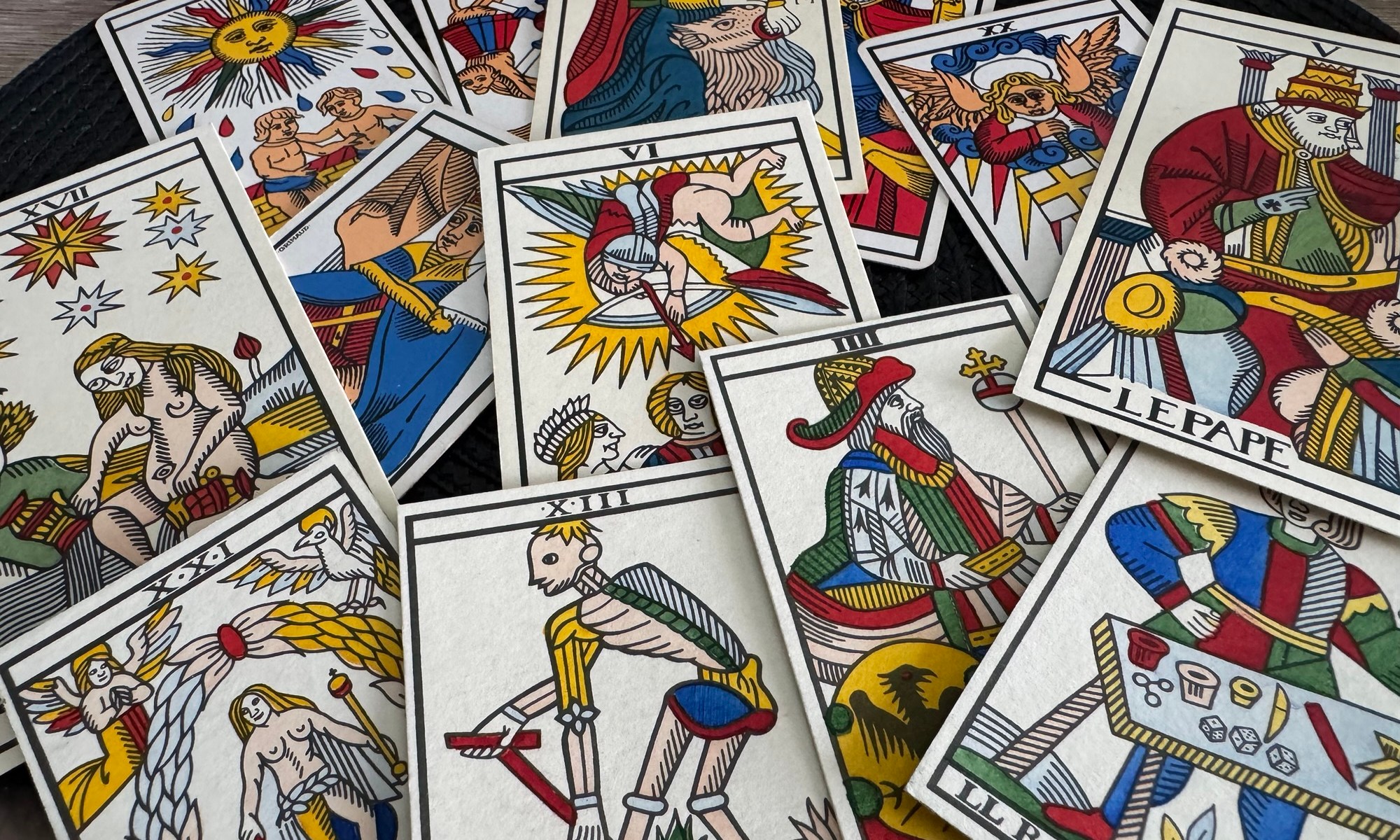
The traditional eikōn of the Lover is unusual and immediately striking. A young man stands between two women, each touching or holding him. Above this curious trio hovers a winged Cupid set within a radiant sun, bow drawn and arrow ready to strike. It is a scene charged with tension, yet remarkably little action occurs. No choice is made. No union is achieved. Instead, the central figure appears caught between opposing forces.
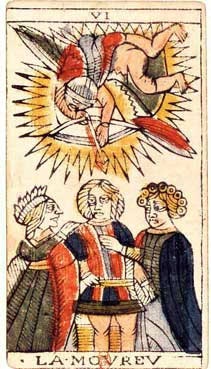
The essence of the Lover is vacillation; its function is to paralyse. For many years this card was a private nemesis of mine. I attempted to read it as a card of love and, later, as a card of choice. Neither interpretation fully satisfied me. Were the card truly about choice, one might expect to see a figure weighing options and reaching a conclusion. Yet the young man does nothing of the sort. He appears trapped by indecision. His companions exert influence from either side, whilst Cupid’s arrow introduces yet another force beyond his control.

The card therefore depicts what happens when reason is subjugated to desire. Conflicting wants, loyalties, attractions, and obligations pull us in opposing directions until we become incapable of meaningful action. We want incompatible things simultaneously. We fear making the wrong choice. Self-preservation urges caution whilst desire urges action. The result is hesitation, confusion, and ultimately paralysis. The Lover is the card of the divided heart. Hosea’s observation1 remains as relevant now as when it was first written: conflicting loyalties render us unstable and uncertain. We are drawn simultaneously towards incompatible desires and find ourselves unable to pursue any of them wholeheartedly. Thus the card signifies not the making of a choice, but the paralysis that arises when we cannot bring ourselves to make one.

For this reason, the Lover often appears when the querent is being pulled in different directions and cannot determine the best course of action. A pervasive feeling of discomfort accompanies the card. One finds oneself at a crossroads, yet no path appears satisfactory. Progress stalls because the underlying problem is not a lack of options but a lack of clarity regarding what is truly wanted. Until this confusion is resolved, the querent remains unable to realise their full potential.

Quite often, the Lover signifies the influence of a third party: someone whose presence complicates matters or exerts undue influence over the situation. In relationship readings this can indeed manifest as the classic love triangle, though not necessarily through infidelity. More often it reflects divided loyalties, emotional uncertainty, or the emergence of feelings for another person whilst an existing relationship is neglected.

The principle extends beyond romance. In business and employment matters, the Lover frequently reveals rivalry, competition, and competing interests. The querent may find themselves struggling to establish a clear position or differentiate themselves from others. Unless they are willing to commit to a particular course of action, competitors may seize the opportunities that indecision leaves behind. The Lover reminds us that vacillation has a cost, for whilst we hesitate, the world continues to move forward.

General: Being pulled in different directions by competing interests, loyalties, or desires. The card signifies uncertainty, hesitation, and difficulty committing to a particular course of action. Third parties often complicate matters, introducing confusion or conflicting advice. Conflicts of interest, divided loyalties, and an inability to decide are common manifestations of the Lover.

Love: In established relationships, the Lover frequently heralds a period of doubt and uncertainty regarding the future. Communication is often poor, with one or both partners reluctant to express their true feelings or concerns. The card may indicate the influence of a third party, whether through interference, divided affections, or the emergence of romantic feelings elsewhere. For those who are single, the Lover often brings opportunities which ultimately fail to develop into lasting relationships. Initial attraction may be strong, but long-term goals and expectations are seldom aligned. The card also warns that not everyone is being entirely candid.

Career: The Lover is associated with professions concerned with relationships and human interaction, including relationship counselling, sexual health services, matchmaking, and similar fields. It may also signify temporary, part-time, or flexible employment. More commonly, however, the card indicates uncertainty regarding career direction. The querent may be struggling to identify the right path forward and would benefit from impartial advice. Within existing employment, the card can reveal rivalry, office politics, conflicting expectations, and unhealthy competition between colleagues.

Finance: Financial difficulties frequently arise through indecision, poor planning, or conflicting priorities. Income and expenditure may have fallen out of balance, requiring difficult choices and a reassessment of financial goals. Dissatisfaction and emotional frustration can encourage impulsive spending, often to temporary effect. The card advises seeking trusted advice and committing to a clear financial strategy.

Health: The Lover is associated with sexual health and may indicate sexually transmitted infections and diseases. More generally, the card often points towards disorders in which desire, impulse, or compulsion override reason and good judgement. This includes conditions such as intermittent explosive disorder, compulsive eating, kleptomania, compulsive spending, and related difficulties with impulse control. Psychological distress arising from internal conflict, indecision, or competing desires may also be present.

Essence: Vacillation.
Function: Paralyse.
Polarity: Neutral.
Astrological Association: Venus.
Timing: Friday. Within seven months.

§

Tarot Cards: Jean Dodal Tarot via Wikipedia Commons. Public Domain.

Featured Image: Ancient Tarot Major Arcana © BP Grimaud/John Waddington Ltd, Leeds & London, Les Tarot de Marseille Jean Noblet, 1650 © Editions «letarot.com» (2001 [hand stencilled trumps]). Les Tarot de Marseille Jean Dodal, 1701 et 1715 © Editions «letarot.com» (2002 [hand stencilled trumps])

  1. Their heart is a divided heart; very well, they must pay for it. Hosea 10:2, Jerusalem Translation. ↩︎
Tarot de Marseille: The Picturebook of Fate: The Fives Part 3

This article continues my series examining the trumps of the Tarot de Marseille, adapted from my unpublished manuscript, Tarot de Marseille: The Picturebook of Fate. As throughout this series, the emphasis is placed upon the traditional eikōn of the card, its historical context, and the practical significations I have found useful through divinatory practice. The interpretations presented here reflect my own experience of working with the Tarot de Marseille and should be understood as a working method rather than a definitive authority.

The Fives: The Pope and Temperance

Let us now turn to another example and, in doing so, introduce a new spread.

The tirage en croix, or cross spread, is perhaps the most popular layout in continental cartomancy. One of the principal reasons for its enduring popularity is its capacity to provide a clear and decisive response to a question—indeed, where appropriate, it may even yield a simple affirmative or negative answer. Several variations exist, and the one presented here is simply the version I utilise most often.

The twenty-one trumps and the Madman or Fool are shuffled and cut, after which four cards are dealt in the form of a cross.

03
010502
04

  • Card 1 (Left): The querent and their manner of approaching the situation.
  • Card 2 (Right): The situation itself, including external influences, whether favourable or adverse.
  • Card 3 (Above): Advice and guidance.
  • Card 4 (Below): The outcome.
  • Card 5 (Centre): The synthesis.

Unlike the first four cards, the fifth is not drawn but calculated. One adds together the numerical values of the four cards already laid, using the numbering of the Major Arcana, and reduces the result to a number not exceeding twenty-two.

For example, should one draw the Madman (0), Justice (8), the Lover (6), and the Sun (19), the calculation is as follows:

0 + 8 + 6 + 19 = 33

As this exceeds twenty-two, one reduces it further:

3 + 3 = 6

The resulting number corresponds to the Lover, which serves as the synthesis.

It should be evident that this synthesis card is not to be read as an additional outcome; that function is already fulfilled by the fourth card. Rather, the synthesis reveals the underlying dynamics of the matter—the deeper currents and governing principles operating behind the question.

A brief note should be made regarding the Madman. When it appears amongst the first four cards, it is assigned the numerical value of zero for the purposes of calculation. However, the matter is treated somewhat differently in the case of the synthesis. Should the final total reduce to twenty-two, the Madman itself becomes the synthesis card.

Michelle was a gregarious, witty, and gifted amateur artist and jewellery maker who was difficult to overlook. Sadly, she lost her job during lockdown and struggled to find similar employment thereafter. When she secured an interview for a receptionist role, she wanted to know whether she would be successful.

The cards were:

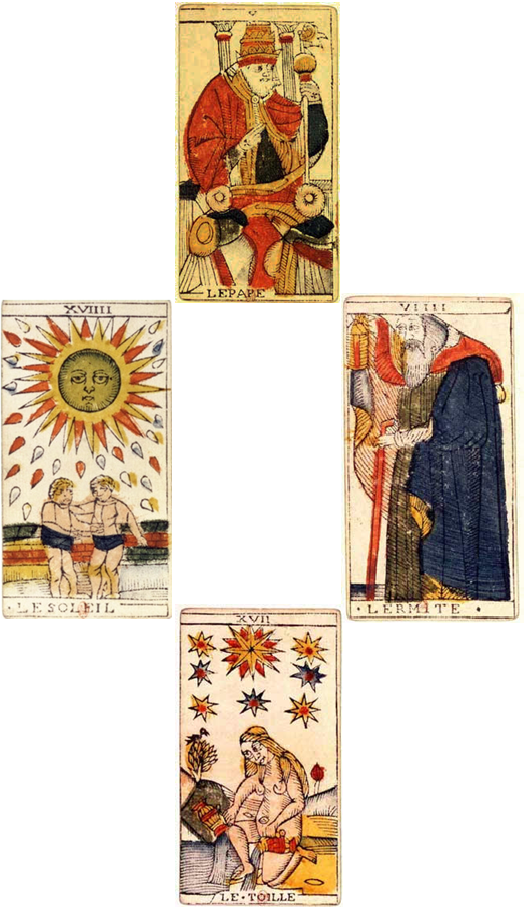
  • Position 1: The Sun
  • Position 2: The Hermit
  • Position 3: The Pope
  • Position 4: The Star
  • Position 5 (Synthesis): The Pope

The reading begins with the Sun in the position of the querent. This card described Michelle remarkably well. She was warm, engaging, enthusiastic, and impossible to ignore. The Sun is open, honest, and direct. It illuminates everything around it and has little interest in concealment or reserve. Michelle’s natural inclination was therefore to approach the interview with confidence, sincerity, and considerable personal charm.

The situation itself was represented by the Hermit. Here we immediately encounter a contrast. Whereas the Sun shines brightly, the Hermit carries only a small lantern. The position Michelle sought required discretion, patience, and good judgement rather than exuberance and visibility.

A receptionist often acts as the public face of an organisation whilst simultaneously serving as a gatekeeper. Sensitive information may pass through their hands and they are required to deal with people tactfully and professionally. Consequently, the role demanded qualities that did not come as naturally to Michelle as the Sun’s warmth and openness.

The Hermit did not suggest that she suppress her personality altogether. Rather, it advised moderation. Michelle would need to turn down the brightness of the Sun somewhat and demonstrate a more thoughtful, careful, and measured side of herself.

In the position of advice appeared the Pope. This card proved crucial to the interpretation, and its significance became even more apparent when it later reappeared as the synthesis.

The Pope advised Michelle to combine confidence with empathy, strength of character with perceptiveness, and communication with understanding. Reception work is fundamentally a mediating role. One must listen carefully, assess situations quickly, and respond appropriately to a wide variety of people. The Pope therefore encouraged Michelle to demonstrate not merely competence, but wisdom in the application of that competence.

The card also suggested that she would benefit from learning as much as possible about the organisation beforehand. Speaking with someone familiar with the establishment, researching its culture, or gaining a clearer understanding of what the employer valued would allow her to present herself more effectively and show how her skills could benefit the organisation.

The outcome was represented by the Star, a highly encouraging card. The Star signifies renewal, hope, and guidance, all of which pointed towards a favourable result.

More importantly, the card highlighted adaptability. Just as the maiden directs water from her two pitchers, Michelle possessed the ability to apply her talents in different ways according to the needs of the situation. The Star suggested that she had the natural qualities required for the role and, crucially, the ability to adapt those qualities appropriately.

The synthesis was calculated as the Pope, reinforcing the importance of that card. Whenever a card appears both within the spread and as the synthesis, it deserves particular attention. Such repetition indicates that the principles symbolised by the card form the very heart of the matter.

The Pope revealed that the interview was not fundamentally about experience or qualifications. It was about demonstrating wisdom, tact, empathy, intuition, and sound judgement. Michelle already possessed the confidence and charisma represented by the Sun. Her challenge was to temper those qualities with the maturity, discernment, and understanding represented by the Pope.

True strength, the Pope reminds us, is not merely confidence. It is confidence guided by wisdom. Likewise, intuition is not guesswork, but perception informed by experience and understanding. The Pope therefore represented both the advice and the solution.

My conclusion was that Michelle had every chance of obtaining the position. Success depended less upon dazzling the interview panel and more upon convincing them that she possessed the judgement and interpersonal skills required for the role. If she could combine the warmth of the Sun with the wisdom of the Pope, the Star strongly suggested that the opportunity would be hers.

And so, it was! Michelle was successful and is still in post four years on.

This example illustrates another important principle of the tirage en croix. Repeated cards and recurring themes frequently reveal the true heart of a reading. Here, the Pope appeared twice, emphasising that genuine strength lay not in confidence alone, but in the wisdom to know how, when, and where that confidence should be applied.

§

Tarot Cards: Jean Dodal Tarot via Wikipedia Commons. Public Domain.

Featured Image: Ancient Tarot Major Arcana © BP Grimaud/John Waddington Ltd, Leeds & London, Les Tarot de Marseille Jean Noblet, 1650 © Editions «letarot.com» (2001 [hand stencilled trumps]). Les Tarot de Marseille Jean Dodal, 1701 et 1715 © Editions «letarot.com» (2002 [hand stencilled trumps])

Tarot de Marseille: The Picturebook of Fate: The Fives Part 2

This article continues my series examining the trumps of the Tarot de Marseille, adapted from my unpublished manuscript, Tarot de Marseille: The Picturebook of Fate. As throughout this series, the emphasis is placed upon the traditional eikōn of the card, its historical context, and the practical significations I have found useful through divinatory practice. The interpretations presented here reflect my own experience of working with the Tarot de Marseille and should be understood as a working method rather than a definitive authority.

The Fives: The Pope and Temperance

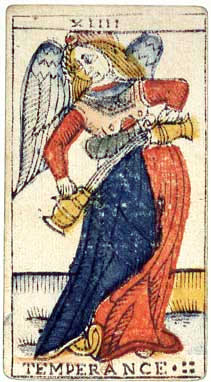
Trump XIV, Tempérance, is a card whose meaning is often taken for granted. Is it simply a card of moderation? Does it advocate abstinence and self-denial? Why have some occult authors referred to it as the Angel of Time? Whilst these interpretations touch upon aspects of the card, they often overlook its central principle. Temperance is concerned not with abstaining from life, but with measuring it correctly.

The traditional eikōn of Temperance is remarkably consistent. We see a winged celestial being pouring liquid from one vessel into another. The action appears simple, yet it requires care, precision, and judgement. Too much or too little would spoil the operation. The angel therefore embodies the principle of measured action, continually adjusting and correcting to achieve the desired result.

The essence of Temperance is measurement; its function is to measure. This distinction is important. Contrary to popular belief, Temperance has little to do with abstinence and cannot be reduced to the simple maxim that everything is good in moderation. True temperance is the exercise of reason and faith to regulate desire. It is the ability to determine not merely whether something should be done, but how much, how often, and under what circumstances.

Human beings rarely achieve such balance naturally. In our fallen state, our appetites, passions, and desires frequently exceed what is good for us, whilst fear, indifference, or weakness may lead us to do too little. Earlier generations understood this imbalance through the theory of the humours, whereby an excess of choler, phlegm, melancholy, or sanguinity could distort not only bodily health but temperament itself. A person dominated by choler becomes rash, aggressive, and impatient, and feverish; one overwhelmed by phlegm passive, inert, and unwilling to act and easily becomes overweight. In either case, reason ceases to govern properly and the individual falls out of balance.

Temperance therefore seeks neither suppression nor indulgence, but right order. It is the virtue by which competing impulses are brought into proper proportion and directed towards the good. The challenge is that the correct measure is never universal. What is appropriate for one person may be excessive for another. What is suitable today may be unsuitable tomorrow. Temperance is therefore not static but dynamic. The angel does not simply divide the contents of the vessels equally; she transfers precisely the amount required.

When Temperance appears in a reading, it frequently indicates that a situation must be reassessed before progress can be made. The querent may need to balance enthusiasm with caution, emotion with reason, or ambition with practicality. Success will not be achieved through force, impulse, or wishful thinking, but through the correct application of effort, resources, and restraint. Vitality and passion must be married to intelligence and good judgement. The desired outcome is attained through the proper balance of skill, timing, and perseverance.

Some esoteric traditions have referred to this trump as the Angel of Time1, a title which at first appears curious. For many years I struggled to see its relevance to the Marseille tradition. Yet time itself is a form of measurement. Days, months, seasons, and years are all ordered according to measure. In this sense, the association is entirely appropriate. Temperance often poses a simple but important question: is this the right time? The answer may not always accord with our wishes. Sometimes the card advises action; at others, patience. In either case, its lesson remains the same: the desired outcome is achieved not by forcing events, but by finding the correct measure and acting accordingly.

General: The careful and correct application of resources, effort, and judgement. Progress comes through adaptability and recognising what circumstances require. Temperance signifies balance, co-operation, and the ability to adjust to changing conditions without losing sight of the desired outcome. The card also has a strong association with timing, particularly knowing when to act and when to wait.

Love: Relationships characterised by mutual respect, patience, and a willingness to accommodate differences. Each partner recognises the strengths and weaknesses of the other and works towards shared goals. Temperance is an excellent card for reconciliation, compromise, and restoring harmony following disagreements. For those seeking love, the card frequently points towards friendship developing gradually into something deeper. The emphasis is upon steady growth rather than passionate intensity.

Career: Temperance is associated with the hospitality industry, including food, drink, accommodation, tourism, and recreation. It may also signify professions concerned with balance, regulation, and quality control, such as food science, environmental health, and similar specialist fields. In career matters, the card generally indicates stability and security, though advancement may be gradual. Temperance advises patience, as lasting success is achieved through steady progress rather than sudden opportunity.

Finance: Temperance signifies a healthy balance between income and expenditure. Whilst significant financial gains are seldom indicated, the card provides reassurance that resources are being managed appropriately. Major purchases should be approached carefully and viewed as long-term commitments. The key question is not whether something can be afforded, but whether it is necessary, appropriate, and proportionate.

Health: Temperance is generally a favourable indicator of both physical and mental wellbeing. The card emphasises balance, moderation, and sensible lifestyle choices, particularly with regard to diet, exercise, rest, and stress management. It advocates neither deprivation nor excess. Anatomically, Temperance is associated with the circulatory system, legs and ankles and the body’s capacity to maintain equilibrium.

Essence: Measurement.
Function: Measure.
Polarity: Positive.
Astrological Association: Aquarius.
Timing: February.

  1. See work of Levi and Lind ↩︎