Tarot de Marseille: The Picturebook of Fate: The Fives Part 2

This article continues my series examining the trumps of the Tarot de Marseille, adapted from my unpublished manuscript, Tarot de Marseille: The Picturebook of Fate. As throughout this series, the emphasis is placed upon the traditional eikōn of the card, its historical context, and the practical significations I have found useful through divinatory practice. The interpretations presented here reflect my own experience of working with the Tarot de Marseille and should be understood as a working method rather than a definitive authority.

The Fives: The Pope and Temperance

Trump XIV, Tempérance, is a card whose meaning is often taken for granted. Is it simply a card of moderation? Does it advocate abstinence and self-denial? Why have some occult authors referred to it as the Angel of Time? Whilst these interpretations touch upon aspects of the card, they often overlook its central principle. Temperance is concerned not with abstaining from life, but with measuring it correctly.

The traditional eikōn of Temperance is remarkably consistent. We see a winged celestial being pouring liquid from one vessel into another. The action appears simple, yet it requires care, precision, and judgement. Too much or too little would spoil the operation. The angel therefore embodies the principle of measured action, continually adjusting and correcting to achieve the desired result.
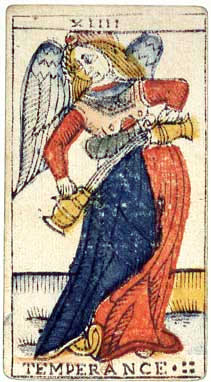
The essence of Temperance is measurement; its function is to measure. This distinction is important. Contrary to popular belief, Temperance has little to do with abstinence and cannot be reduced to the simple maxim that everything is good in moderation. True temperance is the exercise of reason and faith to regulate desire. It is the ability to determine not merely whether something should be done, but how much, how often, and under what circumstances.

Human beings rarely achieve such balance naturally. In our fallen state, our appetites, passions, and desires frequently exceed what is good for us, whilst fear, indifference, or weakness may lead us to do too little. Earlier generations understood this imbalance through the theory of the humours, whereby an excess of choler, phlegm, melancholy, or sanguinity could distort not only bodily health but temperament itself. A person dominated by choler becomes rash, aggressive, and impatient, and feverish; one overwhelmed by phlegm passive, inert, and unwilling to act and easily becomes overweight. In either case, reason ceases to govern properly and the individual falls out of balance.

Temperance therefore seeks neither suppression nor indulgence, but right order. It is the virtue by which competing impulses are brought into proper proportion and directed towards the good. The challenge is that the correct measure is never universal. What is appropriate for one person may be excessive for another. What is suitable today may be unsuitable tomorrow. Temperance is therefore not static but dynamic. The angel does not simply divide the contents of the vessels equally; she transfers precisely the amount required.

When Temperance appears in a reading, it frequently indicates that a situation must be reassessed before progress can be made. The querent may need to balance enthusiasm with caution, emotion with reason, or ambition with practicality. Success will not be achieved through force, impulse, or wishful thinking, but through the correct application of effort, resources, and restraint. Vitality and passion must be married to intelligence and good judgement. The desired outcome is attained through the proper balance of skill, timing, and perseverance.

Some esoteric traditions have referred to this trump as the Angel of Time1, a title which at first appears curious. For many years I struggled to see its relevance to the Marseille tradition. Yet time itself is a form of measurement. Days, months, seasons, and years are all ordered according to measure. In this sense, the association is entirely appropriate. Temperance often poses a simple but important question: is this the right time? The answer may not always accord with our wishes. Sometimes the card advises action; at others, patience. In either case, its lesson remains the same: the desired outcome is achieved not by forcing events, but by finding the correct measure and acting accordingly.

General: The careful and correct application of resources, effort, and judgement. Progress comes through adaptability and recognising what circumstances require. Temperance signifies balance, co-operation, and the ability to adjust to changing conditions without losing sight of the desired outcome. The card also has a strong association with timing, particularly knowing when to act and when to wait.

Love: Relationships characterised by mutual respect, patience, and a willingness to accommodate differences. Each partner recognises the strengths and weaknesses of the other and works towards shared goals. Temperance is an excellent card for reconciliation, compromise, and restoring harmony following disagreements. For those seeking love, the card frequently points towards friendship developing gradually into something deeper. The emphasis is upon steady growth rather than passionate intensity.

Career: Temperance is associated with the hospitality industry, including food, drink, accommodation, tourism, and recreation. It may also signify professions concerned with balance, regulation, and quality control, such as food science, environmental health, and similar specialist fields. In career matters, the card generally indicates stability and security, though advancement may be gradual. Temperance advises patience, as lasting success is achieved through steady progress rather than sudden opportunity.

Finance: Temperance signifies a healthy balance between income and expenditure. Whilst significant financial gains are seldom indicated, the card provides reassurance that resources are being managed appropriately. Major purchases should be approached carefully and viewed as long-term commitments. The key question is not whether something can be afforded, but whether it is necessary, appropriate, and proportionate.

Health: Temperance is generally a favourable indicator of both physical and mental wellbeing. The card emphasises balance, moderation, and sensible lifestyle choices, particularly with regard to diet, exercise, rest, and stress management. It advocates neither deprivation nor excess. Anatomically, Temperance is associated with the circulatory system, legs and ankles and the body’s capacity to maintain equilibrium.

Essence: Measurement.
Function: Measure.
Polarity: Positive.
Astrological Association: Aquarius.
Timing: February.

  1. See work of Levi and Lind ↩︎

Tarot de Marseille: The Picturebook of Fate: The Fives Part 1

This article continues my series examining the trumps of the Tarot de Marseille, adapted from my unpublished manuscript, Tarot de Marseille: The Picturebook of Fate. As throughout this series, the emphasis is placed upon the traditional eikōn of the card, its historical context, and the practical significations I have found useful through divinatory practice. The interpretations presented here reflect my own experience of working with the Tarot de Marseille and should be understood as a working method rather than a definitive authority.

The Fives: The Pope and Temperance

Trump V, Le Pape, or the Pope, is a card that is both misunderstood and misrepresented. Is he merely a conservative patriarch determined to preserve the status quo at all costs? Why do some interpret him as a symbol of bureaucracy, institutions, and red tape? Or does he challenge us to look beyond our assumptions and his imposing regalia to see something altogether deeper?

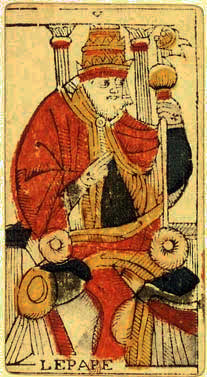
The traditional eikōn of the Pope is both familiar and remarkably consistent. We see an enthroned pontiff vested in a cassock and cappa magna or ferraiolo. One hand is raised in blessing, with two fingers and the thumb extended whilst the ring and little finger remain folded, signifying both the Trinity and the dual nature of Christ. In his other hand he bears a ferula and upon his head rests the Triregnum. At his feet kneel two tonsured figures, receiving his instruction and guidance.

The essence of the Pope is Wisdom; his function is to act as an intermediary. The distinction is important. The Pope does not represent knowledge alone, nor scholarship, intelligence, or learning for their own sake. Wisdom is something rather different. It is one of the Seven Gifts of the Holy Spirit and concerns the ability to perceive reality as it truly is. Wisdom enables us to move beyond our prejudices, passions, and limited perspectives in order to discern Truth and align ourselves with the highest good. The Pope therefore stands not for information, but for understanding.

In modern Europe, where attitudes towards organised religion are often mixed and relativism reigns supreme, the card is frequently recast as a symbol of oppression, conservatism, or institutional authority. Yet this is a superficial reading. The Pope represents neither a particular denomination nor a rigid ideology. Rather, he embodies the principle of Wisdom itself. His role is not to dominate but to guide, not to command but to illuminate. The two acolytes at his feet remind us that wisdom is something transmitted, received, and cultivated through instruction, reflection, and experience.

For this reason, the Pope commonly manifests in readings as a mentor, teacher, elder, counsellor, doctor, or other trusted adviser. Such individuals often appear when guidance is needed and uncertainty prevails. Through a combination of Percipience and inspiration, they help us understand what is truly important and steer us towards the best possible outcome. The Pope reminds us that there is no shame in seeking advice from those who possess greater experience or insight.

The card also challenges us to examine our conscience. Whilst the Empress asks us to communicate and the Emperor to take responsibility, the Pope asks whether we are acting rightly. He encourages reflection upon our motives, our obligations, and the consequences of our choices. In doing so, he becomes an intermediary between the ordinary concerns of daily life and the higher principles by which those concerns ought to be judged.

When the Pope appears, he often signals that guidance, support, or wise counsel is available. More importantly, he asks us to become a source of such guidance ourselves. The card calls us to act with integrity, to place service before selfishness, and to pursue the highest good available within the circumstances before us. In this sense, the Pope is not simply a figure of authority. He is a reminder that true wisdom is expressed through love, understanding, and right action.

General: Wisdom gained through the union of experience, learning, and Percipience. The Pope encourages the querent to look beyond immediate concerns and consider the wider implications of a situation. In times of difficulty, the conscience becomes a reliable guide. The card frequently signifies support, guidance, wise counsel, or the intervention of a trusted intermediary acting on the querent’s behalf.

Love: For established couples, the Pope confirms that the relationship rests upon strong foundations of love, respect, and mutual understanding. Difficulties can be overcome through openness, forgiveness, and a willingness to listen. The card frequently appears in connection with marriage, civil partnerships, and other formal commitments. For those who are single, the Pope tends to promise friendship, guidance, and emotional support rather than the immediate arrival of a new romantic interest.

Career: The Pope is naturally associated with religious vocations of all traditions, including contemporary pagan and spiritual paths. Secular professions include teaching, medicine, counselling, social work, psychotherapy, coaching, divination, and any occupation centred upon guidance, instruction, or the welfare of others. More generally, the card indicates a mentor, adviser, or influential figure whose support can prove invaluable.

Finance: The Pope often indicates a stable and reliable source of income together with the wisdom to manage resources sensibly. Financial difficulties are seldom faced alone under this card. Assistance, advice, or practical support is frequently available through trusted professionals, institutions, family members, or benefactors. The Pope favours prudent decisions and seeking expert guidance before making significant commitments.

Health: More often than not, the Pope signifies a doctor, specialist, therapist, or other trusted healthcare professional. As such, he is generally regarded as a favourable sign in health matters and frequently indicates appropriate treatment, sound advice, and recovery. Anatomically, the card is associated with the muscular system, particularly the thighs, buttocks, and groin.

Essence: Wisdom.
Function: Mediator.
Polarity: Positive.
Astrological Association: Sagittarius.
Timing: December.

§

Tarot Cards: Jean Dodal Tarot via Wikipedia Commons. Public Domain.

Featured Image: Ancient Tarot Major Arcana © BP Grimaud/John Waddington Ltd, Leeds & London, Les Tarot de Marseille Jean Noblet, 1650 © Editions «letarot.com» (2001 [hand stencilled trumps]). Les Tarot de Marseille Jean Dodal, 1701 et 1715 © Editions «letarot.com» (2002 [hand stencilled trumps])

Tarot de Marseille: The Picturebook of Fate: The Fours Part 3

This article continues my series examining the trumps of the Tarot de Marseille, adapted from my unpublished manuscript, Tarot de Marseille: The Picturebook of Fate. As throughout this series, the emphasis is placed upon the traditional eikōn of the card, its historical context, and the practical significations I have found useful through divinatory practice. The interpretations presented here reflect my own experience of working with the Tarot de Marseille and should be understood as a working method rather than a definitive authority.

The Fours: The Emperor and Death

Let us now turn to another example, once again utilising the classic tirage en ligne, or linear draw. As before, the cards are read sequentially, each developing the story told by the previous card. This reading was done in 2010.

Due to an acrimonious divorce, Celeste had not seen her grandchildren for almost eighteen months. Following mediation, her former daughter-in-law agreed to restore contact. Although encouraged by this development, Celeste remained understandably cautious. Earlier attempts at reconciliation had broken down, and she feared the arrangement would prove short-lived.

Her question was simple: “Is this a lasting truce?”

The cards drawn were:

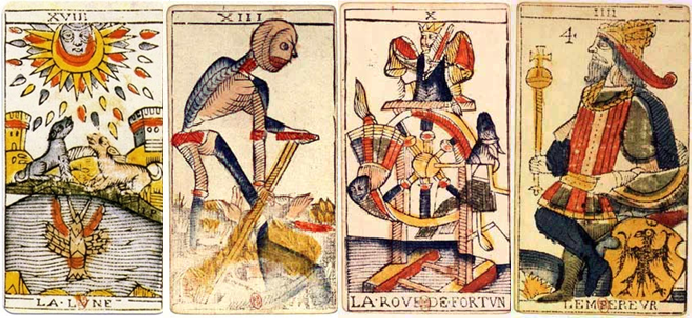
Moon Death Wheel of FortuneEmperor

The reading begins with the Moon, which reveals the source of the problem. The Moon is a card of confusion, anxiety, misunderstanding, and emotional instability. In this instance, the dispute appears to have been sustained not merely by events themselves, but by the fears, assumptions, and misunderstandings surrounding them. Hurt feelings gradually acquired a life of their own, and perceptions became more influential than reality. The result was a situation in which distrust and uncertainty repeatedly undermined attempts at reconciliation.

The appearance of Death immediately afterwards is highly significant. Death acts upon the circumstances created by the Moon. Its scythe cuts away what has outlived its usefulness and brings matters to a definitive conclusion. Here, the card suggests that the confusion, resentment, and destructive patterns represented by the Moon are finally being brought to an end.

The placement of Death before the Wheel of Fortune is particularly striking. The scythe appears almost to cut across the endless turning of the Wheel itself. What is dying is not merely the disagreement, but the pattern of disagreement. Every previous attempt at reconciliation seems to have followed the same course. Contact resumed, relations improved, old grievances resurfaced, and the parties eventually found themselves back where they had started. The Wheel depicts this repeated return to the same point. Death intervenes by terminating the cycle itself.

The Wheel of Fortune therefore describes more than fluctuating circumstances. It reveals the repetitive nature of the conflict: periods of peace followed by renewed hostility, agreements followed by breakdowns, and reconciliation followed by further separation. The card shows a situation trapped within its own momentum.

The reading concludes with the Emperor. This is the card that ultimately answers the question. The Emperor imposes structure, order, and boundaries. Unlike the Sun, he does not suggest emotional warmth or renewed friendship. Instead, he establishes clear expectations and rules that all parties are required to respect.

The Emperor’s appearance is particularly appropriate following formal mediation. Unlike the Pope, who reconciles through wisdom and goodwill, the Emperor reconciles through structure. Expectations are defined, boundaries established, responsibilities clarified, and consequences understood.

In practical terms, the Emperor reflects the mediated agreement itself. Contact is restored not because everybody suddenly likes one another, but because a framework has been established within which each person understands their role and limitations. The relationship becomes governed by structure rather than emotion.

Taken together, the cards tell a coherent story. The confusion and emotional turmoil of the Moon are brought to an end by Death. In doing so, Death cuts through the repetitive cycle represented by the Wheel of Fortune, allowing the situation to move forward rather than endlessly repeating itself. The Emperor then provides a stable framework capable of sustaining the new arrangement.

My conclusion was that the truce appeared considerably more durable than previous attempts. The cards did not suggest warmth, forgiveness, or a complete healing of old wounds. Rather, they suggested that a dysfunctional cycle had been broken and replaced by a workable structure. The parties involved did not need to become friends; they merely needed to respect the framework established by the Emperor.

This example illustrates an important principle of the tirage en ligne: the cards often reveal not merely an answer, but the process by which that answer comes about. Here, each card acts upon the next, transforming confusion into closure, closure into change, and change into stability. The conflict itself is not what ends. What ends is the cycle of conflict.

§

Tarot Cards: Jean Dodal Tarot via Wikipedia Commons. Public Domain.

Featured Image: Ancient Tarot Major Arcana © BP Grimaud/John Waddington Ltd, Leeds & London, Les Tarot de Marseille Jean Noblet, 1650 © Editions «letarot.com» (2001 [hand stencilled trumps]). Les Tarot de Marseille Jean Dodal, 1701 et 1715 © Editions «letarot.com» (2002 [hand stencilled trumps])