Tarot de Marseille: The Picturebook of Fate: The Threes Part 1

This article continues my series examining the trumps of the Tarot de Marseille, adapted from my unpublished manuscript, Tarot de Marseille: The Picturebook of Fate. As throughout this series, the emphasis is placed upon the traditional eikōn of the card, its historical context, and the practical significations I have found useful through divinatory practice. The interpretations presented here reflect my own experience of working with the Tarot de Marseille and should be understood as a working method rather than a definitive authority.

The Threes: The Empress, the Hanged Man and the World

Trump III, L’Impératrice, or the Empress, is one of the most overlooked and misunderstood trumps. Is she the archetypal mother, a representation of some ancient goddess, or a promise of earthly sensuality and domestic bliss? Such interpretations are common, yet they find little support in the card itself. The Marseille Empress is neither pregnant nor idle. She is a ruler occupied with the demands of office, administration, and responsibility.

The essence of the Empress is communication; her function is to interact. Unlike the Popess, who withdraws in order to study and reflect, the Empress engages with the world around her. She is concerned with the exchange of information, the delegation of responsibilities, and the maintenance of relationships through effective communication. Progress depends upon people working together, understanding one another, and acting with a common purpose.

The traditional eikōn depicts a richly dressed woman adorned with the regalia of empire. In one hand she holds an oversized sceptre, the emblem of authority, whilst in the other she bears a shield displaying the imperial eagle. This is not Venusian imagery, nor is there anything to suggest motherhood or pregnancy. Instead, we are presented with a woman whose hands are already full. She is a figure of responsibility, governance, and practical engagement with the affairs of the world.

Significantly, the Empress faces the viewer directly rather than appearing in profile. This is a woman who meets our gaze. She is approachable, communicative, and fully engaged in her duties. She is capable of offering support, assistance, and guidance, but she expects clarity in return. Ambiguity, hesitation, and poor communication find little favour with her. She acts with purpose and efficiency and expects others to do the same.

When the Empress appears in a reading, it often heralds a busy period filled with activity, correspondence, meetings, and opportunities. Plans must be organised carefully and responsibilities distributed appropriately. Communication becomes essential, for there may be little opportunity to retrace one’s steps or correct misunderstandings later. The card frequently accompanies important news, announcements, or information which alters the direction of events.

Historically, an important function of a consort was intercession: the ability to appeal, mediate, and secure assistance on behalf of others. This aspect remains visible within the card. The Empress often indicates that help is available, provided one is willing to ask for it. Doors may be opened through diplomacy, introductions, recommendations, and well-maintained relationships. Success rarely comes through isolation.

This is the heart of the Empress. We live in an age of increasing solipsism, in which attention is directed ever more towards the self and ever less towards others. As our capacity to interact diminishes, misunderstandings multiply and progress becomes more difficult. The Empress stands as a corrective to this tendency. She reminds us that clear communication, co-operation, and meaningful engagement with other people are not merely desirable virtues, but necessities for success.

General: The commencement of a promising period of activity, growth, and new initiatives. The card often heralds important news, correspondence, meetings, or discussions that move matters forward. It signifies cooperation, effective communication, and the ability to bring people together for a common purpose. The Empress may also indicate an offer of assistance, an introduction, or someone willing to intercede on the querent’s behalf.

Love: The Empress promises comfort, companionship, and emotional fulfilment. Relationships are characterised by communication, mutual support, and shared objectives. The card frequently appears when partners are undertaking a joint venture, establishing a home together, or building a future as a team. For those seeking love, the Empress often signifies an introduction through friends, family, colleagues, or social networks. Rarely does the relationship arise in isolation; someone usually helps bring the parties together.

Career: The Empress is associated with professions centred upon communication and interaction, including journalism, public relations, marketing, publishing, editing, translation, broadcasting, and administration. It may also signify roles involving mediation, liaison, or client relations. For men, the card can indicate occupations traditionally associated with women, such as childcare, personal assistance, beauty therapy, hairdressing, and similar caring or supportive professions. More generally, success comes through effective communication and the ability to work with others.

Finance: Financial progress through networking, communication, and co-operation. Assistance or advice may be available from others. The card favours careful organisation and the sensible management of resources.

Health: Anatomically, the Empress is associated with the chest, breasts, ribs, and spleen. The card frequently points towards gynaecological matters, including menstrual disorders, cervical conditions, Bartholin’s cysts, and related concerns. It may also indicate illnesses more commonly encountered in women, such as hyperthyroidism and rheumatoid arthritis. More generally, the Empress advises attention to the body’s need for care, support, and proper maintenance.

Essence: Communication.
Function: Interaction.
Polarity: Neutral.
Astrological Association: Cancer.
Timing: July.

§

Tarot Cards: Jean Dodal Tarot via Wikipedia Commons. Public Domain.

Featured Image: Ancient Tarot Major Arcana © BP Grimaud/John Waddington Ltd, Leeds & London, Les Tarot de Marseille Jean Noblet, 1650 © Editions «letarot.com» (2001 [hand stencilled trumps]). Les Tarot de Marseille Jean Dodal, 1701 et 1715 © Editions «letarot.com» (2002 [hand stencilled trumps])
Tarot de Marseille: The Picturebook of Fate: The Twos Part 4

This article continues my series examining the trumps of the Tarot de Marseille, adapted from my unpublished manuscript, Tarot de Marseille: The Picturebook of Fate. As throughout this series, the emphasis is placed upon the traditional eikōn of the card, its historical context, and the practical significations I have found useful through divinatory practice. The interpretations presented here reflect my own experience of working with the Tarot de Marseille and should be understood as a working method rather than a definitive authority.

The Twos in Action:

Let us now consider a second practical example.

We shall utilise the same spread as before. After shuffling the twenty-one trumps together with the Fool and cutting the deck, three cards are drawn:

010302

  • Position 1: The querent and their approach to the matter.
  • Position 2: The question or situation itself.
  • Position 3: The answer or outcome.

Renee was in her late forties and had worked for the same organisation for approximately twenty years. Her record was exemplary, she was highly experienced, and she enjoyed the respect of her colleagues. Consequently, she was surprised and disappointed when her application for a team manager position proved unsuccessful.

Her question was straightforward: “Why was I unsuccessful?”

The cards drawn were:

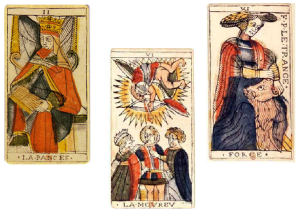
  • Position 1: The Popess.
  • Position 2: Fortitude.
  • Position 3: The Lover.

The answer becomes apparent once the cards are considered together.

The Popess describes Renee’s approach to the matter. As we have seen, the Popess signifies contemplation, study, and expertise. She is intelligent, knowledgeable, and diligent. However, she is also reserved and somewhat withdrawn. Communication is not her strongest suit. The card suggests someone who prefers to demonstrate competence through work rather than through visibility, persuasion, or personal relationships.

Fortitude describes the position itself. This was not merely a technical role requiring knowledge and experience. The successful candidate would be expected to lead others, maintain standards, resolve disputes, motivate difficult personalities, and remain steadfast when faced with pressure or opposition. In short, the organisation was seeking someone capable not merely of performing the work, but of mastering both themselves and others in a challenging environment.

The answer is supplied by the Lover. The essence of the Lover is vacillation and its function is to divide. The card suggests that the hiring panel perceived a lack of decisiveness. They may have questioned whether Renee would be comfortable making difficult decisions, enforcing unpopular policies, or managing competing demands and expectations. The transition from colleague to manager frequently requires a person to balance conflicting interests and, at times, place organisational needs ahead of personal relationships. The Lover indicates that the panel was unconvinced she would be comfortable in such a position.

My conclusion was therefore that Renee’s experience and technical competence were not in doubt. The issue lay elsewhere. The organisation was seeking a manager capable of taking firm decisions, exercising authority, and managing competing priorities with confidence. The feedback she later received from the hiring manager confirmed this interpretation, emphasising concerns about leadership style and decisiveness rather than knowledge or ability.

§

Tarot Cards: Jean Dodal Tarot via Wikipedia Commons. Public Domain.

Featured Image: Ancient Tarot Major Arcana © BP Grimaud/John Waddington Ltd, Leeds & London, Les Tarot de Marseille Jean Noblet, 1650 © Editions «letarot.com» (2001 [hand stencilled trumps]). Les Tarot de Marseille Jean Dodal, 1701 et 1715 © Editions «letarot.com» (2002 [hand stencilled trumps])

Tarot de Marseille: The Picturebook of Fate: The Twos Part 3

This article continues my series examining the trumps of the Tarot de Marseille, adapted from my unpublished manuscript, Tarot de Marseille: The Picturebook of Fate. As throughout this series, the emphasis is placed upon the traditional eikōn of the card, its historical context, and the practical significations I have found useful through divinatory practice. The interpretations presented here reflect my own experience of working with the Tarot de Marseille and should be understood as a working method rather than a definitive authority.

The Twos: The Popess, Fortitude and the Angel

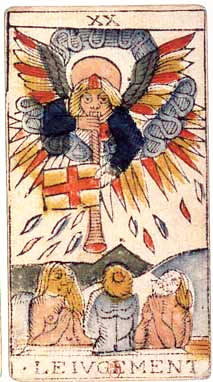
Trump XX, Le Jugement, or Judgement, is a fascinating and profound card. Does it signify judgement in the ordinary sense of the word? Does it refer to matters that have been settled once and for all? Or is it a card of transcendence, renewal, and the passage from one state of being to another? Whilst all of these ideas touch upon the card, none quite captures its essence. This is a card not of endings, but of new life.

The earliest recorded name for this trump was l’Angelo, the Angel, a title which the present author prefers. The essence of the card is resurrection; its function is to revive. These terms are fundamental to understanding the card. Something that was dormant, forgotten, lost, or believed finished is called back into life. The Angel restores movement where there was stagnation and possibility where there appeared to be none.

The traditional eikōn of the card has altered very little over the centuries. We see an angelic being sounding a trumpet from above whilst the dead emerge from their tombs. Souls are reunited with their reconstituted bodies as they rise from the grave. The distinction is important. This is not the Last Judgement itself, but the bodily resurrection which precedes it. The image is therefore concerned less with condemnation or reward than with restoration and renewal.

For this reason, the Angel is one of the great cards of second chances. It signifies an opportunity to begin again, freed from the burdens of the past yet wiser for the experience. Old mistakes need not define the future. Hope is not lost, even when circumstances suggest otherwise. The card encourages the querent to abandon old grievances, relinquish past hurts, and clear away what no longer serves a useful purpose. Resurrection is only possible when the dead wood has first been discarded.

When the Angel is prominent in a reading, it is not uncommon for the past to re-emerge in unexpected ways. One may encounter people not seen for many years, revisit former places, recover something thought lost, or receive an inheritance. What has gone before seldom disappears entirely under this card. Instead, it returns transformed, asking to be understood in a new light.

The angelic figure dominates the upper portion of the card, occupying more than half the image. Its trumpet awakens the dead and calls them forth from silence. Consequently, the Angel is also a card of revelation, sudden insight, and decisive breakthrough. What was obscure becomes clear. What was hidden emerges into the light. Solutions appear, connections are made, and matters that seemed insoluble suddenly make sense.

The Angel occupies a unique place within the sequence of trumps. Whereas the Wheel of Fortune signifies the sublunar sphere and thus the changing circumstances which bring the querent to the cards, the Angel signifies the primum mobile, the first cause which sets those circumstances in motion. For this reason, the cards surrounding the Angel frequently reveal the deeper causes, reasons, and originating factors which lie behind the events described elsewhere in the reading. The Wheel shows what is happening; the Angel reveals why.

General: Second chances and opportunities to begin anew. The card signifies renewal, recovery, and the chance to leave the past behind whilst retaining the wisdom gained from experience. It often indicates a change in personal status, usually for the better, a calling towards one’s true vocation, or a sudden insight that transforms one’s understanding of a situation. The Angel may also signify an heirloom, inheritance, legacy, or something from the past returning with renewed significance.

Love: If the question concerns whether a relationship is truly over, the Angel is one of the strongest indications that reconciliation remains possible. The card favours forgiveness, renewed understanding, and the revival of feelings thought lost, provided both parties are willing to let go of old grievances. For those seeking a partner, the Angel frequently points towards someone connected with the past: a former acquaintance, an old neighbour, a childhood connection, or someone linked to places and experiences already known to the querent.

Career: The Angel is associated with broadcasting and communications, including researchers, producers, presenters, runners, and similar roles behind the scenes. It also governs musicians and professions involving sound more generally. Other occupations include restoration, antiques, conservation, renovation, property conversion, and development. In career matters, the card often points towards reviving an old project, returning to a previous field, or discovering a vocation that had previously gone unrecognised.

Finance: The opportunity to start afresh financially. The card may signify an inheritance, legacy, recovered assets, or a welcome improvement in circumstances (return to solvency, debt written off/paid). Previous setbacks need not determine future success.

Health: Anatomically, the Angel is associated with the feet. In health matters, the card may indicate the return or recurrence of a previous condition and should therefore be treated with some caution when prominently placed in a health reading. More positively, it can signify recovery, rehabilitation, and renewed vitality following illness or a period of decline.

Essence: Resurrection.
Function: Revive.
Polarity: Neutral.
Astrological Association: Pisces.
Timing: March.

§

Tarot Cards: Jean Dodal Tarot via Wikipedia Commons. Public Domain.

Featured Image: Ancient Tarot Major Arcana © BP Grimaud/John Waddington Ltd, Leeds & London, Les Tarot de Marseille Jean Noblet, 1650 © Editions «letarot.com» (2001 [hand stencilled trumps]). Les Tarot de Marseille Jean Dodal, 1701 et 1715 © Editions «letarot.com» (2002 [hand stencilled trumps])