This article continues my series examining the trumps of the Tarot de Marseille, adapted from my unpublished manuscript, Tarot de Marseille: The Picturebook of Fate. As throughout this series, the emphasis is placed upon the traditional eikōn of the card, its historical context, and the practical significations I have found useful through divinatory practice. The interpretations presented here reflect my own experience of working with the Tarot de Marseille and should be understood as a working method rather than a definitive authority.
The Fours: The Emperor and Death
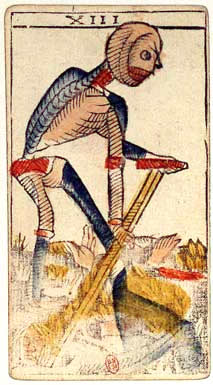
Trump XIII, La Mort, or Death, is traditionally left untitled in the Marseille packs; hence the designation L’Arcane sans nom, the Nameless Arcanum. Death: one of the two certainties of life. But how should we read it? Is it really just a card of transformation and change? Does it ever signify death itself? Whilst modern interpretations often soften its message, the Marseille card is neither subtle nor ambiguous. It speaks of endings.
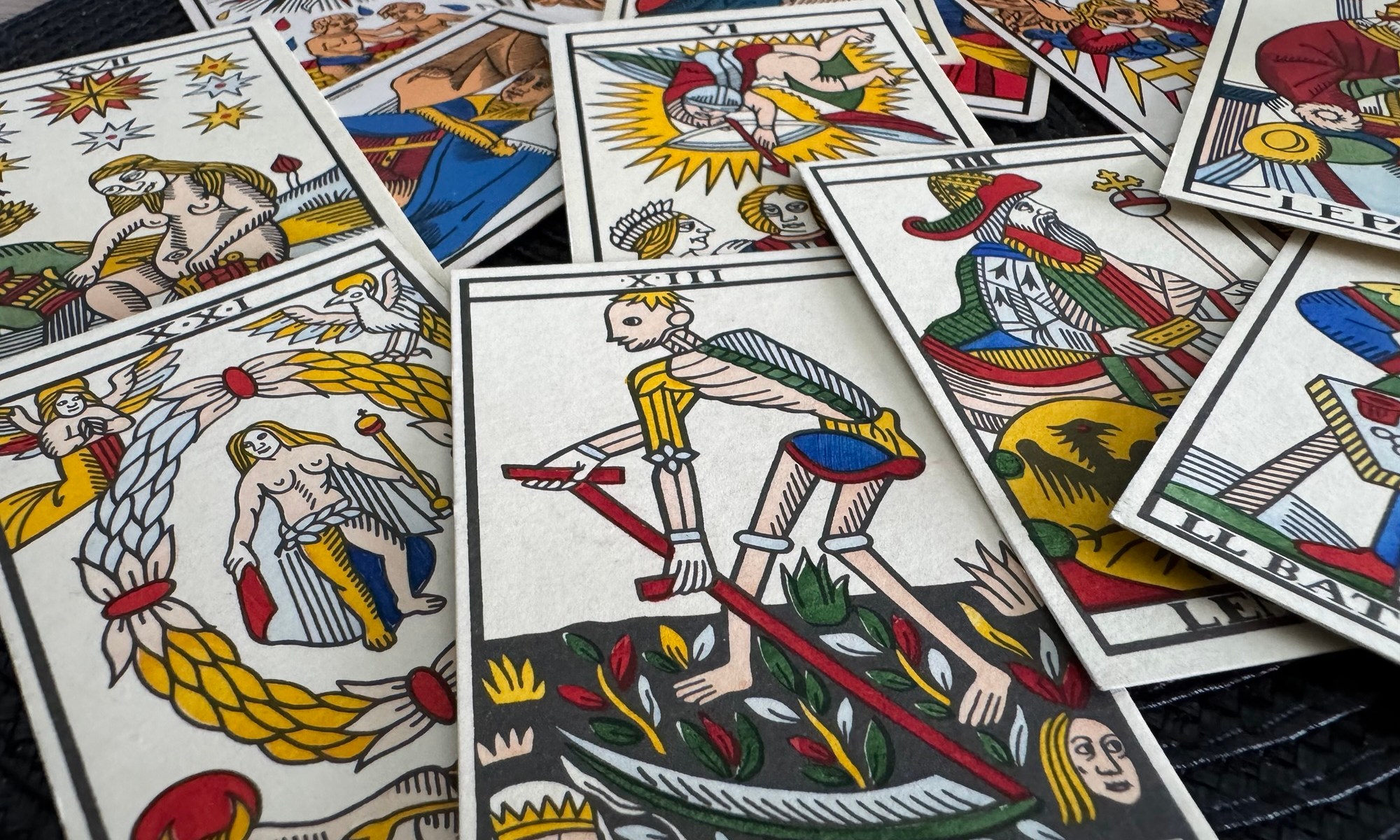
The traditional eikōn of the thirteenth trump is one of the most familiar in the Tarot and would have been readily understood by medieval and early modern audiences. Here we see a personification of Death: an animated skeleton wielding a great scythe. At her feet lie severed hands, feet, and crowned heads. The message is straightforward. Death comes for princes and paupers alike. Rank, wealth, beauty, and power offer no exemption from her harvest.
The essence of the Death card is demise; its function is to terminate. Death marks the point at which something reaches its natural conclusion. In the words of Ecclesiastes, “There is a season for everything, a time for every occupation under heaven: a time for giving birth, a time for dying…”
Death is perhaps the most feared card in the Tarot, yet it represents the one fate from which none of us can escape. Curiously, we seldom speak of death directly. Instead, we rely upon euphemisms: people pass away, pass on, or fall asleep. It is from such discomfort that the popular notion of Death as a card of “transformation” largely arises. Yet the dead do not transform. They decompose. The body breaks down and returns to its constituent parts. Before anything new can emerge, something old must first come to an end.
This is the true meaning of the Death card. Something has reached the end of its allotted season and must be cut away. Situations wither, relationships come to an end, opportunities are lost, and chapters of life close. As Ecclesiastes reminds us, there is “a time for planting; a time for uprooting what has been planted.” Death marks precisely such a season. Something has fulfilled its purpose and can continue no longer.
Significantly, the card does not reveal what follows the ending. In this respect, Death is one of the clearest trumps in the pack. It makes no promises about renewal, rebirth, or what may come next. Death merely informs us that something is finished. To understand what is ending, and what consequences may follow, one must look to where Death directs her scythe.
Death cuts to the bone. In a reading, the scythe cuts directly to the heart of the matter, stripping away pretence, delay, and indecision. For this reason, the card frequently appears when a difficult choice can no longer be postponed. The querent stands at a crossroads and must decide upon a course of action. Death’s message is blunt: choose, or circumstances will choose for you.
Nor is the card confined to symbolic endings. It is not uncommon for Death to herald financial losses, periods of hardship, the termination of agreements, redundancies, or the ending of relationships. Whilst the card seldom predicts physical death directly, it invariably signifies the end of something important. Death arrives with her scythe, and once she has passed, matters cannot remain as they were before.
Although rare, the Death card can on occasion foretell an actual death. In practice, such indications are seldom unexpected and usually concern someone already elderly, infirm, or approaching the end of their natural life. One should be cautious, however, and never rely upon Death alone. Where such a meaning is intended, it will ordinarily be corroborated by surrounding cards and the wider context of the reading
General: The end of a situation, phase of life, partnership, or established way of doing things. The card signifies conclusions, loss, separation, and the necessity of letting go. Material or financial losses are common, though not inevitable. Death frequently appears when an important decision can no longer be avoided and circumstances compel decisive action.
Love: Relationships often enter a crucial and sometimes painful phase under this card. Matters cannot continue as they have, and changes become unavoidable. In some cases this leads to reconciliation through honesty; in others, to separation, whether temporary or permanent. When Death is prominent, there is often a profound sense of loneliness or emotional distance. For those who are single, the card is generally unfavourable for new relationships. More often than not, it suggests that a previous attachment has not yet been laid to rest and that time alone is needed before moving forward.
Career: Death is naturally associated with undertakers, morticians, pathologists, bereavement counsellors, and others who work directly with the dead. It may also signify occupations involving clearance, disposal, recycling, demolition, or waste management. In employment matters, the card often indicates a contraction in opportunities within the preferred field. A change of direction, retraining, or accepting a reduction in status or remuneration may be necessary. Unfortunately, it can also point towards redundancies, closures, and downturns affecting a particular industry or workplace.
Finance: Significant financial losses may occur under this card. More commonly, it signifies a period in which financial obligations exceed available resources, forcing difficult choices and sacrifices. The querent may need to reduce expenditure, liquidate assets, or abandon expensive commitments. Death can also indicate burdensome debts, particularly where repayment has become unrealistic without substantial change.
Health: Anatomically, Death is associated with the skeletal system, including the teeth. The card may indicate fractures, osteoporosis, rickets, osteomyelitis, temporomandibular disorders, and dental complaints, particularly toothache. When supported by surrounding cards, especially the House of God, it may signify surgical intervention.
Essence: Demise.
Function: Termination.
Polarity: Negative.
Astrological Association: None.
Timing: Now.
§
Tarot Cards: Jean Dodal Tarot via Wikipedia Commons. Public Domain.
Featured Image: Ancient Tarot Major Arcana © BP Grimaud/John Waddington Ltd, Leeds & London, Les Tarot de Marseille Jean Noblet, 1650 © Editions «letarot.com» (2001 [hand stencilled trumps]). Les Tarot de Marseille Jean Dodal, 1701 et 1715 © Editions «letarot.com» (2002 [hand stencilled trumps])

