This article continues my series examining the trumps of the Tarot de Marseille, adapted from my unpublished manuscript, Tarot de Marseille: The Picturebook of Fate. As throughout this series, the emphasis is placed upon the traditional eikōn of the card, its historical context, and the practical significations I have found useful through divinatory practice. The interpretations presented here reflect my own experience of working with the Tarot de Marseille and should be understood as a working method rather than a definitive authority.
The Fours: The Emperor and Death
Let us now turn to another example, once again utilising the classic tirage en ligne, or linear draw. As before, the cards are read sequentially, each developing the story told by the previous card. This reading was done in 2010.
Due to an acrimonious divorce, Celeste had not seen her grandchildren for almost eighteen months. Following mediation, her former daughter-in-law agreed to restore contact. Although encouraged by this development, Celeste remained understandably cautious. Earlier attempts at reconciliation had broken down, and she feared the arrangement would prove short-lived.
Her question was simple: “Is this a lasting truce?”
The cards drawn were:
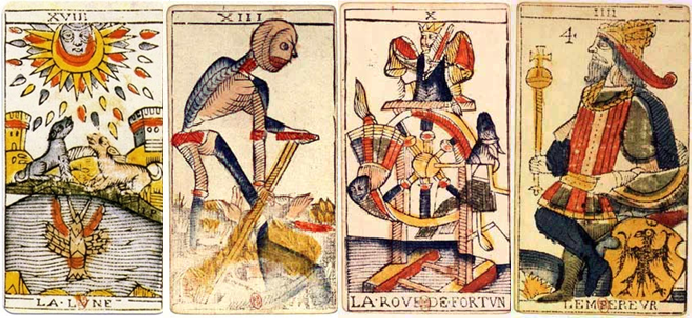
Moon – Death – Wheel of Fortune – Emperor
The reading begins with the Moon, which reveals the source of the problem. The Moon is a card of confusion, anxiety, misunderstanding, and emotional instability. In this instance, the dispute appears to have been sustained not merely by events themselves, but by the fears, assumptions, and misunderstandings surrounding them. Hurt feelings gradually acquired a life of their own, and perceptions became more influential than reality. The result was a situation in which distrust and uncertainty repeatedly undermined attempts at reconciliation.
The appearance of Death immediately afterwards is highly significant. Death acts upon the circumstances created by the Moon. Its scythe cuts away what has outlived its usefulness and brings matters to a definitive conclusion. Here, the card suggests that the confusion, resentment, and destructive patterns represented by the Moon are finally being brought to an end.
The placement of Death before the Wheel of Fortune is particularly striking. The scythe appears almost to cut across the endless turning of the Wheel itself. What is dying is not merely the disagreement, but the pattern of disagreement. Every previous attempt at reconciliation seems to have followed the same course. Contact resumed, relations improved, old grievances resurfaced, and the parties eventually found themselves back where they had started. The Wheel depicts this repeated return to the same point. Death intervenes by terminating the cycle itself.
The Wheel of Fortune therefore describes more than fluctuating circumstances. It reveals the repetitive nature of the conflict: periods of peace followed by renewed hostility, agreements followed by breakdowns, and reconciliation followed by further separation. The card shows a situation trapped within its own momentum.
The reading concludes with the Emperor. This is the card that ultimately answers the question. The Emperor imposes structure, order, and boundaries. Unlike the Sun, he does not suggest emotional warmth or renewed friendship. Instead, he establishes clear expectations and rules that all parties are required to respect.
The Emperor’s appearance is particularly appropriate following formal mediation. Unlike the Pope, who reconciles through wisdom and goodwill, the Emperor reconciles through structure. Expectations are defined, boundaries established, responsibilities clarified, and consequences understood.
In practical terms, the Emperor reflects the mediated agreement itself. Contact is restored not because everybody suddenly likes one another, but because a framework has been established within which each person understands their role and limitations. The relationship becomes governed by structure rather than emotion.
Taken together, the cards tell a coherent story. The confusion and emotional turmoil of the Moon are brought to an end by Death. In doing so, Death cuts through the repetitive cycle represented by the Wheel of Fortune, allowing the situation to move forward rather than endlessly repeating itself. The Emperor then provides a stable framework capable of sustaining the new arrangement.
My conclusion was that the truce appeared considerably more durable than previous attempts. The cards did not suggest warmth, forgiveness, or a complete healing of old wounds. Rather, they suggested that a dysfunctional cycle had been broken and replaced by a workable structure. The parties involved did not need to become friends; they merely needed to respect the framework established by the Emperor.
This example illustrates an important principle of the tirage en ligne: the cards often reveal not merely an answer, but the process by which that answer comes about. Here, each card acts upon the next, transforming confusion into closure, closure into change, and change into stability. The conflict itself is not what ends. What ends is the cycle of conflict.
§
Tarot Cards: Jean Dodal Tarot via Wikipedia Commons. Public Domain.
Featured Image: Ancient Tarot Major Arcana © BP Grimaud/John Waddington Ltd, Leeds & London, Les Tarot de Marseille Jean Noblet, 1650 © Editions «letarot.com» (2001 [hand stencilled trumps]). Les Tarot de Marseille Jean Dodal, 1701 et 1715 © Editions «letarot.com» (2002 [hand stencilled trumps])

