Three Fives and a Love Story

When discussing the challenges beginners face learning the Tarot, conversations tend to center on the appropriate beginners’ decks, Court Cards, or whether to use reversals or not. However, in my experience, the real challenge is synthesizing individual cards’ auguries to deliver a coherent narrative or “story.” Without this, readings become fragmented, and the big picture is lost. Yet, despite the unmistakable merit of being able to weave a story from the cards in front of you, quite a few teachers advocate avoiding combining cards or even summarization.

I believe part of this is the overreliance on “positional spreads” (Pentagram, Horoscope, Celtic Cross, Magic Seven, etc.). There is nothing wrong with these patterns; I use all four. However, there is now a strong tendency to see each card in singular isolation rather than as part of a spread.

For this reason, I recommend newer readers ensure they have a few looser spreads, such as the Square of Nine, Lucky Thirteen, or the Three Fives.

The Three Fives appear as the fifteen-card spread in Richard Gardner and Rolla Nordic texts. I, therefore, assume it originates with Frank Lind’s course. However, Doane and Keyes demonstrate a draw titled the Three Sevens, which is identical save for the differing amount of cards. Lind might have adapted his 15-card draw from Zain’s writings. However, I’ve used a 25-card spread for twenty-odd years, which is much the same save for its size. I’ll describe that at the end.

In early June, I had cause to practice the Three Fives for a 24-year-old Questioner who wanted to know about his future and “love life.” He disclosed he was homosexual.

The Three Fives

Lay the cards in three rows, starting at the lower right corner as below.
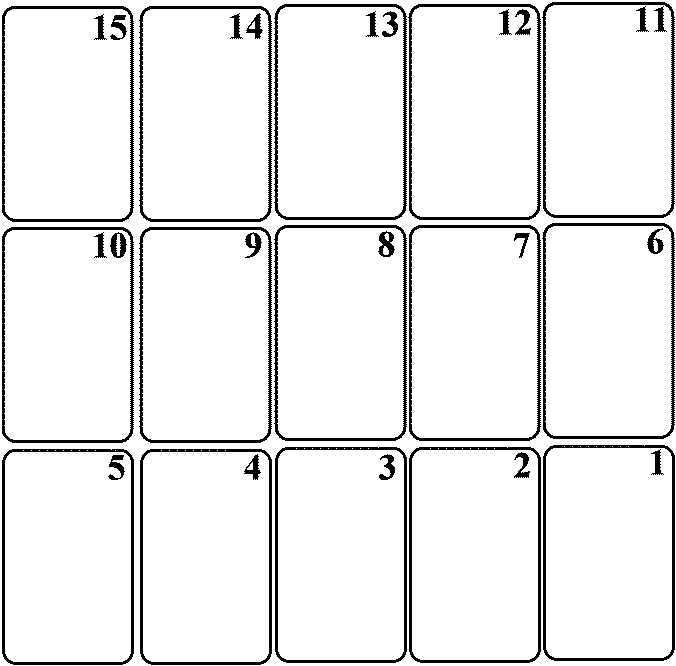
The spread is read right to left.

The bottom row is the past, the middle the present, and the top row is the future.

The timeline is helpful for a reader who is not used to reading “free form” and wants to practice weaving cards together. It is almost like each row is a sentence in a three-line paragraph.

Here are Harri’s cards:
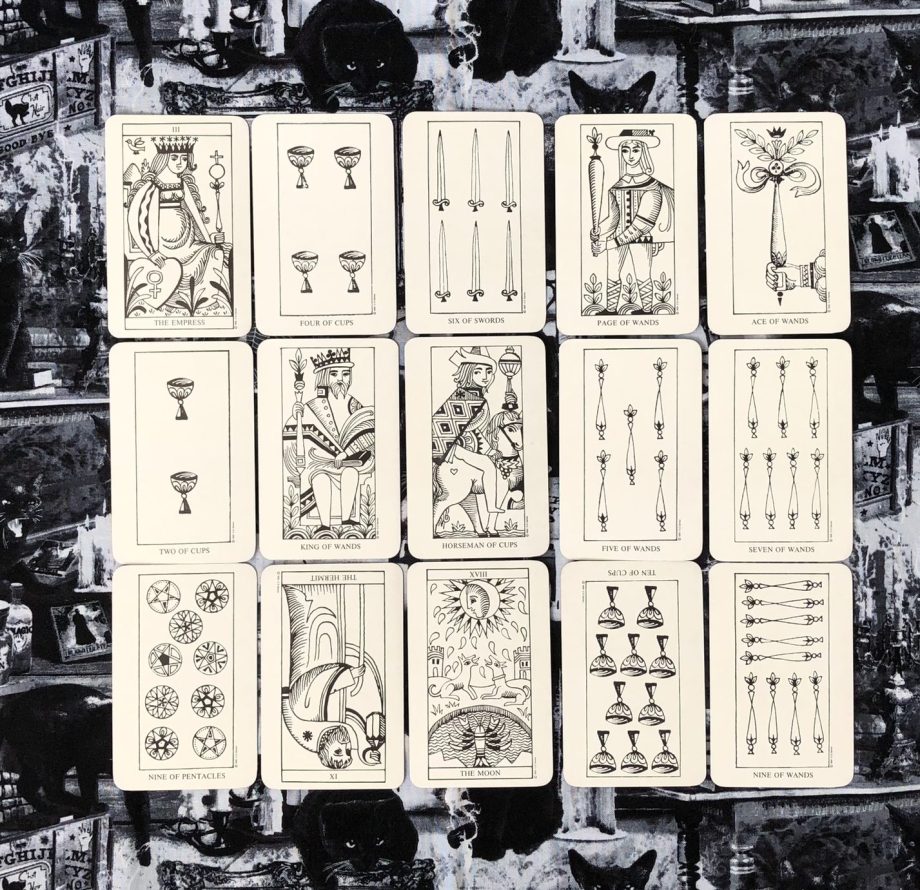
In the past, Harri has benefited from a good (if somewhat eccentric [10 of Cups, reversed]) network of friends who have helped and supported him.

Much to everyone’s surprise, one of these developed into something more (10 of Cups, reversed).

Unfortunately, they played Harri false (10 of Cups, reversed + The Moon + The Hermit, reversed). He was swept away by foolish talk (The Moon) and threw caution to the wind (The Hermit, reversed), lavishing his attention and money (9 of Pentacles) on the relationship without limit (The Hermit).

Moving to the present:

The 7 of Rods is associated with teaching. Harri is not a teacher but now works with teenagers in a high school. This new role has proven a positive and stabilizing influence and introduced Harri to new people (5 of Rods). He is considering doing a Ph.D. (7 of Rods), which would benefit him (5 of Rods).

However, Harri’s thoughts have turned to love. We know this from Harri’s question, but the Horseman of Cups explains why. Harri has met the King of Rods. Horsemen signify thoughts, here of a Cups-nature (love, family, home…). As the King follows it, the King occupies Harri’s thoughts. The King is an astute but friendly man (touched by Cups), likely older than Harri.

Harri and the King enjoy each other’s company and share similar interests (2 of Cups). He is likewise interested in Harri but cautious (The Hermit falling below him).

In the future, there will be discussions (Knave of Rods) about opportunities available to Harri for further advancement (Ace of Rods).

Aces signify news, with Gardner and Nordic seeing the Ace of Rods as news of an opportunity or a business letter. Doane and Keyes, however, include “activity” and a venture to benefit reputation or honor gained from mental activity. Recalling Harri’s interest in pursuing a Ph.D., an option for this or something similar (Ace) will likely be discussed with him (Knave of Rods = discussion).

Harri must think carefully, as the 6 of Swords warns against recklessness and the need to budget your energies. If we look at the central column – the Moon, the Horseman of Cups, and the 6 of Swords – Harri can get caught up in the moment. My intuition was that Harri might not be in the best position at this time (either financially [recall the 9 of Pence] or with other commitments) to take on such an endeavor right now. It would, therefore, be prudent to discuss these carefully and plan (Knave of Rods + 6 of Swords).

In doing so, Harri will ensure he has the appropriate resources (4 of Cups) to realize his goals (Arcumum III. The Empress).

There is good news for love, too. If he takes things slowly (6 of Swords), Harri will discover he has gained (4) the King of Rods’ affections (Cups). The King will invite Harri into his circle (4 of Cups). The King is quite discreet (Rods = Earth) and, if they work together, which I suspected from the 2 of Cups, will want to remain professional. However, over time they will find themselves a good match (4 of Cups + Arcanum III. The Empress).

The spread doesn’t have a particular time span. 6 – 8 weeks would be a fair average. The final card, The Empress, is the card of Cancer, so I would expect events to have played out by July or August.

As you can see, some cards can be read twice in different contexts, as I did in the future row. Other times some cards in a row will refer to one topic and the others something else (as in Harri’s present). There is no rule for when this occurs. It comes with time and familiarity, so that your intuition can guide you.

Square of 25

The Square of 25 is a spread I have utilized for twenty-odd years, nobody taught me this, but such squares are common.

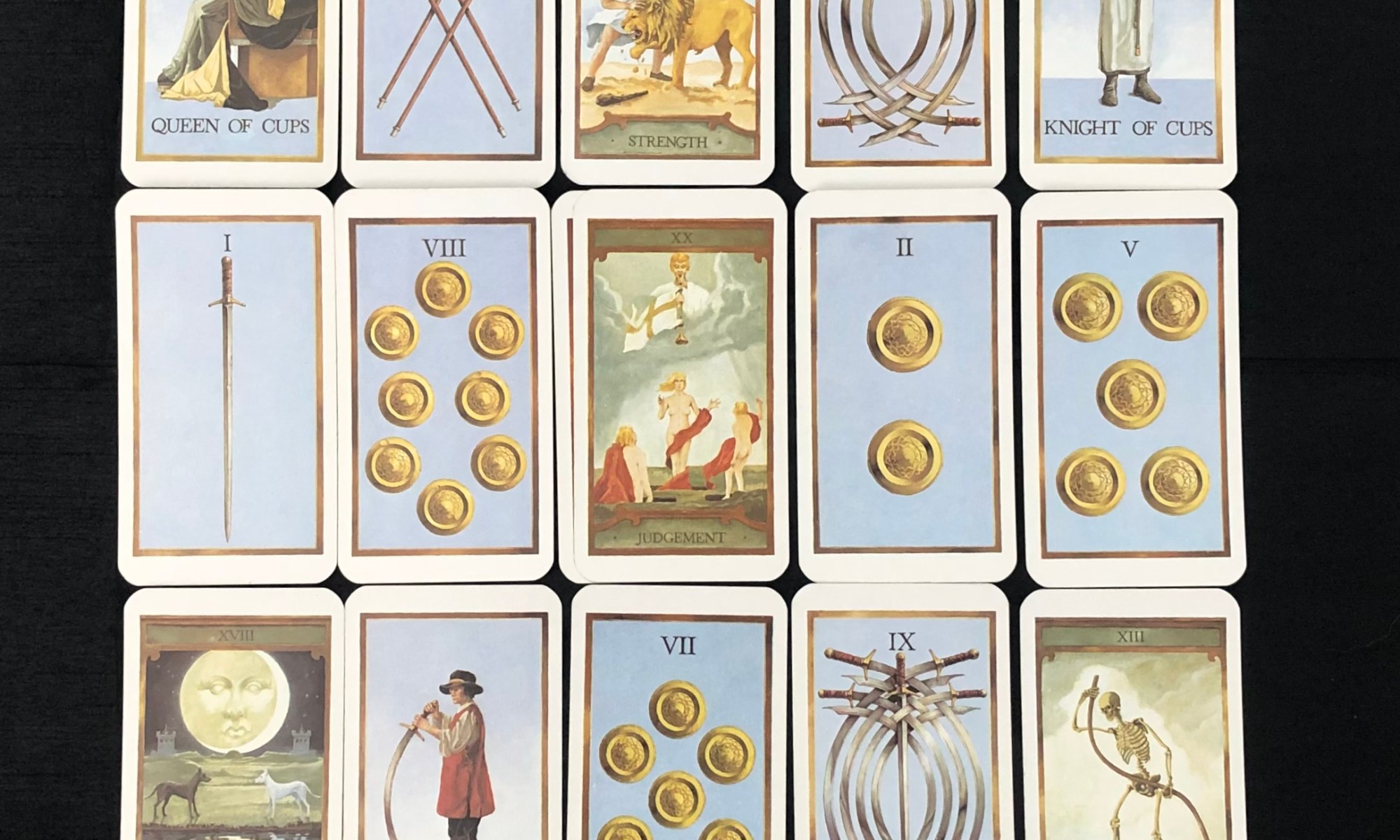
When doing the spread, a Questioner card is drawn from the deck, placed at the center of the spread, and the fifteenth card is dealt over the Questioner card. Here the Questioner card was the Queen of Staves and is covered by Arcanum XX. Judgement.

The cards are dealt bottom to top, and in the direction the Questioner card faces. They are also read in the direction the Questioner card faces. In the image below, the Queen faces left. As such, the cards were dealt and read right to left, starting with the 2 of Staves (bottom right) and ending with the 3 of Staves (top left).
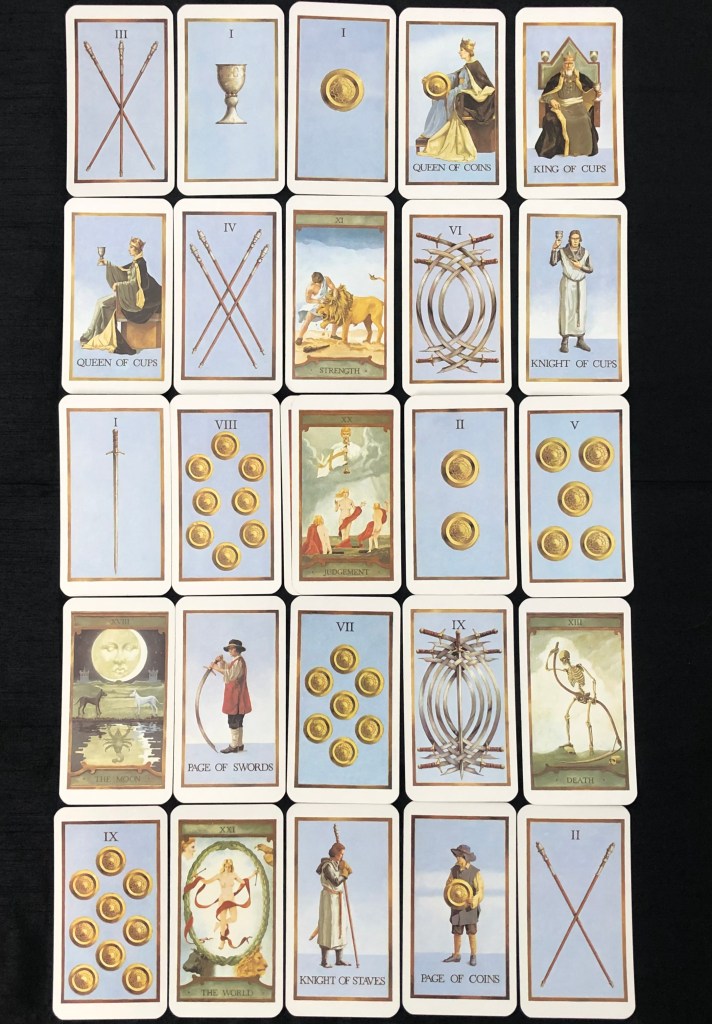
I read the bottom row as the past, the second and third rows as the present, and the fourth and fifth rows as the future.

The card covering the Questioner card is the central theme or influence, the card of Fate. You can read the “X” it forms like a surprise.

Sometimes I give the columns a meaning and read them as a secondary reading.

§

Deck: The Rolla Nordic Tarot, US Games Systems, Inc.

The Tarot Shows the Path by Rolla Nordic, published by Regency Press in 1960.
The Tarot Speaks by Richard Gardner, published by Universal-Tandem in 1974.
How to Read Tarot Cards by Doris Chase Doane and King Keyes, published by Barnes and Noble in 1979.
Three Norns and Rune Stones

During my sabbatical from the Tarot, I looked at a divinatory system that has held a particular fascination for some time: the Elder Futhark Rune Stones. I had looked at this specific method once or twice before. However, for various reasons, found them off-putting. I did not encounter that issue on this occasion. I love them.

As an apprentice at casting the Rune Stones, I have focused on two patterns: one described by Tony Willis and another by Paul Rhys Mountford. The latter is utilized below. As with the Kipper Cards, I thought it prudent to focus on one primary source at first. I settled on Horik Svensson as his text accompanied my Rune set. Once I had digested this information, I read texts by Tony Willis and Paul Rhys Mountford.

In readings I have not included the blank stone.

Since the first wave of coronavirus, I have worked from home. Before Covid-19, I had begun to find my career less rewarding. Part of this is the culture and politics. Despite a promotion in March, I have seriously considered resigning. Such action would come with an obvious financial consequence. For this reason, I decided to ask the Runes: should I quit my current position?

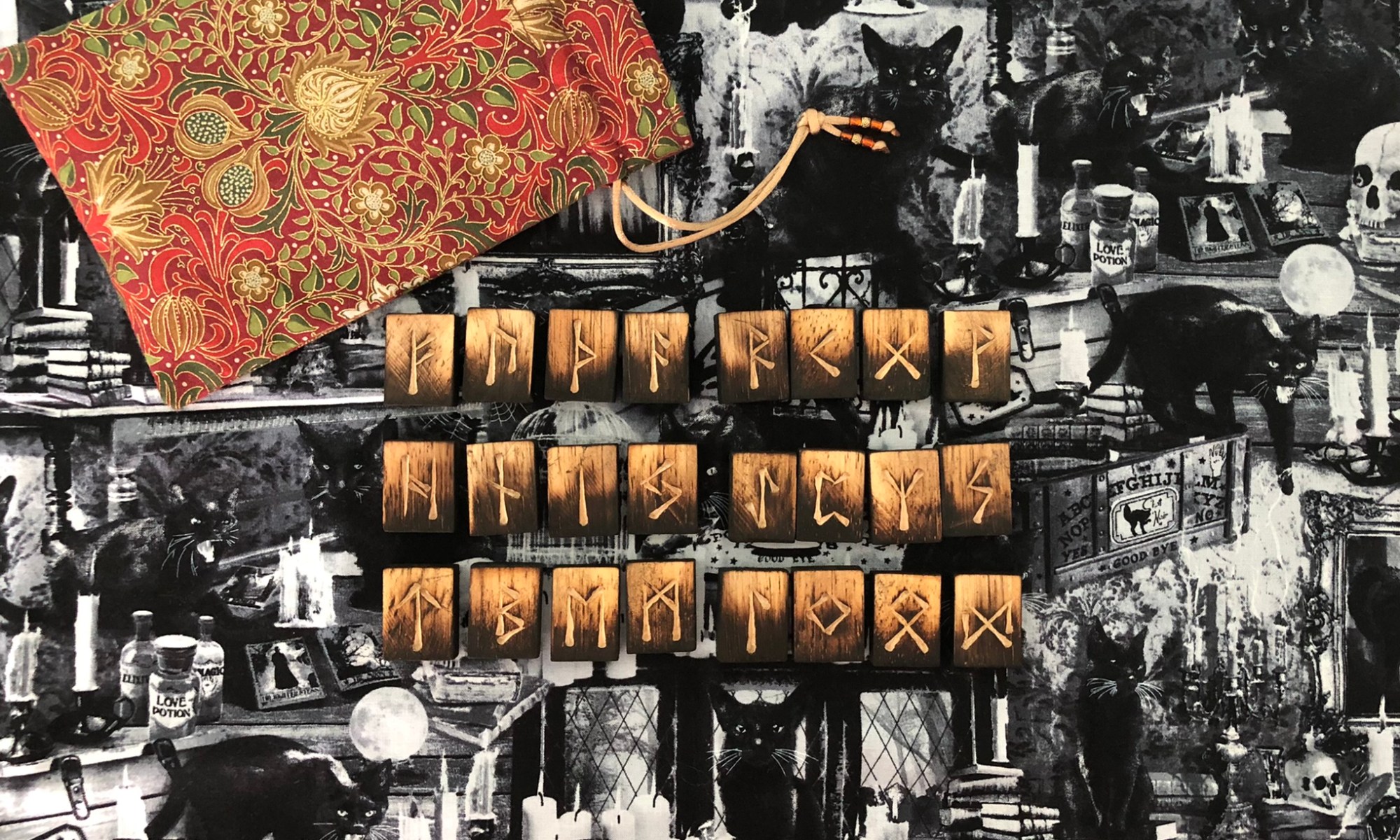
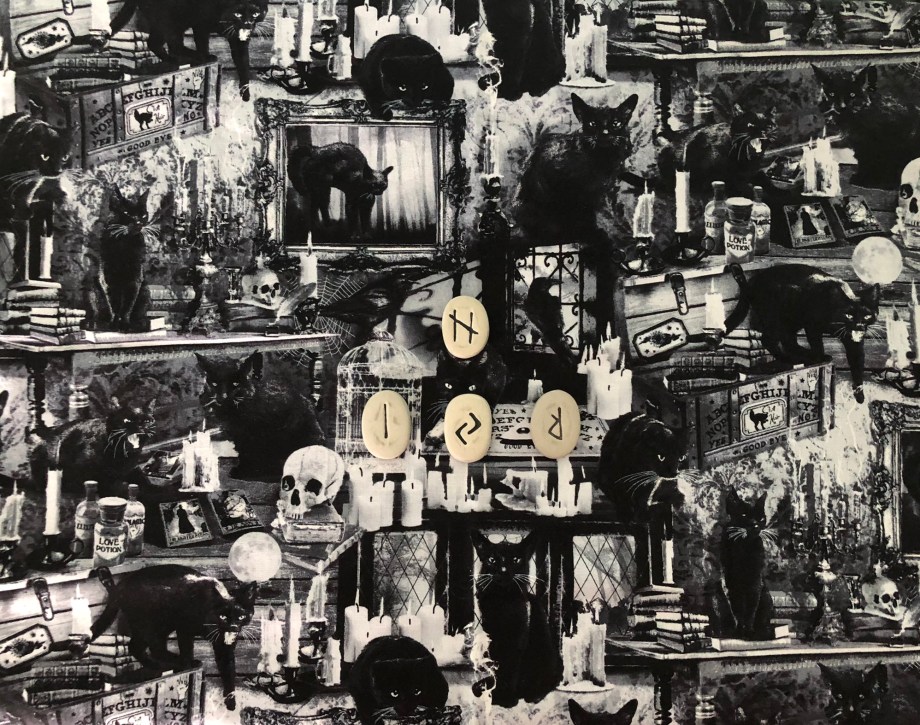
The Three Norns uses four Rune Stones; the first signifies the issue, the second the root of the matter, the third the current events, and the fourth is the likely outcome. The first stone is set above the other three.

The four Runes drawn were: Hagall, Is, Jara, and Rad (reversed).

Hagall (or Hagalaz), meaning hail, signifies the issue. Since the start of the pandemic, I’ve found my role often centers on putting out fires. Sometimes it feels like a hailstorm. Everything was disrupted, and all plans were put aside: including changes I fought for. Like the weather, is not a situation I can control or change.

Is reinforces that. We’re still in a period of stasis where existing plans and development are on hold. My manager, with whom I have a frosty relationship, finds this entirely satisfactory as it means specific changes are on hold. Probably, indefinitely. Certainly whenever we talk its “on hold, for now.”

Jara (or Jera), meaning “time of year”, is interesting as the current events. We reap what we sow. In the last six months, I’ve received a promotion, commendation, and offered a secondment, which I declined. I regret the latter now — but it was my choice.

The answer is Rad (or Raido), reversed. Resigning without another position would be foolish — and far from easy. I could go back to reading palms full-time, but I don’t like have clients in my home. Instead, I should focus on finding a new job and then go. It’s not time to set out just yet.

So I’ve not resigned but I am looking for alternative employment and asked for a formal meeting to discuss my concerns.

§

The Runes Pack by Horik Svensson, published by Carlton Publishing Group in 1995.

The Runic Workbook by Tony Willis, published by The Aquarian Press in 1986
Nordic Runes by Paul Rhys Mountford, published by Destiny Books in 2003.

Consequences Spread and Playing Cards

Some Readers prefer to amass an extensive collection of spreads, whereas others like to create new ones for each reading. I like to keep to a small pool that can be used with different decks and are easily adapted to different contexts. The familiarity ensures I don’t have to worry about forgetting what a position signifies and can be 100% focused on the cards. But there is no right or wrong. If an arsenal of spreads works for you, that’s great.

Popularised by Sasha Fenton, the “Consequences” spread was once quite popular in the 1980s and 1990s. I saw several Readers still using this in the 1990s but by 2000 it seemed to have vanished. I first came across it in Sasha Fenton’s Tarot In Action!, which I primarily purchased because it was illustrated with the deck I then worked with (the beautiful The Prediction Tarot). I found the Consequences spread a helpful layout and used it a lot, especially when I started doing readings for other people.

The Consequences Spread, can be adapted to all contexts (love, work, finances, health). You can also use Tarot cards, Kipper Cards, the Petit Lenormand Oracle, the Oracle Gé, or Playing Cards. I used the latter in early June for a woman considering resigning from her job.

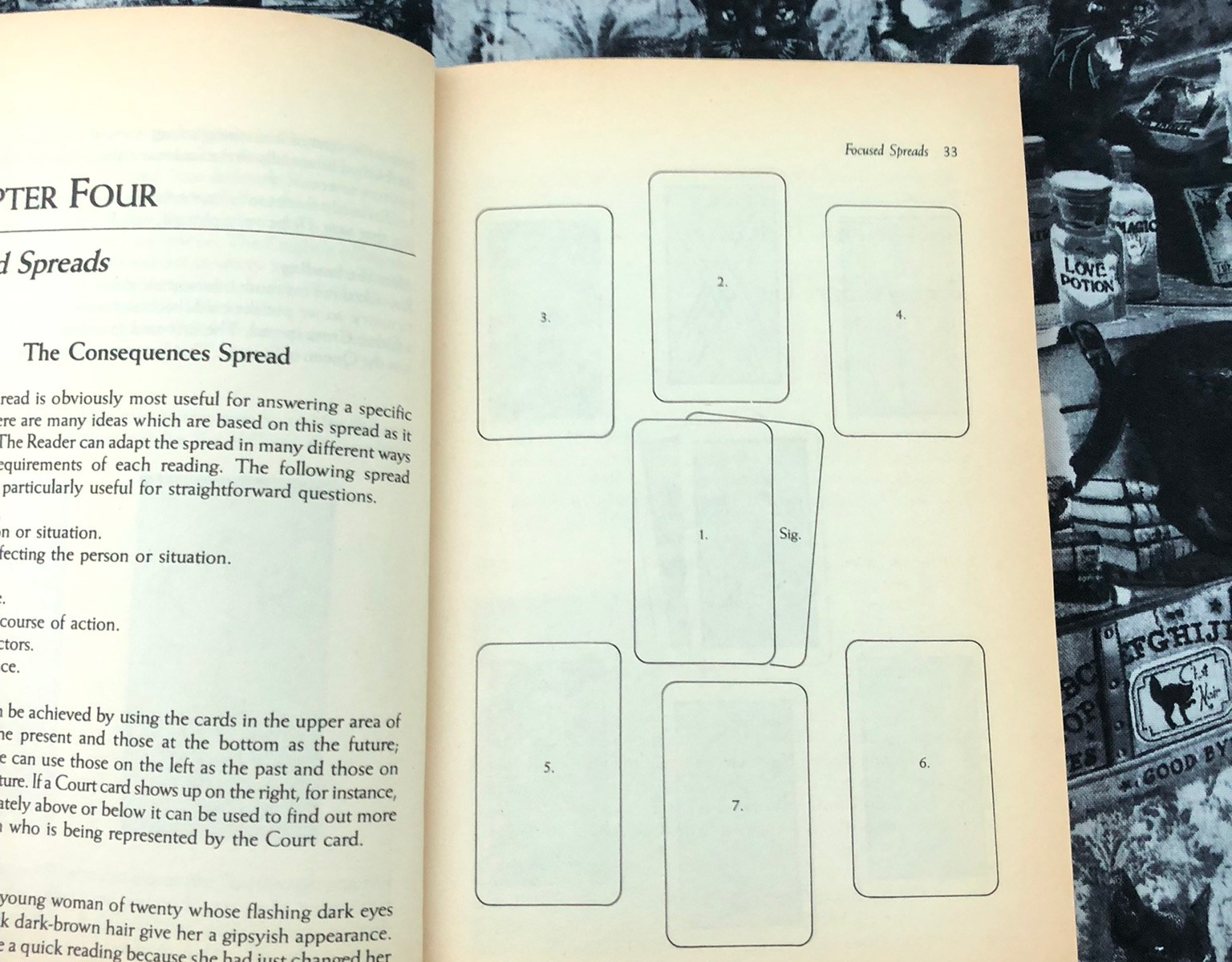
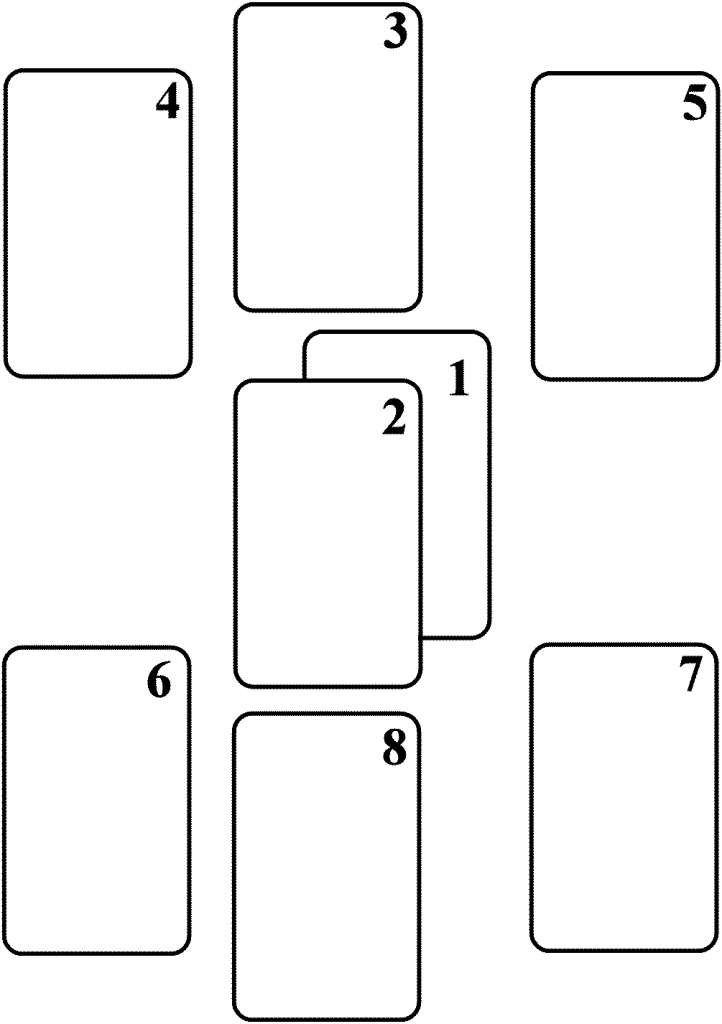
The Consequences Spread is dealt as shown below.

  1. The Questioner’s card.
  2. The person or situation.
  3. Matters affecting the person or situation.
  4. The past.
  5. The future.
  6. Suggested course of action.
  7. Outside factors.
  8. Consequence.

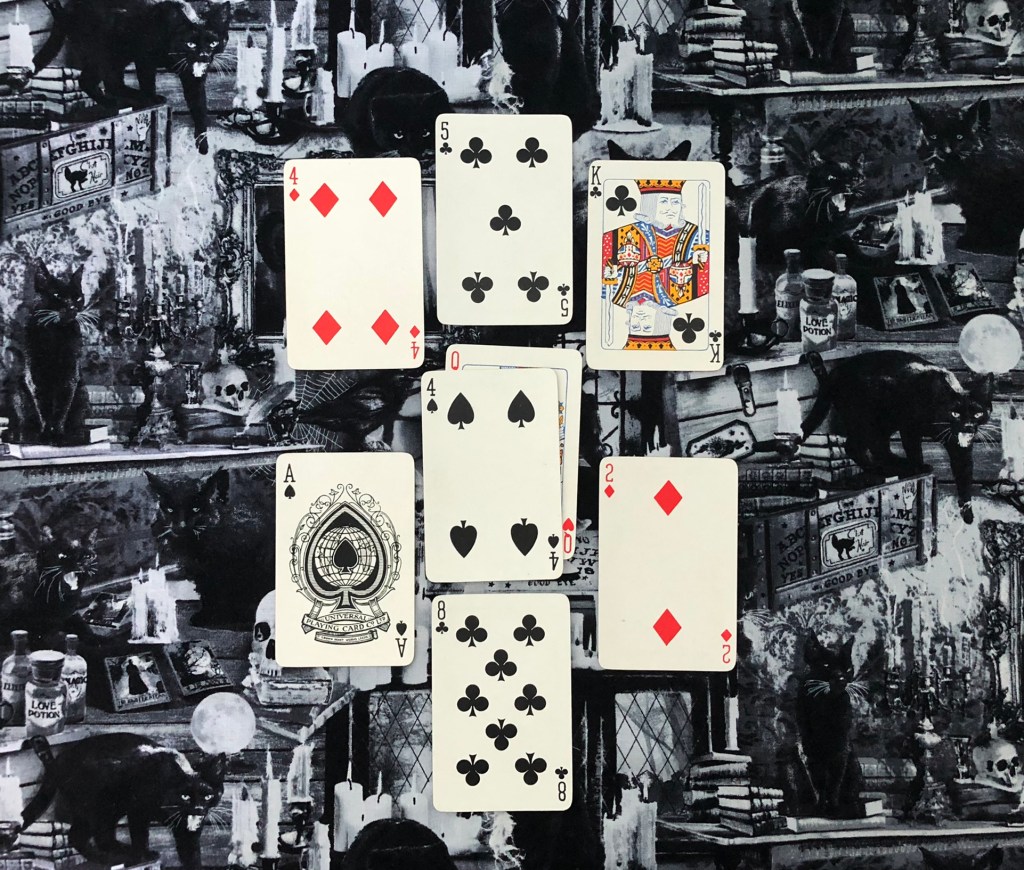
Rebekah has dark-blonde hair and is in her forties, so I selected the Queen of Hearts as the Questioner card. The remaining 51 cards were shuffled, cut and dealt as below.


Cards #2 and #3 were the 4 of Spades and 5 of Clubs. Rebekah feels physically and mentally exhausted (4 of Spades) after returning to a busy and demanding role (5 of Clubs). Rebekah had been off work for some time due to illness. The combination of Spades and Clubs emphasizes that Rebekah is severely taxed with a heavy workload.

The 4 of Diamonds, as card #4, can indicate sitting behind a desk. Rebekah is no stranger to the office. She has worked for the company for almost 15 years at the same desk and in the same role. However, Regina Russell also states that the card signifies the office or den in the home. On putting this forward, Rebekah told me she had worked from home for almost 12 months before returning to her place of work. She now finds the commute tiring.

The fifth card signifies the future. Here we find the King of Clubs, which would represent Rebekah’s boss. In my experience, when a Court Card falls here (card #5), it identifies who will initiate the events or circumstances revealed in card #7, here, occupied by the 2 of Diamonds:

There are meaningful discussions to be had soon. During these talks, Rebekah’s boss will put forward different ideas and scenarios to help Rebekah. As the 2 of Diamonds is also said to indicate imagination, these could well be things that have not occurred to Rebekah. Likewise, Rebekah can put forward suggestions and ideas.

After these discussions, Rebekah can decide what she thinks is best for her (card #6 Ace of Spades), and in doing so, she will be able to move forward.

Traditionally, the Ace of Spades is a card of endings, but I did not read it as tendering her resignation. Why? Intuition. The consequence, 8 of Clubs, can show a new job, but also new duties or transfers. I said that after discussing different scenarios, Rebekah would choose (Ace of Spades) to transfer to a new role (8 of Clubs) that is less stressful for her in her current role. Rebekah is an insurance underwriter but her new role will likely be more administrative or secretarial (the 8 of Clubs falls next to the 2 of Diamonds).

When? There are a couple of timing methods available. First, clubs are associated with weeks. So we could say in eight weeks (end of July). Clubs are also the suit of earth and summer, which would indicate around the third week of August. Both point towards July/August.

§

Deck: Deluxe Playing Cards (Alf Cooke), c. 1930 – 1940.

Consequences Spread: Tarot In Action! by Sasha Fenton, published by Aquarian Press in 1987.