The WT? Card

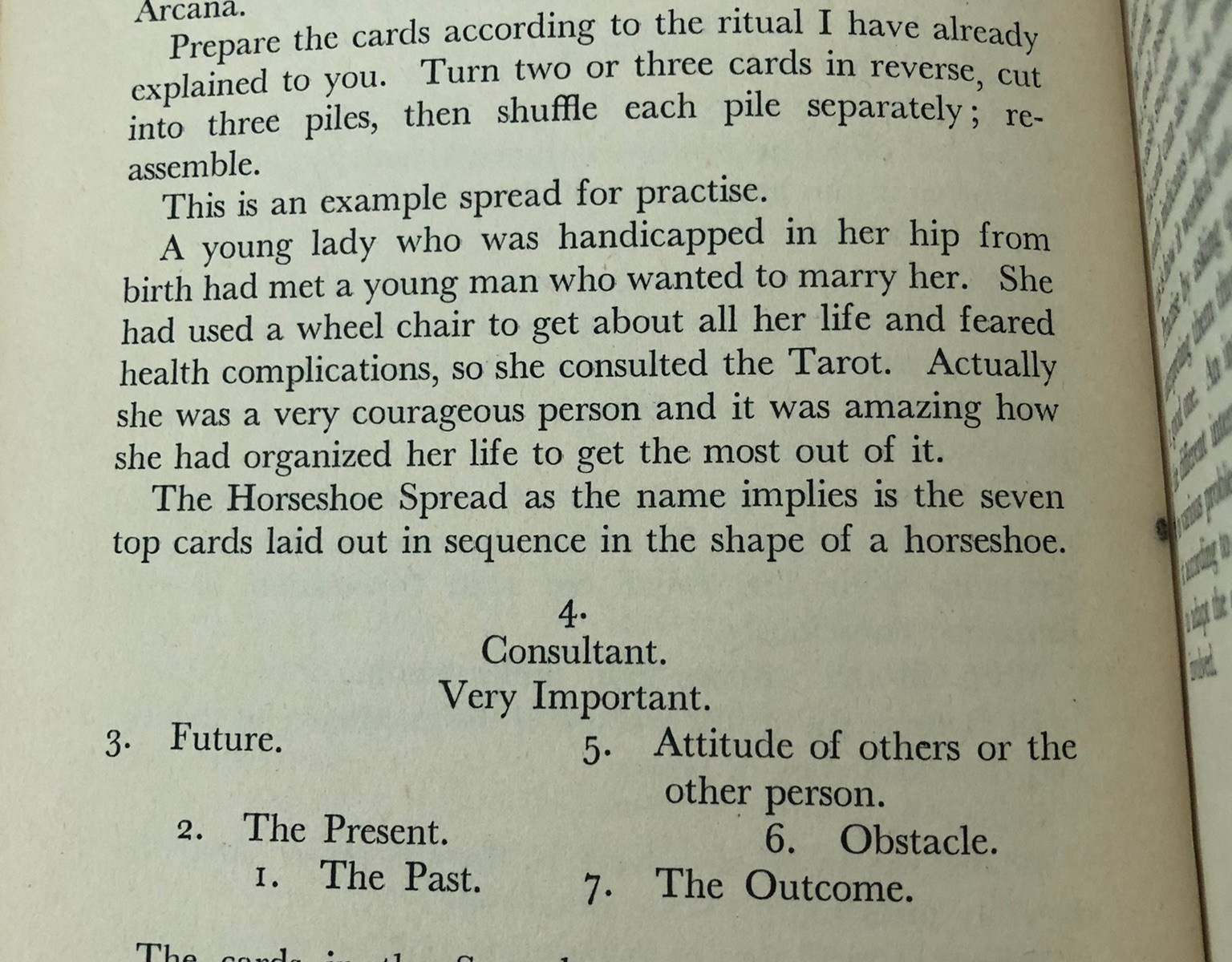
The Horseshoe is a classic spread for the Tarot cards and one of the first I committed to memory. I’ve always found it clear and concise. Being so well-known, it does exist in several variations (I use one of two different variations depending upon the question).

Regardless of how familiar you are with a spread, there will be times when the cards throw you a curveball. A card will appear that makes no sense. The Questioner will insist that the card or your interpretation (or even both) is wrong. What can you do? Some deal clarifying cards. I never do that: I always go with the card. Not everything will make sense straight away. Plus, the cards can reveal circumstances or details we were not privy to. If the other cards are “spot on,” then a rogue WT? card must be given the benefit of the doubt.

I had a WT? card appear in May when reading for a someone who had taken out a grievance at work. After she had made her complaint, a counter-grievance was made. The complaint centered on the Questioner feeling victimized due to comments made by a male colleague. It was very complicated.

The WT? threw both the Questioner and I. But it also was a moment where I had to put my faith in the cards.

The Horseshoe is laid out as follows:
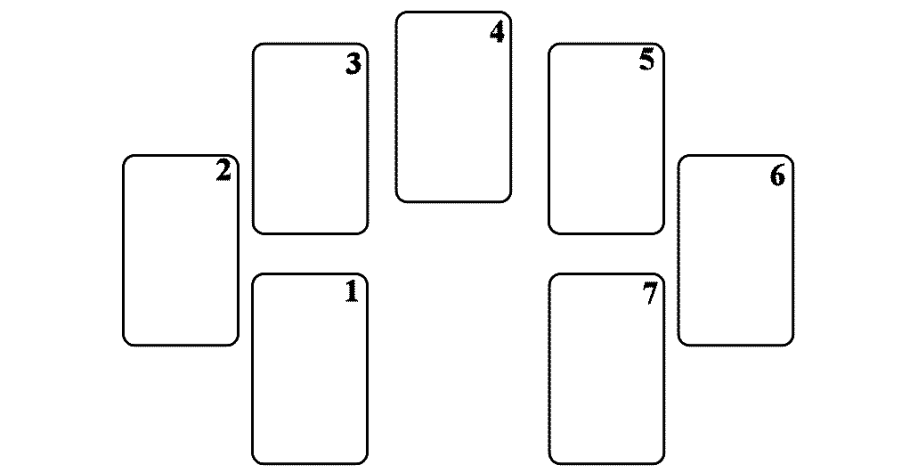
  1.  The Past.
  2. The Present.
  3. The Future.
  4. The Questioner.
  5. The Other People Involved.
  6. The Obstacle.
  7. The Outcome.

In Classic Tarot Spreads, Sandor Konraad suggested reading card #4 first. This card describes the Questioner and how she approaches the situation, so it’s helpful to see what is said here first. 

Similarly, cards #3 and #7 have to be considered together as both describe the future. In my experience, this is best done last.

Using the Rolla Nordic Tarot, I laid out the Horseshoe as follows:
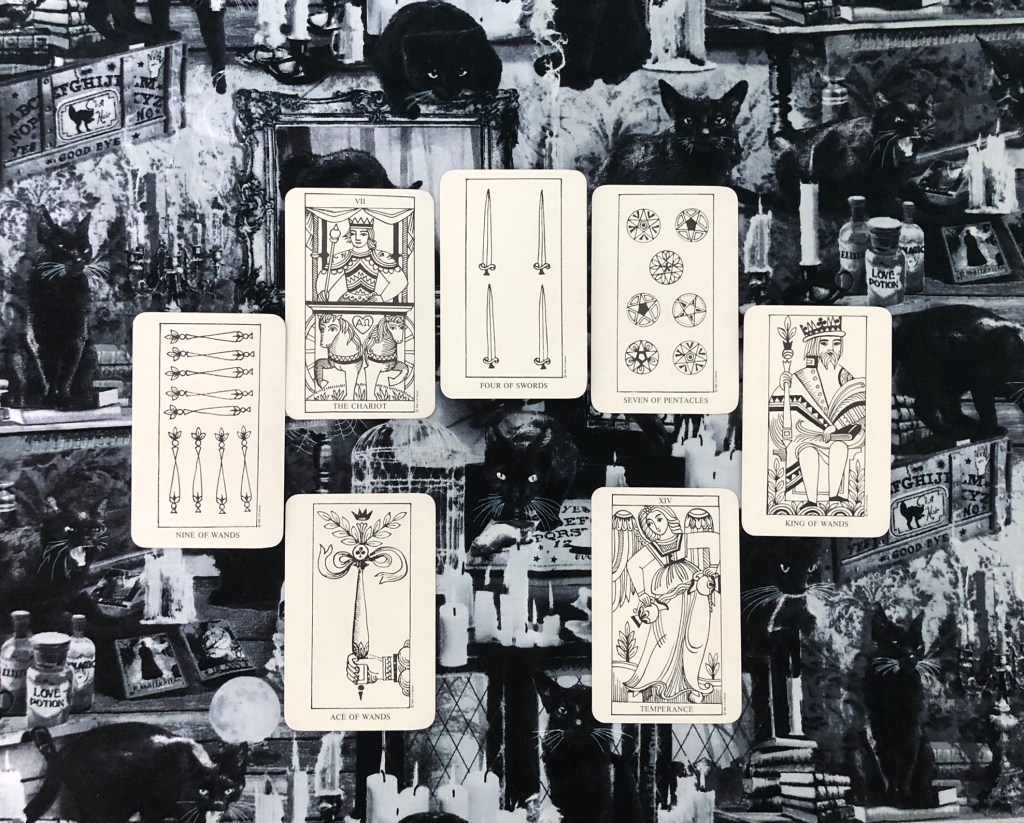
  1.  Ace of Rods.
  2.  9 of Rods.
  3. Arcanum VII. The Chariot.
  4. 4 of Swords.
  5. 7 of Pentacles.
  6. King of Rods.
  7. Arcanum XIV. The Angel of Time.

The Questioner appears as the 4 of Swords. The entire affair is regrettable, and she wants to put it behind her. It has affected her health (Swords) and seen her on half-pay due to sickness absence (The 4 of Swords can indicate financial reversals). 

Let’s look at cards #1 and #2. All aces signify news. The Questioner received an e-mail (Ace of Rods) that triggered a formal complaint (also in writing). She has sought advice from the Union, who have supported and advised the Questioner (9 of Rods). Part of that advice was identifying supportive statements from colleagues.

Card #6 represents the current obstacle. Here we find the King of Rods. Rods are the earth suit, and the King has fallen next to an air card (Pentacles). He’s thus undignified. The King of Rods is said to be an “Active type of man oriented towards efficiency” (Garnder) and “helpful in successful business ventures” (Pushong). Nordic says he has a “Lawyer or Stockbroker outlook.” Undignified, he is pedantic and obsessed with detail and procedure at the expense of the main objective. What should be a simple task becomes a long-drawn-out affair.

The Questioner identified this person as the HR investigating officer. He had interviewed the Questioner as part of the investigation, which was very “unpleasant” and “intrusive.” After the meeting, he e-mailed an additional ten questions. Nothing seemed to be moving.

So what was the WT? card? It was the 7 of Pentacles. Sevens indicate changes or movement, and the card often infers travel (in general), a business trip, or changes to how you earn. When I told the Questioner that it appeared as if either the King of Rods or another person was away, she could not understand the card’s message. None of the panel have roles requiring traveling. I pointed out that this could be annual leave, but she shook her head. The other associations did not seize me. I reiterated if not the King, then someone was away.

The pence suit is ruled by Jupiter, who rules Sagittarius and Pisces and whose day of the week is Thursday. I doubted we would have to wait for December or even 12-days (Jupiter has a 12-year cycle). The reading was done on Tuesday (Mars’s day). I told the Questioner we would need to wait and see, and by Thursday, we should have a clearer idea. Fingers crossed!

Cards #3 and #7, VII. The Chariot and XIV. The Angel of Time/Temperance, come from the Greater Arcana.

Arcanum XIV. The Angel of Time signifies diplomacy and moderation but is also, as its title suggests, is a symbol of time. As an outcome, there is always a delay with this card. Nothing will be rushed; everything has its appointed moment. You must be patient.

The card predicts that rather than direct action (disciplinary action, warnings, etc.), the resolution will focus on attempts to restore professional, if not harmonious, working relationships over time. The Questioner will be expected to give a little. As colleagues, their roles require crossover. They will need to find a way of working together.

In doing so, the future is bright as Arcanum. VII The Chariot predicts a successful period and progress in her career. As a chariot is a mode of transport, this is often in a new place or at least a new role (often but not always with promotion). In time, this will all be behind her and she can forge ahead realizing a personal ambition.

The Questioner had hoped her colleague would be redeployed if not disciplined. However, Arcanum XIV. infers steps will be taken to restore harmony between them, perhaps through mediation. If the Questioner can demonstrate some willingness, she will be rewarded in the long term and move forward. The Chariot shows movement in her life (her future) rather than her colleague’s.

On Wednesday, the Questioner contacted HR for an update and to discuss a phased return to work. She learned that the HR advisor, the King of Rods, was out of the office (he was on mandatory training) and would not return until the following Monday. No update was given, and the Questioner was told to wait.

§

Deck: The Rolla Nordic Tarot, US Games Systems, Inc.

The Tarot Shows the Path by Rolla Nordic, published by Regency Press in 1960.
The Tarot Speaks by Richard Gardner, published by Universal-Tandem in 1974.
The Tarot Of The Magi by Carlyle A. Pushong, published by Regency Press in 1969.
Classic Tarot Spreads by Sandor Konraad, published by Whitford Press in 1997.

The Card Reader’s Fifteen Card Spread

My friend, Hugh, acquired Regina Russell’s well-regarded Card Reader’s Handbook earlier this year. He was impressed. Valuing his opinion, I took the plunge. It is a brilliant treatise on the art of cartomancy. The cards’ significations are close to those I use and echo Dr. Leo Martello.

In her text, Russell introduces a three-stage reading process. Before the 1970s/80s, such sequential readings were not uncommon. Even Juliet Sharman-Burke included the practice in her correspondence course and book, The Complete Book of Tarot. However, then as now, you can use each spread individually.

The fifteen-card spread, which Russell starts her readings with, has become a personal favorite. You can use it outside the staged process. Since acquiring the book, I’ve used it with Playing Cards and Tarot cards in addition to the Mlle Lenormand Oracle and Kipperkarten cards. It’s brilliant.

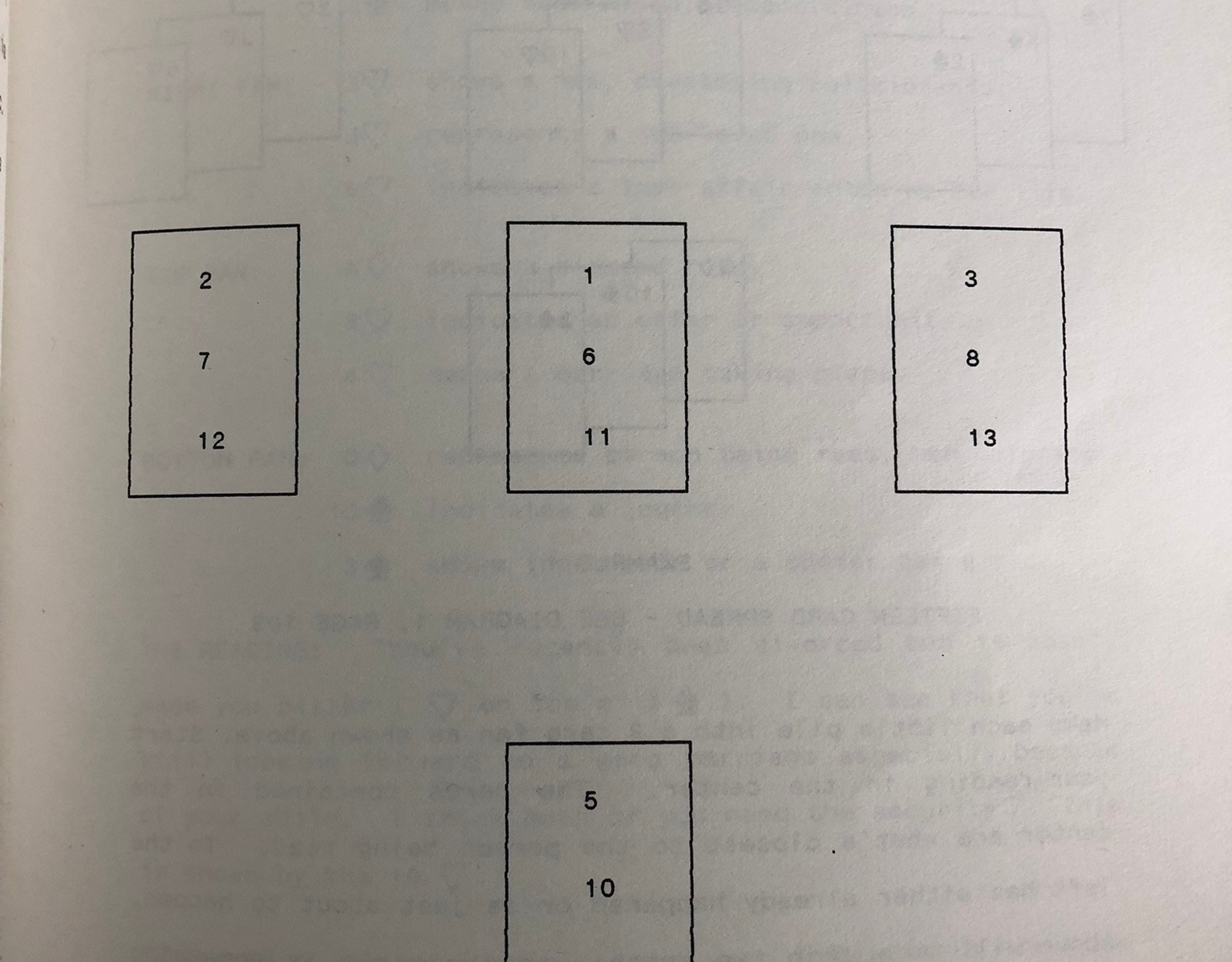
Essentially, the spread is five fans of three cards. They are laid out as follows:

The cards in the center are what is closest to the Questioner. To the left is the recent past or something just about to happen. The cards to the right are something new coming into the Questioner’s life. The cards above are set to occur within two months—those below in two months’ time.

Last month I used the spread to read for a husband and wife, Niamh and Fionn. Niamh and I met several years ago. Fionn is self-employed and in February underwent an emergency ileostomy.

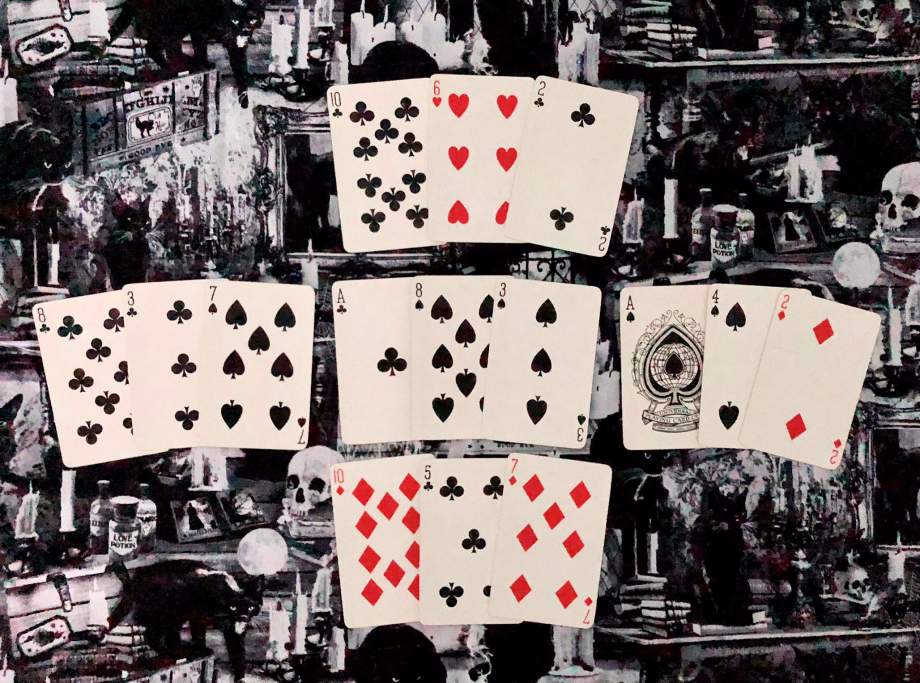
Fionn’s reading was as shown below.

Most of the cards are black, and clubs and spades are in the majority, so Fionn has his work cut out (clubs) to overcome his challenges (spades). The difficulties are financial (3 Diamonds).

Considering Fionn’s circumstances, the presence of the 8 of Spades at the center is unsurprising. It is the card of the doctor. Next to it is the Ace of Clubs: we have a hospital. Fionn had an appointment that week and would have some investigations (3 of Spades). On turning the 3 of Spades over, I immediately seized on x-rays. Fionn said “no” to this, but I said he might be surprised. However, the 3 of Spades covers all tests and investigations.

The Ace of Clubs also signifies documents, particularly official ones, and his treating physician (8 of Spades) may be asked to clarify some matters regarding his needs (3 of Spades + the fan on the right). Essentially, we have a medical report.

The trio to the left can signify the recent past and present. Fionn is worried about his surgery’s effect on his business (7 of Spades). 8 of Clubs often indicates our work. He runs a small landscape gardening and block paving company. Before his admission, things had been going well with a slight expansion and taking on a part-time trainee (3 of Clubs). This has now stalled (7 of Spades) as Fionn cannot lift, is in pain, tires quickly, etc. Fionn wants clarity on his recovery time.

The three cards to the right describe events occurring within a month or something new coming in Fionn’s life. Remembering the Ace of Clubs, we can see a decision (Ace of Spades) will be made within a month regarding what financial assistance Fionn is entitled to (4 of Spades + 2 of Diamonds). As the 2 of Diamonds falls last, we can be reasonably sure it is favorable. Fionn will get some form of social assistance. There will also be a discussion about realistic recovery times and how Fionn might need to adapt and slow down (Ace of Spades + 4 of Spades). Some of these changes will also be diet-related (2 of Diamonds) due to changes in digestion (Spades = elimination system).

The three cards above and below the center cards refer to events occurring within two months and in two months, respectively.

Fionn will receive a further helping hand (2 of Clubs) within the next two months following a business deal with a man (10 of Clubs + 6 of Heart). The 6 of Hearts is often a friend, brother, son, or son-in-law. Whoever he is, he’s got good business sense and ideas (10 of Clubs). Sometimes the 10 of Clubs is a journey, usually over water, and I wondered if this could be one of Fionn’s relatives from Ireland. Otherwise, Fionn will be traveling to see a friend who is supportive.

Let’s look at the final fan. Russell states that the three cards below can indicate something the Questioner doesn’t want to happen, associating the position with delay and dislike. I’ve not found this to be the case all the time. Sometimes it is just something occurring in two months’ time.

The 5 of Clubs can indicate reorganization and reevaluating. With the 10 of Diamonds, Fionn will need to look at his business plan and make changes to cover him until he can return to work (5 of Clubs). He can do things more efficiently and cheaply, and should look at supplies, etc. I also suspect this could be via further investment (10 of Diamonds) from either a loan or his earlier dividends (7 of Diamonds). The 7 of Diamonds at the end promises benefit in the long run even if Fionn is reluctant.

Fionn had his appointment with his consultant and was given a form for a chest x-ray because he had a drain fitted during his admission due to fluid build-up. He was surprised. When something seizes the Reader, it is best to go with it even if the Questioner disagrees. Time will tell. You or they may be wrong. The cards will invariably be right.

Fionn was also advised that his consultant had been contacted about his benefits claim. I’ve asked Fionn to keep me up-to-date.

§

Deck: Deluxe Playing Cards (Alf Cooke), c. 1930 – 1940.

Card Reader’s Handbook, self published by Regina Russell in 1976.
The Complete Book of Tarot by Juliet Sherman-Burke, published by Pan Macmillan in 1985.

The Dame’s Nowl

Think of the universal substance, of which thou hast a very small portion; and of universal time, of which a short and indivisible interval has been assigned to thee; and of that which is fixed by destiny, and how small a part of it thou art.

Marcus Aurelius, The Meditations Book V (Long trans.)

Cartomantes have long favoured “star” patterns of varying sizes and operations. Here, we will look at a late nineteenth-century variation I refer to as the Dame’s Nowl.

Like Basil Ivan Rakoczi’s Coven of Thirteen – popularised by Dawn R. Jackson – the Dame’s Nowl employs 13 cards. Unlike Rakoczi’s variation, the Dame’s Nowl forgoes mirroring for positional contexts: charting the past, the present and the future alongside unhelpful influences or problems. Consequently, it is an excellent alternative to spreads such as the Celtic Cross.

“The Fashionable Fortune-Teller”

Between 1896 and 1913, “Minetta” authored two books on cartomancy and one on tasseomancy. Minetta also conceived a Bésigue-style deck, specifically for cartomancy, and provided the instructions for a Petit Lenormand published as the Gypsy Bijou Fortune Telling Cards.

Minetta’s identity has never been identified. Several names have been proposed. Caitlín Matthews has suggested that Minetta was Cicely Kent.

There are similarities between Cicely Kent’s text and Minetta’s; although they are not without differences. However, there are also differences between Minetta’s 1896 and 1913 books. Although both manuscripts utilise the same readings, there is some difference in interpretations, and Minetta gives different definitions for multiples in the two texts. It thus the current author’s feeling that two different authors might have written under than penname, one quite possibly being Cicely Kent. Of course, however, this could be development: as diviners, we all grow and change.

The Dame’s Nowl or Star of Fortune:

Minetta’s Star of Fortune appears in both books. It is, however, titled method II in 1896. As I know another spread with this title, I refer to Minetta’s as The Dame’s Nowl.

Minetta’s Method II

In her 1896 text, Minetta states to:

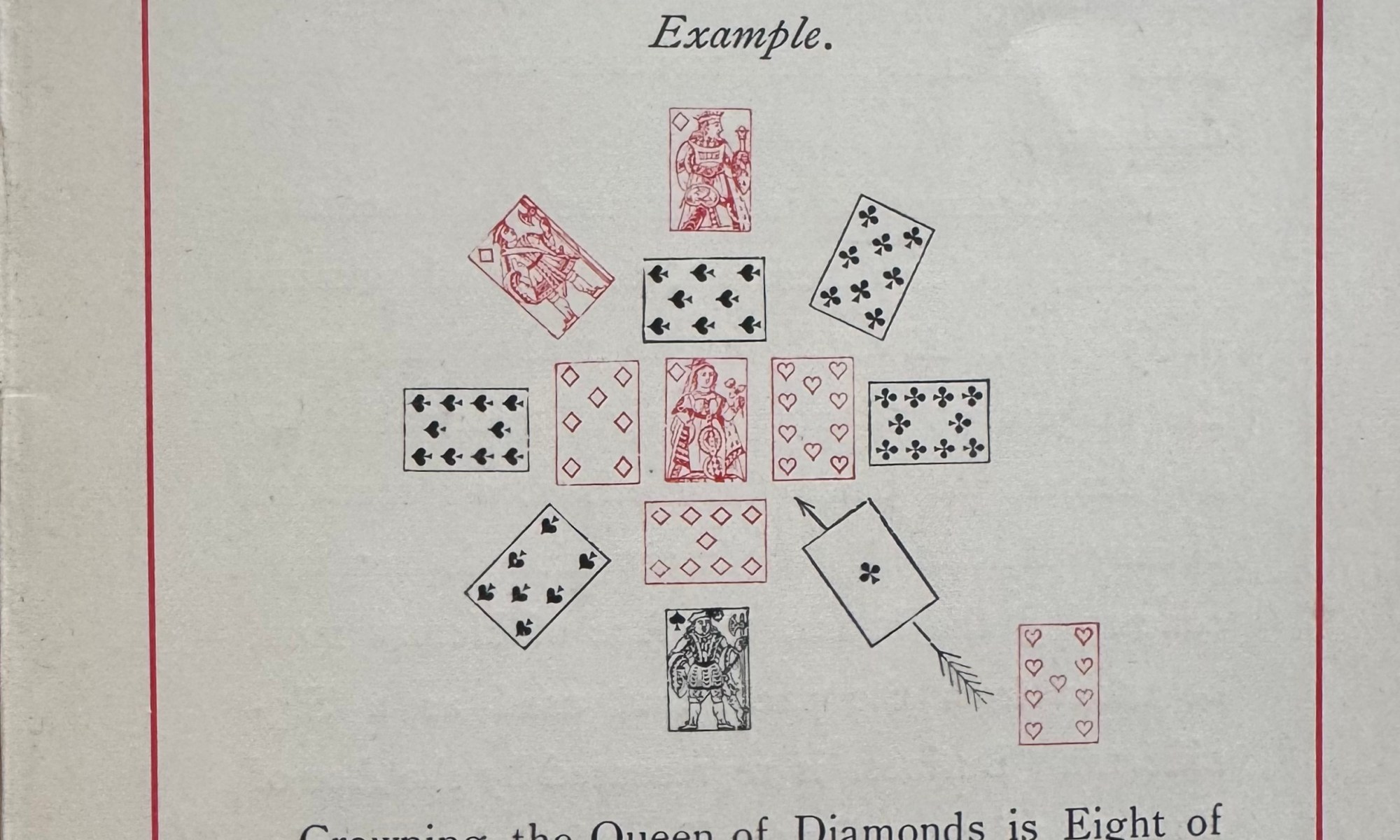
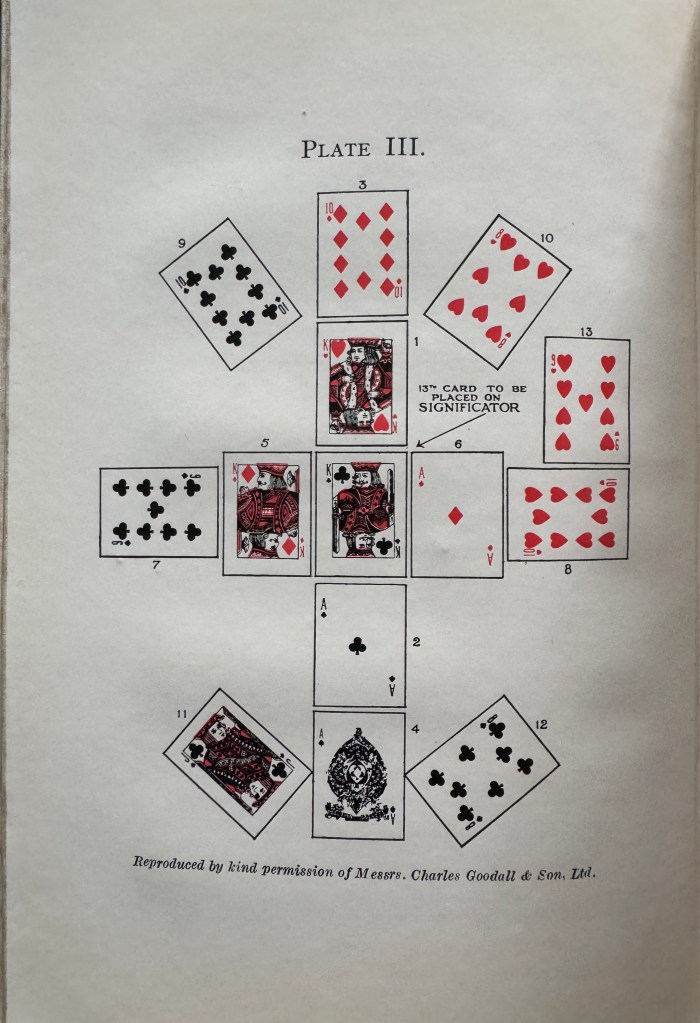
Place two at the head of the significator, two at the feet, two on the right, two on the left, one in each corner, and one on the significator, making in all thirteen cards.

What The Cards Tell (p. 26)


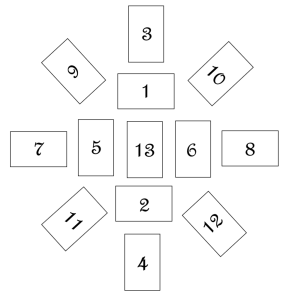
In Card Reading, Minetta states the specific order, as indicated in the diagram below.

Both Cicely Kent and Sepharial adhere to this order.

Cecily Kent’s Star of Fortune

Minetta’s instruction for reading the spread is:

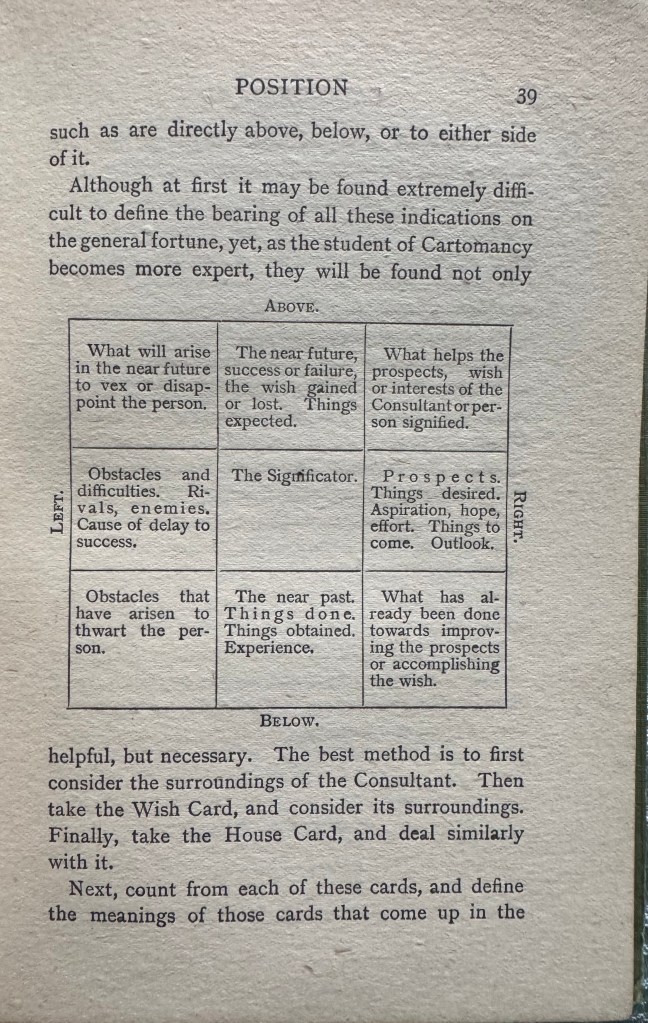
Those cards which crown the significator predict the near future; those at the feet, the past; those to the left, obstacles; those to the right, the distant future; the top corners, present details; those at the feet, the past details; the card on the top of the significator, the consolation.

What The Cards Tell (p. 26 – 27)


Minetta removes the significator before shuffling. It is placed centrally, with the thirteenth card placed upon it.

Adhering to standard sinister (left) and dexter (right) conventions, Minetta sees cards to the left as challenging and problematic. Those to the right can advise on remedy and assistance. These become more pronounced in her 1913 text which includes a table diagram.

Minetta’s Table

Following the Nowl: Stacey’s Reading

Let us look at a reading with the Petit Lenormand. This reading was done just before Christmas 2019. Stacey is a young woman and wanted a general look at where her life was going. For general readings, spreads such as the Coven of Thirteen or the Astrological Wheel are often preferred. However, Stacey seemed quite unhappy, so I thought it was best to ascertain both her background and challenges.

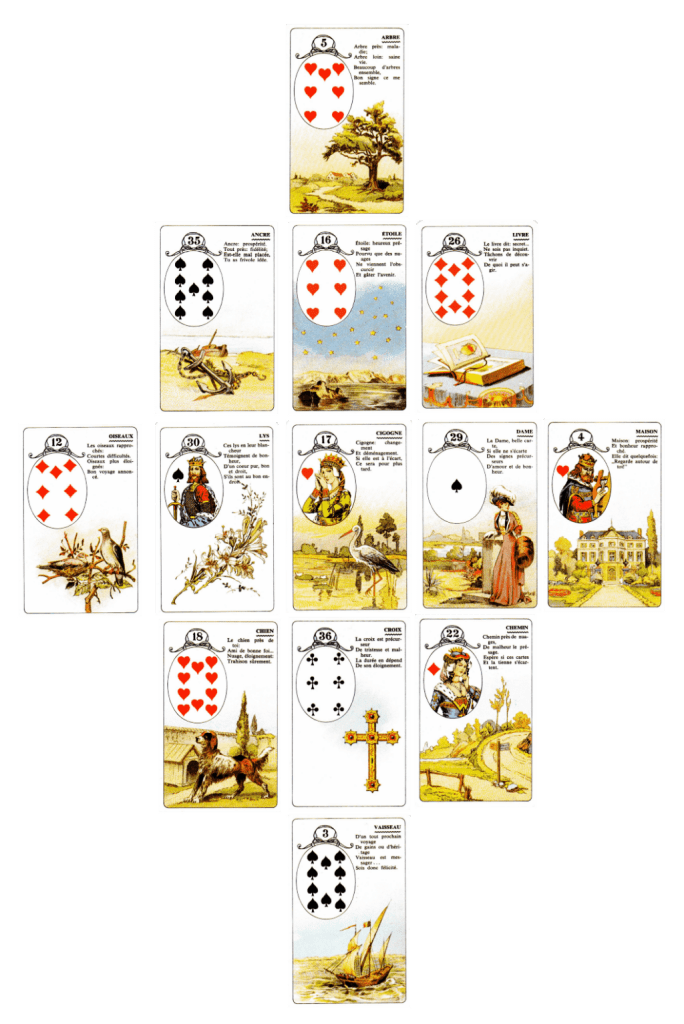
The cards as they fell:

At the heart of the star, we find the Stork. Change is afoot. We will bear this in mind as we examine the cards’ different combinations.

We will start with the bottom section as these describe the past circumstances. Keeping the Stork card at the forefront of our mind, we see that there has been a difficult transition (Cross Boat) in Stacey’s life.

With the Cross crowning the Boat card, we know that this will have been a significant shift in Stacey’s circumstance and marked a milestone.

Looking to the left and right of the Cross, we see the Hound and Path cards which sheds more light. Stacey’s decisions (Path) has seen her relocate (Cross Boat), which has meant that she has lost her familiar surroundings (Hound Cross). The presence of three tens further emphasises that.

Unfortunately, this has left Stacey feeling out in the cold, and a period of disquiet has ensued (Birds Lilies). With the Lilies on the left and the Cross and Boat at the star’s feet, one was sure that Stacey had moved away from her family.

Both the Birds and Hound cards are near enough to the Lilies to be read as persons, but one was not seized to interpret them as specific individuals. However, the two queens and two kings do denote male and female acquaintance. With the Hound on the sinister side of the star, and the presence of two sixes in the spread, it is clear Stacey has struggled to form new relationships, and this has magnified her discomfort.

Moving upward, the Anchor’s orientation poses a dichotomy. Stacey’s attempts to find a sense of place will continue to prove difficult and keep her moored to her present feelings. Fortunately, the Tree and the Stars bring a soothing solution.

Over the coming weeks, she will take some time out (Tree) and focus on herself and where she feels she needs to be in life (Tree Book). We note the Stars are the Tree’s roots in this spread, and they seem to be guiding Stacey back home. But the Book falls adjacent to the Stars and crowns the significator. Stacey is urged not to rush into any decisions, which seem to have been the case in the past (Path).

Further into the future, Stacey will find herself moving into more comfortable times (Lady and the House). With the presence of both the Tree and the Lilies cards, it is likely this is a move back to familiar surroundings. Coming back to the Stork, we remember that it is a migratory picture: Stacey will go back home.

Stacey was in her first year at university but was not enjoying her surroundings and her course.

After some reflection, Stacey decided to transfer to a new university in her hometown. Due to the lockdown, Stacey returned home in the Spring. That fits with the Lady looking to the House card (last week of Spring).

§

Images:

Featured Image, Morigan221, CC BY-SA 3.0 https://creativecommons.org/licenses/by-sa/3.0, via Wikimedia Commons.

Cards, Jeu Lenormand © Carta Mundi

References:

Kent, C., 1921. Telling Fortunes by Cards. 1st ed. Herbert Jenkins: London, pp. 90 – 96.
Minetta, 1896. What the Cards tell. (What the Cards told. A fact.) By Minetta. 1st ed. Downey & Co.: London, pp.26 – 28.
Minetta, 1913. Card-reading. A practical Guide. 1st ed. William Rider & Son: London, pp.39 – 47.
Rakoczi, B., 1970. Fortune Telling. 1st ed. London: Macdonald Unit 75, pp.30 – 36.