
And God said, “Let there be lights in the firmament of the heavens to separate the day from the night; and let them be for signs and for seasons and for days and years, and let them be lights in the firmament of the heavens to give light upon the earth.” And it was so
Genesis 1:14-15 (RSV CE)
We had found the stars, you and I. And this is given once only.
André Aciman, Call Me By Your Name
Star, confirms good luck in all your enterprises, but if it surrounded by clouds, it indicates a long period of misfortune
Original Instructions
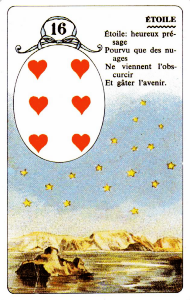
Card No. 16 in the Petit Lenormand, the Stars, is represented by the Six of Hearts. It is often regarded as one of the deck’s most fortunate cards, associated with wishes, destiny, inspiration, and guidance. Whilst these meanings are not without merit, they are secondary to a far more fundamental principle: the Stars provides clarity.
The Essence and Function of the Stars
The traditional eikōn exists in two principal forms. Simpler decks depict a single star as a grapheme or glyph. More elaborate patterns show a night sky illuminated by numerous stars above a body of water or distant landscape. Despite these artistic variations, the symbolism remains essentially the same. The heavens stand above the world, providing orientation and direction to those below.
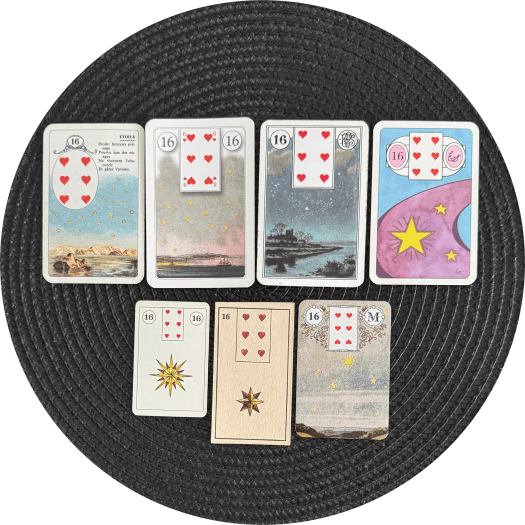
The essence of the Stars is clarity and its function is to guide.
For millennia, mankind has looked to the stars for guidance. Long before maps, satellites, and compasses became commonplace, travellers navigated by the heavens. Sailors crossed oceans using the stars to establish their position and direction. The North Star, Polaris, became especially important because its apparent fixity allowed travellers to orient themselves even in darkness.
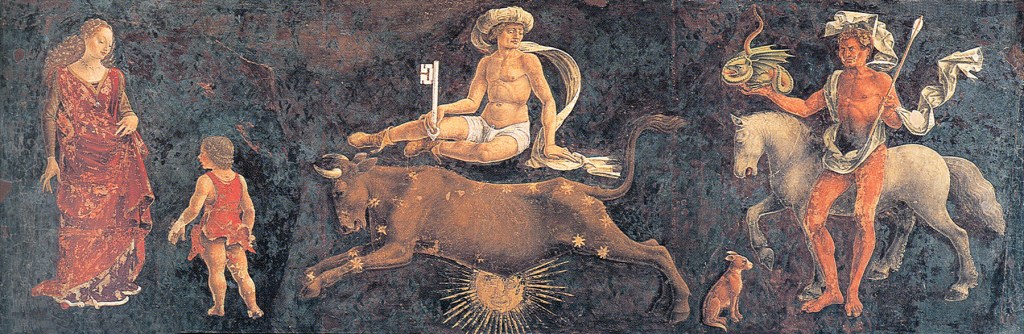
The stars were not merely guides through space, but through time as well. The ancient Egyptians used groups of stars known as decans to divide the night and structure their calendar. Later, during the Hellenistic period, the observation of the heavens gave rise to horoscopic astrology, a sophisticated system that sought to understand time, fate, and human experience through the movements of celestial bodies. In both cases, the stars were valued because they revealed patterns and provided orientation. They allowed people to understand where they were and, equally importantly, where they were going.
I adjure you, my most precious brother, and you, initiates into this mystic art, by the starry vault of heaven and by the twelve-fold circle, by the Sun, the Moon, and the five wandering stars by whom all of life is guided, and by Providence itself and Holy Fate, to preserve these matters in secret and not to share them with the vulgar, but only with those worthy of them and able to preserve and requite them as they deserve
Vettius Valens, Anthology (Riley, trans)
This connection between divine guidance and celestial light also permeates the religious traditions familiar to the creators of the Petit Lenormand. On the fourth day of Creation, God placed the heavenly lights in the firmament to serve as signs, seasons, days, and years. The stars were intended to mark time and provide order to the world.
Likewise, God’s promise to Abraham invoked the stars of heaven as an image of destiny and fulfilment beyond immediate comprehension.
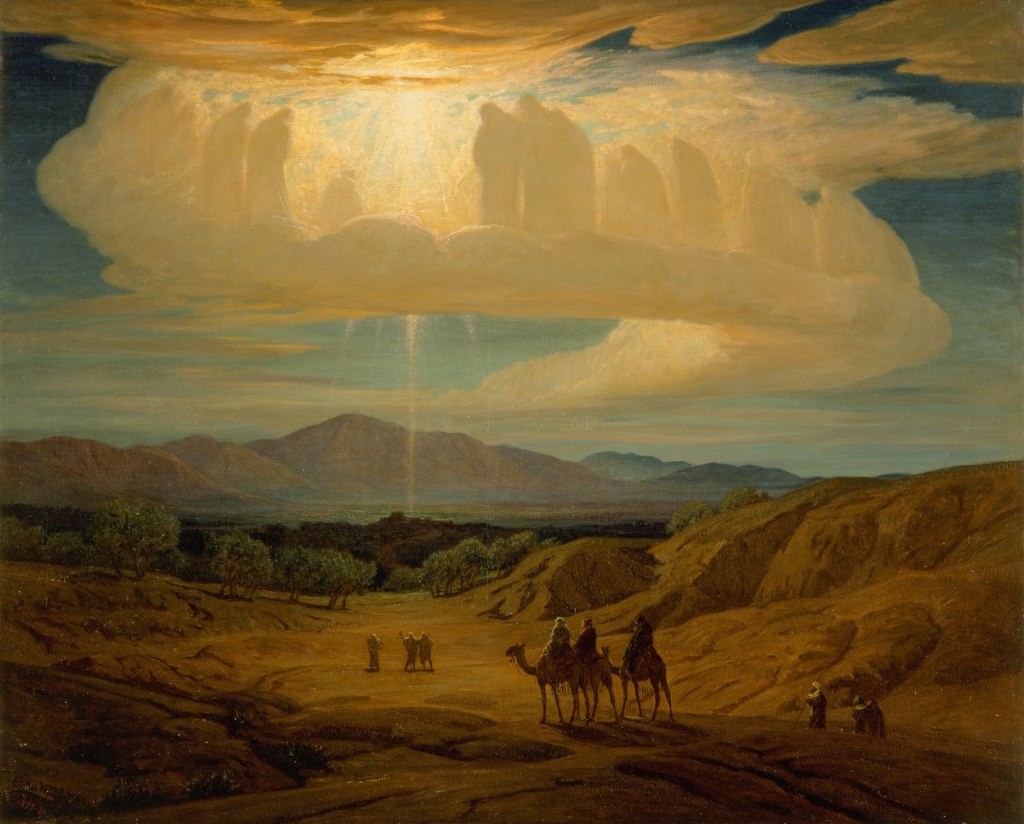
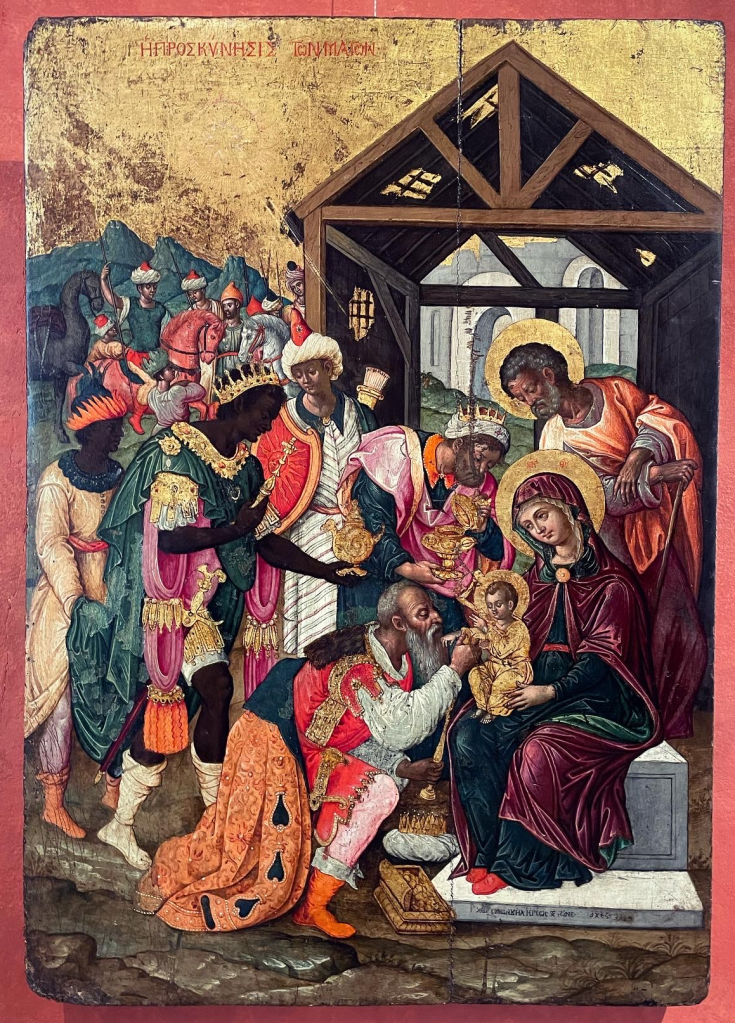
Perhaps the most striking example is found in the Gospel account of the Magi. Guided by a star, they travelled from afar to adore the Christ Child. In Christian tradition, this event came to be understood as the first revelation of Christ to the nations. The star did not grant the Magi their wish. Rather, it showed them where they needed to go. It provided direction, certainty, and illumination.
This distinction is vital when reading the card.
Many modern authors describe the Stars as a wish card. In practice, I have never found this particularly accurate. The Stars does not grant wishes. It does not simply bestow success, happiness, or fulfilment. Rather, it provides the clarity necessary to realise those aspirations. It reveals where our attention should be focused and what path should be followed. The card joined to the Stars often describes precisely the area of life requiring deeper exploration and more serious consideration.
Vocation and Fulfilment
The Stars is especially important in questions concerning vocation and personal fulfilment.
Many readers confuse the Stars with the Sun or Moon. Whilst these cards may overlap, they describe very different phenomena. The Sun brings success, vitality, and visibility. The Moon brings recognition, reputation, and public esteem. The Stars, however, concerns direction and calling. It reveals what genuinely fulfils the individual and where their talents and interests can best be developed.
For this reason, the Stars often identifies a person’s niche. It points towards the area in which they should specialise, deepen their knowledge, or concentrate their efforts. The card does not merely show what one can do successfully, but what one feels called to pursue. In career readings, it frequently indicates the subject, profession, or field that gives meaning and purpose to one’s work.
A person may enjoy financial success under the Sun or public recognition under the Moon, yet still feel dissatisfied and adrift. The Stars seeks to remedy this by providing direction. It helps us discover not merely what we are capable of doing, but what we ought to be doing.
Love and Relationships
In matters of love, the Stars often describes a relationship that expands one’s horizons and encourages personal growth. The connection may be regarded as a true love, soulmate, kindred spirit, twin flame, or any of the other labels people use to describe relationships of unusual depth and significance.
What matters is not the terminology, but the experience itself. A Stars relationship broadens the perspective of those involved. It encourages learning, exploration, and development. The individuals help one another become more fully themselves.
The card’s guiding function is particularly evident here. The relationship often provides a sense of direction and purpose, helping both parties understand themselves more clearly and identify what they genuinely want from life.
When difficulties have arisen, the Stars can also be an encouraging sign. Because its nature is to guide, it frequently indicates that a relationship can be brought back onto the correct course. Misunderstandings may be clarified, goals re-aligned, and a shared sense of direction restored. The card does not promise that every relationship will survive, but it does suggest that clarity and honest reflection can illuminate the path forward.
For this reason, the Stars frequently indicates a period of study, reflection, planning, or specialisation. The card encourages a deep dive into the matter it touches. One moves beyond superficial understanding and begins to perceive the underlying patterns and connections that were previously overlooked.
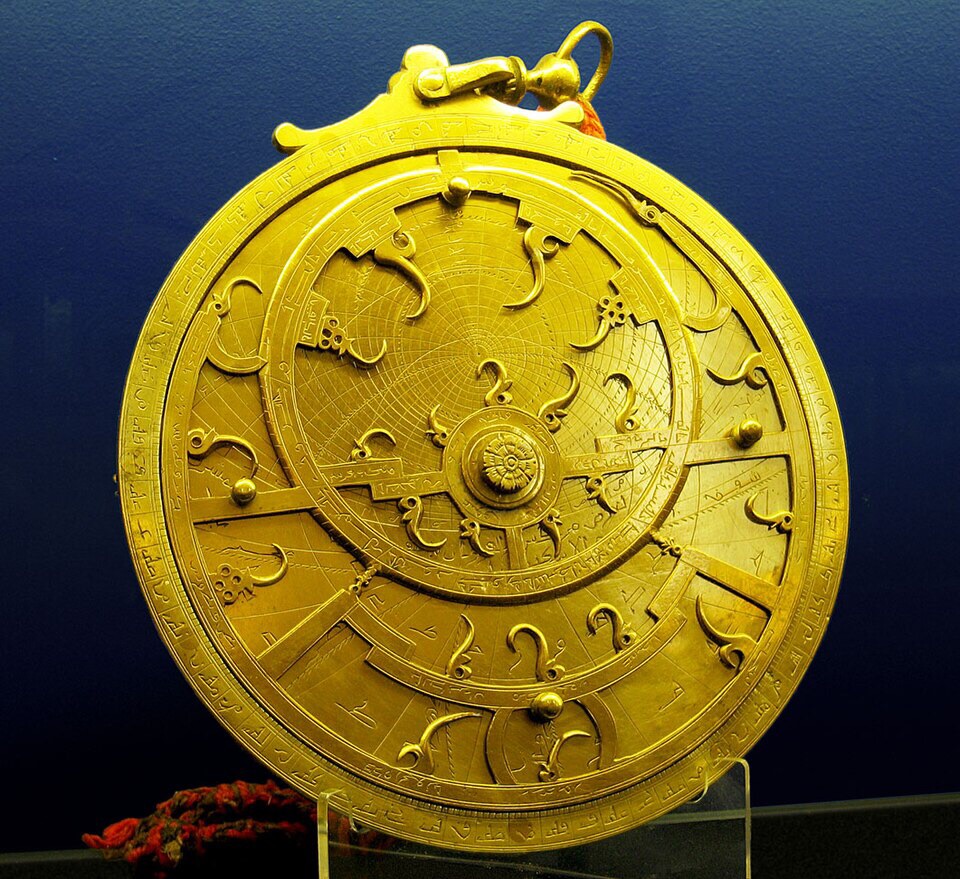
In many respects, the Stars functions as a celestial astrolabe. It provides orientation and situates the seeker within a larger framework. Acting through the primum mobile, it reveals not merely where we are, but where we ought to be heading. The card therefore possesses a strongly chronocratic quality, helping us understand the proper timing, direction, and development of events.
This also explains the card’s longstanding interaction with the Clouds.
Traditionally, the combination of the Clouds and Stars has often been regarded as unfortunate. Whilst experience supports the difficulty implied by this pairing, the reason is frequently misunderstood. The misfortune does not arise because the stars themselves have become malevolent. Rather, the Clouds obscures them.
Without the stars, we lose our bearings. The path becomes uncertain. We struggle to understand what we truly want, where we should be directing our efforts, and what steps need to be taken next. Navigation becomes difficult because clarity has been removed. The resulting confusion, hesitation, and misdirection are the true hardship indicated by the combination.
The Clouds does not destroy the guidance offered by the Stars. It merely hides it from view.
Coda
At its heart, the Stars is a card of clarity, guidance, and orientation. It illuminates the path ahead, reveals underlying patterns, and helps the seeker understand where their efforts should be directed. Unlike the Key, which grants access, or the Ship, which provides movement, the Stars tells us where we ought to be going and how we might best arrive there.
Person and Description
Person
The Stars is not, in itself, a person card and is therefore not ordinarily used as a significator. When appearing alongside a person card, however, it can provide valuable information concerning both physical appearance and temperament.
Physical Description
The Stars often describes an individual who possesses a certain sparkle or luminosity that is difficult to define precisely. There is frequently something appealing, engaging, or memorable about them that cannot be adequately explained by conventional measures of attractiveness. Others simply seem to notice them.
The card also suggests a good sense of style. Such individuals are often well-presented and may have an appreciation for jewellery, decorative accessories, or clothing that catches the light. Depending upon the person, this can range from understated elegance to a fondness for more sparkly or eye-catching attire.
Free from adverse cards, the Stars frequently indicates clear skin and an attractive complexion. The appearance is often healthy, bright, and unblemished. Negative cards may modify this. The Mice can point towards acne, blemishes, or scarring, whilst the Coffin may suggest dryness, dullness, or skin conditions that diminish the card’s natural radiance.
In terms of stature, the Stars usually describes someone of average height and build. Rather than determining size, the card contributes an overall sense of refinement, brightness, and attractiveness.
Temperament
The Stars is one of the most intellectual cards in the Petit Lenormand. It frequently describes individuals with a keen mind, broad knowledge, and a genuine desire to understand the world around them.
These people are often drawn towards specialised interests and may devote considerable time and energy to mastering a particular subject. The topic itself matters far less than the depth of commitment. One person may become an authority on astronomy, another on railway history, vintage watches, philately, or Star Wars memorabilia. Stars people rarely dabble; they study.
The card’s connection with navigation, astronomy, and the heavens also creates a natural affinity for science, technology, and analytical thinking. Scientists, engineers, programmers, physicists, researchers, and academics frequently appear under the Stars. It may also indicate an interest in astrology, divination, and esoteric subjects, although this should not be overstated merely because one is conducting a card reading.
Perhaps the most distinctive quality of the Stars person is their sense of direction. Unlike many who drift through life uncertain of what they want, Stars people often possess clear goals and a strong understanding of how to achieve them. They are guided by ideals, ambitions, and long-term aspirations.
There is also an expansive quality about them. Their curiosity continually draws them towards new ideas, deeper understanding, and broader horizons. Consequently, they can sometimes be difficult to tie down. Like the stars themselves, they are oriented towards what lies beyond the horizon and are seldom content to remain confined for long.
Above all, the Stars describes a person seeking clarity, knowledge, and purpose. Whether through study, discovery, science, technology, or spiritual inquiry, they are driven by a desire to understand both where they are and where they are going.
Special Features
Grand Tableau
Traditionally, the Stars augurs good fortune in one’s affairs because it provides clarity and direction. When we know where we are going and how to get there, success becomes considerably more likely.
When the Stars encounter the Clouds, however, their light is obscured. We no longer possess the information, understanding, or perspective required to navigate the situation effectively. The resulting disarray has traditionally been interpreted as misfortune, but the reality is rather more nuanced. The problem is not that the Stars has become malevolent; it is that its guidance can no longer be clearly seen.
When this occurs, it is often best to wait. It does not mean the goal must be abandoned. Rather, it suggests that the seeker is navigating without sufficient information and would be wise to postpone action until conditions become clearer.
Ideally, the Stars should fall both close to and above the significator. This suggests a particularly favourable position, as understanding, resources, and timing all align. The farther away the Stars lies, the less clear the direction becomes and the longer matters may take to achieve.
Direction
For millennia, travellers navigated by the stars. Chief among these was Polaris, the North Star, whose position in the constellation of Ursa Minor allowed sailors and travellers to establish true north even in darkness.
Consequently, it is only natural that the Stars can signify north, much as the Sun often signifies south.
This is not a signification the cartomante will make use of every day, but from time to time it can prove surprisingly helpful. Thus, Ship–Stars might indicate a journey to the north or travel in a northerly direction. Likewise, House–Stork–Stars may show relocation north of one’s present residence. Both combinations have appeared in readings over the years.
More broadly, direction should not be understood solely in geographical terms. Just as sailors once used the stars to establish their position, the Stars often indicates the direction in which one’s attention, effort, or movement ought to be directed.
The Mental Plane
The Stars can also provide valuable insight into the seeker’s state of mind and approach to life. The card often reveals what currently occupies their attention and where their mental energy is being directed.
Thus, Stars–Birds may describe someone who is excitable, mentally overstimulated, or easily distracted, whereas Stars–Sun often indicates optimism, confidence, and an ambitious outlook.
This principle can be applied practically. Stars–House suggests that domestic concerns, family life, or property matters require attention. Stars–Ship may indicate a need to broaden one’s horizons, take a journey, or simply step away from the familiar in order to regain perspective. Stars–Book often encourages study, research, or specialised learning.
In this respect, the Stars differs markedly from the Key. The Key provides access and answers. The Stars does not necessarily unlock anything. Rather, it points towards the area demanding our attention and encourages a deeper understanding of it.
The Deep Dive
One of the Stars’ most characteristic qualities is its tendency towards specialisation.
When the Stars falls with another card, it frequently invites the seeker to develop expertise in that area. The card encourages study, mastery, and a deeper understanding of the subject concerned.
Thus, Stars–Book may indicate advanced study or scholarship. Stars–Ship can point towards expertise in travel, foreign cultures, or international affairs. Stars–Fishes may suggest specialised financial knowledge or investment expertise. Stars–Bouquet often appears in connection with artistic development or refined creative skills.
The Stars rarely encourages superficial engagement. It asks us to look deeper, understand more fully, and develop genuine mastery.
Expand
Like the Fishes and the Park, the Stars possesses a quantitative quality.
The distinction is important. The Park multiplies. The Fishes deepens. The Stars expands.
One need only imagine a clear night sky, stars spreading across the horizon in every direction. The card therefore signifies growth, extension, dissemination, and expansion.
This quality can prove beneficial or troublesome depending upon the circumstances. Several years ago, I read for a client whose first three cards in a Grand Tableau were House–Coffin–Stars. Black mould (Coffin) had spread (Stars) throughout the client’s flat (House).
More positively, Fishes–Stars has appeared in connection with investments yielding substantial returns. One client more than doubled their original stake.
The important point is that the Stars itself is neutral. Clarity is neither inherently good nor bad. The card illuminates and expands whatever it touches, whether beneficial or harmful.
Timing
In matters of timing, the Stars is a relatively swift card and frequently accelerates events or reinforces the timing of neighbouring cards.
Under the auspices of the Stars, one should proceed with clarity but without unnecessary delay. Once the correct course of action has been identified, hesitation rarely proves beneficial.
Traditionally, the Stars signifies night, in contrast to the Moon’s association with evening. Thus, Cavalier–Stars may indicate a visitor arriving at night, a late-night journey, or news received after dark. These interpretations are most commonly employed in short-term readings, though they can occasionally prove relevant in larger spreads such as the Grand Tableau, particularly when appearing amongst the opening cards.
Over the years, I have also observed a recurring association between the Stars and the Feast of the Epiphany, traditionally celebrated on 6 January. This is not a traditional attribution, but one that has appeared with sufficient regularity in my own practice to merit mention. In most cases, the manifestation occurs around the date itself, extending from a few days before to roughly a week afterwards.
Health
Within the body, the Stars is associated with the skin. Free from adverse influences, it often signifies healthy, clear skin and good complexion. Other cards refine the picture. The Sun may point towards dryness or sensitivity, whilst the Mice can indicate parasites, repetitive tics, blemishes, or conditions that gradually diminish the skin’s appearance.
More commonly, however, the Stars appears in connection with sleep, cognition, concentration, and mental clarity. Just as the stars help travellers orient themselves physically, the Stars governs our ability to orient ourselves mentally.
When well-placed, the card supports clear thinking, good concentration, and healthy sleep patterns. When afflicted, difficulties may arise. Stars–Mountain, for example, can indicate insomnia, disrupted sleep, mental fatigue, or difficulty functioning effectively due to exhaustion.
On rarer occasions, the Stars can indicate an illness spreading or progressing. This is seldom an unexpected development, particularly where chronic or serious conditions are concerned, but it remains an important consideration. Here, the card reflects its expansive quality, showing a condition extending beyond its previous boundaries. As always, the surrounding cards will clarify whether such progression is significant, manageable, or merely part of an already recognised medical situation.
The Stars in Action
As the name suggests, the Astrological Wheel, sometimes called the Horoscope Spread, has its origins in astrological practice, specifically the twelve mundane houses. It remains one of the most popular layouts amongst cartomantes. As someone with a long-standing interest in astrology, it is a spread for which I have a particular affinity and one that I frequently employed when reading with the Tarot and Oracle Belline.
One of its principal strengths is that it covers the major areas of life: relationships, family, career, finances, education, health, and wellbeing. As one becomes more comfortable with the layout, it is also possible to obtain increasingly detailed information by examining the relationships between houses and, when appropriate, employing techniques such as derived houses.
The Astrological Wheel
The spread contains twelve positions whose meanings derive from the core significations of the astrological houses.
I emphasise core significations because each house possesses multiple layers of meaning, some of which are specific to specialised branches of astrology such as mundane astrology (the study of nations and political events) or decumbiture charts (cast when a person takes to their bed through illness). That the Fifth House can signify ambassadors is of little practical importance to the average client.
The basic significations are as follows:
- First House: The querent’s mental state, health, and constitution.
- Second House: The querent’s income, finances, and possessions.
- Third House: Communications, siblings, and neighbours.
- Fourth House: Home, domestic life, and parents.
- Fifth House: Children and hobbies.
- Sixth House: Pets, employees, illness, and difficulties.
- Seventh House: Partners and committed relationships.
- Eighth House: Outgoings, debts, losses, and endings.
- Ninth House: Education, travel, religion, and spiritual life.
- Tenth House: Career, public life, and major projects.
- Eleventh House: Friends, hopes, wishes, and good fortune.
- Twelfth House: Problems, challenges, and misfortune.
Some of these significations may surprise modern readers. My own approach follows earlier Hellenistic, Perso-Arabic, and Medieval and Renaissance astrologers. Consequently, I regard the First House as the principal house of health and vitality, whilst the Sixth pertains to illness, servants, employees, and difficulties. Likewise, I consider the Tenth House rather than the Sixth to be the primary house of career and public activity.
For our purposes, however, we are concerned only with the basic significations of the houses. This is a card spread rather than a natal and solar return chart.
Even so, it is easy to see how the houses relate to one another. The First and Sixth Houses, for example, describe health and ill-health respectively. Examining both positions allows us to compare a person’s strengths and vulnerabilities.
Justine’s Reading
Justine was studying the Petit Lenormand and specifically requested that we use the Astrological Wheel.
Whilst I frequently employ this spread with the Tarot and Oracle Belline, it is not one I utilise often with the Petit Lenormand. This is simply because I generally prefer the Grand Tableau or the Great Wheel. Nevertheless, the Astrological Wheel is perfectly suited to the Lenormand and was included by both Mary Marco and Jeanine Goffinet in their influential work on the cards.
The spread may be performed using twelve, twenty-four, or all thirty-six cards. The deck is shuffled and cut before dealing one card into each house and, if desired, covering each position once or twice to create greater depth.
In this example, we shall focus solely upon the Second and Eighth Houses, as these govern Justine’s finances.
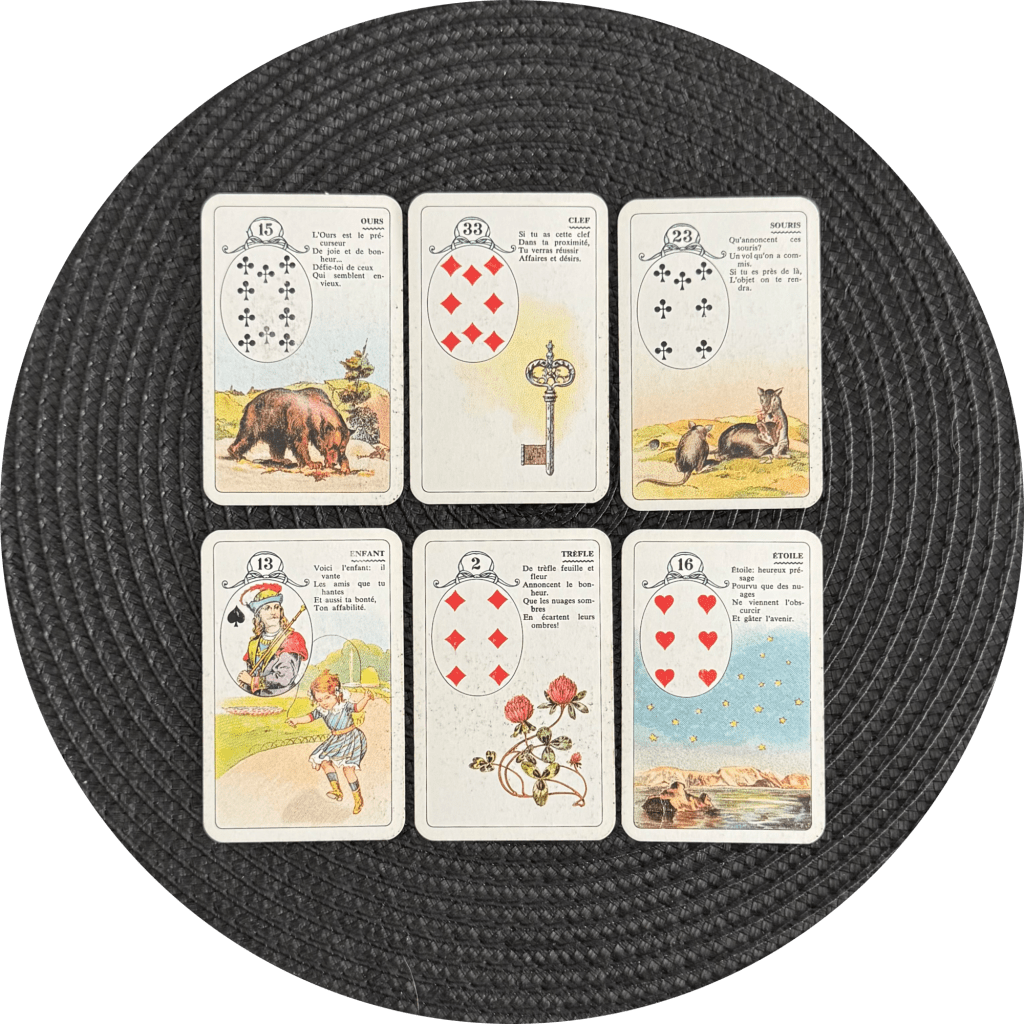
Second House: Bear – Key – Mice
Eighth House: Child – Cloverleaf – Stars
The Second House immediately revealed a mixed picture.
The Bear confirmed that Justine possessed resources and ordinarily enjoyed a stable income. There was no indication of poverty or a complete lack of financial security.
The Key, however, occupied a pivotal position between the Bear and the Mice. As discussed earlier in this series, the Key opens what precedes it and secures what follows.
Thus, the Key is opening the Bear, granting access to its resources. At the same time, it is securing the Mice. This is an important distinction. The loss indicated by the Mice is no longer merely a possibility. It becomes something certain.
Fortunately, the Mice remains the Mice. The loss is real, but relatively small. We are dealing with leakage, erosion, and gradual reduction rather than catastrophe.
The sequence therefore suggested that Justine’s income would diminish for a period of time, forcing her to make use of savings or existing resources in order to compensate for the shortfall.
The Eighth House explained why caution was required.
At first glance, the presence of the Cloverleaf and Stars appears encouraging because both are traditionally regarded as fortunate cards. Yet context is everything. This is the Eighth House, which governs debts, losses, financial obligations, and endings.
The Child here does not signify something new. Rather, it describes something small, immature, and underdeveloped. A minor debt, modest financial obligation, or relatively insignificant liability is being shown.
The Cloverleaf initially appears reassuring. It suggests something temporary and manageable, perhaps an instalment plan, short-term payment arrangement, credit agreement, or other obligation expected to resolve itself quickly.
The critical card, however, is the Stars.
As discussed throughout this article, the Stars expands whatever it touches. It does not merely increase; it spreads outward and extends itself. Here the Stars follows both the Child and the Cloverleaf, showing that a small and initially manageable obligation is beginning to grow beyond its original limits.
Taken together, the two houses described opposing movements.
Resources were being reduced whilst obligations were expanding.
I therefore advised Justine that her income would likely be reduced for a period of time. If she had any existing credit-card balances, instalment plans, or buy-now-pay-later arrangements, she would be wise to address them sooner rather than later. There would be a temptation to rely upon such facilities to bridge the gap, but the expanding nature of the Stars suggested that interest charges and repayment obligations could become increasingly burdensome if left unchecked.
The outcome reflected the cards closely.
Shortly after the reading, Justine experienced a quiet period at the salon where she worked as a hairdresser. The resulting reduction in income made it difficult for her to maintain certain credit payments. Concerned about mounting interest, she negotiated a payment plan and adjusted her spending accordingly.
The cards had not predicted financial ruin. Rather, they accurately identified a temporary reduction in income and highlighted how a modest financial obligation could expand into a more significant concern if left unmanaged. In this respect, the Stars performed exactly as expected: it showed a small problem spreading gradually beyond its original boundaries.
§
Images:
Featured Image: NASA, ESA, A. Aloisi (STScI/ESA), and The Hubble Heritage (STScI/AURA)-ESA/Hubble Collaboration, Public domain, via Wikimedia Commons
Cards:
Lenormand Cards: Jeu Lenormand © Cartamundi, WanderWüst © Jorge/Wandering Oracle, Lenormand Fortune-Telling Cards © Zao-Gelli, The Lenormand Oracle © Verlag für die Frau, Leipzig, Nieuwe Lenormand © Amber Studio/Erna Droesbeke, Lenormand 36 Orakelspielkarten © Königsfurt-Urania,
References:
Boroveshengra, A., 2013. Cartomantes’ Cabinet: The Petit Lenormand Course.
Boroveshengra, A., 2015. Lenormand Thirty Six cards. 2nd ed. Create Space.
Ignatius Press (2005) Holy Bible RSVCE Compact Zipper. Ignatius Press.
Marco, M. and Goffinet, J., 1989. Petit Lenormand. Bruxelles: Servranx.
Matthews, C. 2014 The Complete Lenormand Oracle Handbook: Reading the Language and Symbols of the Cards. Rochester, VT: Destiny Books.
Meuris, B., 2018. Petit Lenormand Encyclopaedia: Volume 1. Create Space.
Silvestre, C., 2003. Le Petit Lenormand. [Montpellier]: Gange éd.


 Journal of a Cartomante


.jpg)