Fox Associations

In the sixteen years since I first began to write about the Petit Lenormand, requests for “combination lists” have been both frequent and persistent. They are, however, something I have consistently declined to produce. My view has always been that it is far better to learn how to combine cards properly before committing any fixed pairing to memory. Of course, certain traditional associations do exist, and many of them hold true. Even so, you will not require them every time those cards appear together in a reading.

Times also change. In the early 2000s, I was working in the healthcare sector and read for a great many doctors, nurses, physiotherapists and the like. At that time, the Letter–Birds combination appeared endlessly. Do you remember pagers? I cannot recall when that combination was last appropriate. What was once ubiquitous has now become an historical curiosity.

The other difficulty with combination lists is that they are entirely devoid of context. They must be written—and read—as though everything were equal, which is almost never the case in practice. Some might even describe them as a form of creative fiction: neat, tidy, and occasionally useful, but never a substitute for genuine interpretative skill.

Of all the cards I was asked for combinations list, six appear with striking regularity: the Clouds, the Scythe, the Fox, the Mice, the Key and the Cross. Five of the nine traditional negative cards, and one can understand why they provoke anxiety. I can also understand the Key, too. Yet the Fox is the card that tops the list, time and again. I eventually realised that this was often because the person asking used the Fox as a work card; when it appeared outside professional matters, they struggled to relate it to the rest of life.

It is profoundly unhelpful to think in such terms. No Lenormand card means work, finance or sex in and of itself. Some cards have an affinity with certain spheres of life, certainly, and when examining a particular topic in a reading—especially in the Grand Tableau—you may draw upon these affinities to build a fuller and more nuanced picture. But they are contributory functions, not categorical definitions. To treat any card as the exclusive representative of a core concept is to limit the system and, ultimately, to limit one’s own interpretative ability.

So, for what it may be worth, here are some Fox associations—again, all things being equal, and I genuinely would not attempt to memorise them.

14 – 01: An untrustworthy visitor or confidence trickster. Something is amiss with the car, motorcycle, bicycle or horse, and there may be cheating in sport.

14 – 02: A day of misfortune. A lie told off the cuff, and someone feigning happiness or “putting on a front.”

14 – 03: An unprofitable enterprise. A warning against travel, as any journey undertaken is likely to encounter difficulties.

14 – 04: Domestic discomfort and tension behind closed doors. Something is wrong with the property. As a person: an unreliable man.

14 – 05: Poor lifestyle choices causing long‑term issues. A possible misdiagnosis or need for a second opinion (contrast with 14 – 05). Entrapment in long‑standing lies.

14 – 06: Deceit comes to light, though matters remain less transparent than they appear. As a person: an untrustworthy and unpleasant (usually older) man.

14 – 07: Temptation, inducement and spite; lies, intrigue and hidden agendas. A caution against detours. As a person: an untrustworthy and unpleasant (often older) woman.

14 – 08: Wrong treatment or a poor reaction to it (compare with 14 – 05). Feigning illness or grief for advantage. Ignorance, or a secret taken to the grave.

14 – 09: A charm offensive or douceur with strings attached. Occasionally, difficulties involving a woman.

14 – 10: A sudden display of aggression or intimidation. Sabotage of your efforts, often in work. Sometimes, criminal fraud.

14 – 11: Wrong punishment. Arguments arising from deception, or pointless quarrelling. Writing something known to be untrue, even libel.

14 – 12: Baseless rumour or speculation, though often dismissed as unfounded worry. Rarely, slander or a false‑positive pregnancy test. As a person: an untrustworthy couple.

14 – 13: A deceitful or manipulative child, though often a “little white lie.” Vivid imagination. Very occasionally, questions of biological parentage.

14 – 15: An older person acting out of character, or a sign something is wrong with them. Rarely, controlling behaviour or extreme jealousy. Very rare: a wig or hairpiece.

14 – 16: Poor timing: the stars are not aligned. A warning against proceeding now. Sometimes, overconfidence in skill or ability.

14 – 17: Not the right moment for change. Frustration, false starts and matters failing to take off. As a person: unreliable, hyperactive.

14 – 18: Dishonesty from someone close, or a false friend. A dishonest employee or rivalry at work. Something amiss with a pet. Rarely, peer pressure.

14 – 19: A need for assistance, as your perspective lacks objectivity. General struggle with life. Rarely, passing off something as antique or lying about one’s age.

14 – 20: Propaganda, fake news and grooming. Social discomfort or being amongst people not to your taste/caution when going out. Rarely, internet or social‑media scammers.

14 – 21: Walking into a misjudged situation that will require effort to resolve. Occasionally, giving up prematurely or overstating a problem.

14 – 22: A wrong choice or misguided direction. Problems with a commute or planned route. Expect delays.

14 – 23: Safeguard against theft or vandalism. More often, an unwelcome truth about a person or situation comes to light.

14 – 24: Loving the wrong person and heading for heartache. A third party or love rival. Emotional manipulation used to exploit or control.

14 – 25: A contract with hidden obligations or unfair terms—check the small print. A relationship moving in the wrong direction. Repeating the same mistake.

14 – 26: Discovering the truth, or a warning of paperwork problems. Rarely, falsified documents or qualifications.

14 – 27: Post going astray, intercepted mail or deliberate tampering. Sometimes, a wrong number or telemarketing scam. Text to the wrong person!

14 – 28: An untrustworthy man. Occasionally, self‑delusion.

14 – 29: A dishonest woman. She may also be deluding herself.

14 – 30: Absence of a moral compass; infidelity. Abuse of position or power. Unhealthy family dynamics.

14 – 31: Success fails at the final hurdle. Matters will not go well—contingency planning is essential. Occasionally, heating problems.

14 – 32: Defamation or the deliberate falsification of credentials—lying on a CV or providing false references. Your performance is being watched closely, and any mistake will be used to someone’s advantage. Occasionally, an undeserved reputation.

14 – 33: You’re being lied to. Security is compromised—change passwords and locks. Occasionally, a lie uncovered but the realisation comes too late.

14 – 34: A fraudulent transaction or financial scam. Otherwise, a warning to budget as money will soon be tight. Moonshine.

14 – 35: No stability in relationships, work, finances or home life. Too much baggage; difficulty moving on. As a person: a fair‑weather friend.

14 – 36: The mask slips and truth emerges; trial by fire. Treachery is left behind and you are ready to move on. Occasionally, suffering caused by deceit.

§

Cards: WanderWüst © Jorge/Wandering Oracle

Featured Image: WanderWüst © Jorge/Wandering Oracle, Lenormand (Symbole): Die echten Altenburg-Spielkarten © Königsfurt-Urania,Jeu Lenormand © Cartamundi, Lenormand Fortune-Telling Cards © Zao-Gelli, Nr. 1941 Mlle Lenormand Wahrsagekarten © Piatnik, The Lenormand Oracle © Verlag für die Frau, Leipzig (1982).

A Lily Among the Thistles: The Lilies Card

I am the rose of Sharon, the lily of the valleys. As a lily among the thistles, so is my love among the maidens.

My Beloved is mine and I am his. He pastures his flock among the lilies.

The Song of Solomon 2:1-2, 16, The Jerusalem Bible (1966)

Lilies, announces a happy life unless surrounded by clouds where it indicates sorrows in the family. If this card is found above the person it indicates virtue, below, it cast doubts on their principles

Original Instructions

Like the Fox and Birch Rod, card No. 30 – the King of Spades – the Lilies is a card that divides opinion. Is it the notorious “sex card”? A symbol of purity? Or the Petit Lenormand’s eikōn of all things venerable and elderly?

The Essence and Function of the Lilies

The essence of the Lilies is serenity; its function is righteousness. One once proposed “ecstasy” as its essence, intending a profound emotional and spiritual union that brings tranquillity to the soul. Yet the term was too often misunderstood, and “serenity”—the harmony of mind, body, and spirit—is the more accurate expression of the card’s nature.

Traditionally, the Lilies depict a branch of white Easter or Madonna lilies, though some historical decks employ other varieties or colours, subtly altering the descriptive interpretation.

As with the Fox, folklore provides the key to the Lilies’ seemingly contradictory associations. These are ancient, varied, and deeply rooted in European tradition.

Hellenistic myth holds that the lily sprang from Hera’s breast milk, linking it with marriage, fertility and fidelity. The fleur‑de‑lis, meanwhile, has long symbolised kingship, chivalry, and protection. In the langage des fleurs, lilies convey meanings ranging from love and majesty to rebirth and passion. Though chrysanthemums are more commonly associated with death, lilies too may evoke grief and funerary rites for Anglos, adding a further note of solemnity to their symbolism.

Within the Judeo‑Christian European tradition—the one most relevant to Lenormand—the lily is intimately connected with both Our Lord and his Blessed Mother. The Madonna lily appears frequently in depictions of the Annunciation, where St Gabriel bears a spray of lilies. Though often said to signify virginity, its symbolism is richer: the three petals evoke the Holy Trinity and reflect Our Lady’s unique relationship to it—Daughter of the Father, Mother of the Son, and Spouse of the Holy Spirit.

A persistent misunderstanding must be addressed. The lily’s association with purity is frequently taken as a synonym for virginity and, by extension, celibacy. This conflation is misleading. In the Annunciation, the lily points not primarily to virginity in a narrow or physiological sense, but to the mystery of the Immaculate Conception: Our Lady’s own conception free from original sin—“Hail, full of grace, the Lord is with you” (Luke 1:28, RSVCE). To reduce the symbol to celibacy alone is to flatten its theological and symbolic depth. The Immaculate Conception is not the Incarnation; St. Anna and St. Joachim conceived Our Lady in the normal manner. Her perpetual virginity forms part of this mystery, but it does not exhaust it.

Assumption of the Virgin by Francesco Botticini

The lily also appears in depictions of the Dormition and Assumption, reinforcing themes of incorruptibility and exalted grace. The assumption lily blooms around 15 August, aligning with the Feast of the Dormition of the Theotokos. The Easter lily, by contrast, signifies the Resurrection and the joy that follows Calvary. In the Song of Solomon, the bride is likened to a lily among brambles (or thistles)—an image of love, beauty, and delight.

The Resurrection by Carl Heinrich Bloch, 1881

These associations—grace, renewal, tenderness, and moral purity—form the interpretative field of the Lilies card.

Interpretative Principles

The Lilies is sometimes dismissed as a “catch‑all” card, and not without reason. More than almost any other eikōn, it demands context. It is rarely read as an event and only occasionally as a topic outside a Grand Tableau. Its primary role is atmospheric: in the absence of malefic influences, it brings fulfilment, harmony, and a sense of belonging. In relationships, it denotes tenderness, mutual respect, and genuine affection.

When read independently, the Lilies most often signifies a person or, in certain contexts, an institution charged with a duty of care. It is also associated with the family—though not the household, which belongs to the House card.

Functionally, the Lilies represents righteousness or moral excellence. It encourages the virtues that sustain harmony—integrity, charity, honesty, humility—and thus the attainment of one’s highest potential.

Coda

At heart, the Lilies is an atmospheric card, bringing contentment and tendresse to situations and relationships. Otherwise, it is most commonly read as a man or, thematically, as the family.

Person and Description

Person

Card no. 30 corresponds to the King of Spades. In playing‑card folklore, the King of Spades is associated with King David the Prophet; accordingly, when read as a person, the Lilies signifies a man. Following Etteilla, the suit of spades is associated with the female significator—the Lady (Ace of Spades). Accordingly, the King may also represent a maternal relative or, for a married man in a relationship reading, a relation by marriage.

Most court cards—such as the Fishes (King of Diamonds) or the Roads (Queen of Diamonds)—are read as persons only when paired with a social card. This is because their personal interpretation is a secondary function, activated only when the spread explicitly calls for it. The Lilies, however, like the Serpent, the Hound, and the Bear, is read as a person in the majority of draws.

Marco and Goffinet observe that this typically occurs when the Lilies is read in isolation. Experience confirms this, though what is “isolation”? The Lilies is best read as a person when it occupies a non‑descriptive position—when functioning as a trigger card, for example, or often as a focus card. In other instances, cultivated intuition guides the decision.

Consider Lilies + Ring. While it may indicate a close familial bond, outside a Grand Tableau it more commonly signifies an agreement involving a man. In the Game of Destiny example on this site, the Lilies is descriptive in the first stage but a person in the third. Positioned between the Birch Rod and the Book, it was more coherent to read it as a person: signs of illness (Tree + Birch Rod) required investigation (Book) by an individual (Lilies).

With practice, one becomes attuned to the language of the cards, and immediate cognition—true intuition—reveals when the Lilies denotes a person.

Though many sources describe the King of Spades as an older man, this should not be assumed. Court cards shed fixed attributes, and their physical and psychological qualities emerge through surrounding cards. Unless additional indicators—such as the Tower or Clouds—explicitly suggest “age”, the King will simply denote an adult male, often near the seeker’s own age. One should never presume advanced years without clear support.

Physical Description & Temperament

Like all cards, the Lilies may describe a person’s physical appearance when paired with a person card. Its aesthetic is one of refinement and striking presence. Whereas the Bouquet denotes classical beauty—soft, harmonious, and conventionally pleasing—the Lilies suggests a sharper, more sculpted elegance. It evokes the sort of individual whose features are arresting rather than merely pretty: poised, immaculate, and possessed of an almost austere allure. Think of the cool, chiselled glamour of Marlene Dietrich or the sleek, commanding presence of Buster Crabbe. Temperamentally, such a person is composed, dignified, and self‑possessed, with an air of quiet authority and a natural inclination towards restraint and decorum. They are loyal, tender, and notably discerning—a good judge of character. Experience shows that those signified by the Lilies will give everyone a fair chance; yet once their good opinion is lost, it is lost irrevocably.

A slight caution is necessary when describing colouring. The Lilies often indicates clear skin and fair hair, but this does not necessarily imply white hair; it may be ash, flaxen, or platinum. Grey hair belongs more properly to the Clouds card. Moreover, this colouring applies only when the deck depicts a white‑yellow lily. If the card shows lilies of another hue, that colour should be used instead. The ASS Lenormand, for example, has a distinct pink tint—an easy detail to overlook, as one client discovered when they met someone who matched every other aspect of the description but had, quite literally, pink hair. I had missed this.

Special Features

Above or Below

Traditionally, cartomancers paid close attention to whether the Lilies fell above or below the person card. The original instructions state: “If this card is found above the person it indicates virtue; below, it casts doubts on their principles.” This reflects a broader rule within Lenormand: a card influences the card beneath it. When such a card falls above a person card—“crowns” it, in divinatory parlance—it guides, elevates, or directs the individual. Consequently, several cards are markedly more auspicious when placed above the significator, such as the Stars, the Sun, the Moon, and the Key.

The Lilies follows this principle closely. When it falls above the significator, its qualities—serenity, righteousness, moral clarity—guide and shape the person’s conduct. When it falls below, those qualities are not held aloft; the individual’s own motivations, desires, and needs become the primary driving force. The Lilies still colours the interpretation, but it does not “crown” the querent.

It is worth reiterating that virtue, in this context, must not be confused with sexuality. Virtue is not chastity; it is an inner excellence, a disposition towards harmony, integrity, and a flourishing life. The Lilies speaks to moral character, not sexual behaviour.

Practically, this feature is especially useful when examining partnerships—romantic, familial, or professional. Noting whether the Lilies lies above or below a partner card offers nuance in judging the surrounding descriptive cards. Above, it suggests that the person is guided by the Lilies’ qualities; below, that those qualities are present but not determinative. This simple positional observation can provide a surprising degree of insight into the dynamics at play.

The Grand Tableau below illustrates this principle in practice. The Lilies appears in the first row, immediately to the right of the Lord card and above the Lady, who sits in the bottom row.

Epic Light Lenormand

© Kathleen Bergmann

The querent—the Lady—is a principled, well‑adjusted woman who dislikes conflict (Birch Rod crowning). The Lilies falling to the right of the Lord describes him as essentially decent: good‑natured, loyal, and fundamentally sound in character. Yet it does not fall above him. He is not self‑serving, but neither is he above exploiting grey areas when it suits him; the Lilies does not “crown” him, and thus its virtues do not guide his conduct in a decisive way.

The gentleman in question worked in finance and had been offered a secondment requiring twelve months in Hong Kong. He was keen to pursue the opportunity, even though it meant postponing a planned wedding (Stork, Ring, Birch Rod). The Lilies’ position—beside him but not above—captured this nuance perfectly: a fundamentally decent man, but one whose personal ambitions and practical considerations outweighed the guiding influence of serenity, loyalty, and moral restraint.

The Lord lies in the domicile of the Ship card, indicating a man keen to move forward and pursue opportunities for advancement. He also knights to both the Ring and the Heart, showing that he is in love with his fiancée and genuinely wishes to marry her; however, he sees this occurring after he has addressed his professional aspirations. Knighting, after all, reveals what lies “around the corner.” His focus is on building a better life rather than on the wedding day itself.

The querent was under pressure to end the relationship, yet the individual urging this course of action was neither neutral nor trustworthy, as shown by HoundSerpent and FoxHound. Fortunately, the situation is not irreparable. Clarity can be restored by gaining a proper understanding of each other’s needs (StarsBirch Rod) and by removing the poisonous words and influences that have clouded judgement (StorkSerpent).

Sex and the Lilies

For some readers, the Lilies is the so‑called “sex card.” Others prefer the Birch Rod or the Serpent for such matters. In truth, no single Lenormand card pertains specifically to sex or sexuality. If the querent asks about sex, then all thirty‑six cards become “sex cards,” for the context of the question governs the interpretation. The cards speak to the subject placed before them.

In questions concerning romantic relationships, the Lilies contributes a quality of tendresse—a deep bond marked by affection, devotion, and emotional maturity. It signifies a relationship characterised by gentleness, mutual respect, and a serene, enduring love. When the question explicitly concerns sex, the Lilies describes the act not in crude or mechanical terms, but as unitive: an expression of love that joins two people physically (and spiritually). It speaks to intimacy as an extension of tenderness, not as an isolated or purely physical pursuit. Hence the often cited Lilies—Sun being “great sex” would be true, but only in a specific context.

Family and Relationships

When approached as a topic (usually in a Grand Tableau), the Lilies generally pertains to the family, though its emphasis lies more upon one’s relationship with them than upon specific events.

For example, the Tree and the Coffin falling with the Lilies may indeed indicate a significant illness or bereavement within the family. Yet in practice it is far more common for such combinations to speak of emotional distance, estrangement, or a sense of rejection within the family dynamic. Conversely, benefic cards around the Lilies describe closeness, support, and a deep sense of belonging.

Timing

Traditionally, the Lilies is associated with winter. When paired with the Clouds, it may denote snowfall or blizzards. In my own practice, it has also shown a consistent affinity with Wednesday, though this is a personal correspondence rather than a traditional one.

Health

In matters of health, the Lilies pertains to the hormonal system—the internal regulators of development, mood, metabolism, growth, and reproduction. With supportive cards, it may also indicate issues relating to sexual health. Its influence is subtle but significant, pointing to the underlying rhythms and balances that sustain the body’s well‑being.

The Lilies in Action

A woman consulted the cards, desperate to resolve an acrimonious dispute with her daughter‑in‑law. What, if anything, could she do to remedy the situation? The cards fell as shown below.

Of note, neither the querent’s nor her daughter‑in‑law’s significators—the Lady and the Serpent —appear. This indicates that the matter is not something the querent can resolve by her own efforts alone.

As the trigger card, the Lilies is best read here as a person. The querent should seek assistance from a man (Lilies) who possesses natural authority (BearBirch Rod) and who can, where necessary, take the parties involved to task (Birch Rod) and restore a sense of stability and clarity (StarsAnchor).

As the reading is for a woman, the Lilies in this context would most likely represent a member of the querent’s own family (Spades). The Bear often denotes someone “senior”—a parent, grandparent, or aunt/uncle. In this instance, it transpired that the figure in question was the querent’s elder brother, who did indeed intervene.

The reading below was performed in August 2025 for a man struggling to decide between two options. No information was given regarding the specifics. What, then, could he do?

The Lord appears as the first card, indicating that no one can make the decision on his behalf. However, a female friend (Stork, supported by two Queens) can help him unravel the situation (StorkSerpent) and arrive at an informed decision with clarity (Book) and peace of mind (Lilies). You’ll note, here, the Stork overcomes the Serpent taking the venom (danger) from the Book.

§

Images:

Cards: Jeu Lenormand © Cartamundi, WanderWüst © Jorge/Wandering Oracle, Nr. 1941 Mlle Lenormand Wahrsagekarten © Piatnik, Lenormand Fortune-Telling Cards © Zao-Gelli, Lenormand (Symbole): Die echten Altenburg-Spielkarten © Königsfurt-Urania, Jeu de 32 cartes à jouer belote © Fournier, Epic Light Lenormand © Kathleen Bergmann.

Featured Image: Cantique des Cantiques by Gustave Moreau via Wiki Common.

References:

Burke, L. (1867) Illustrated Language of Flowers. London ; New York : G. Routledge and Sons. 
Delclos, M., 2013. Le Livre du Petit Lenormand. 1st ed. Escalquens: Éd. Trajectoire.
George, R., 2014. Essential Lenormand. 1st ed. Llewellyn Publications, U.S.
Marco, M. and Goffinet, J., 1989. Petit Lenormand. Bruxelles: Servranx. 
Matthews, C. (2014) The Complete Lenormand Oracle Handbook: Reading the Language and Symbols of the Cards. Rochester, VT: Destiny Books. 
Rublack, U. (2010) Gender in Early Modern German history. Cambridge: Cambridge University Press. 
The RHS Lindley Library Vol. 10: The Victorian Language of Flowers, 2013.
Silvestre, C., 2003. Le Petit Lenormand. [Montpellier]: Gange éd.
Watson, C.B. (1961) Shakespeare and the Renaissance Concept of Honour.

Trigon Lords of the Sect Light: Lena Zavaroni

I inform you that every thing which is decided and indicated comes to be from the lords of the triplicities. And for every thing of tribulation and hardship which afflicts people of the world and generality of men, the lords of the triplicities decide it [1]

Carmen Astrologicum, Dorotheus of Sidon

Dorotheus of Sidon’s emphatic endorsement of triplicity underpins much of his monumental treatise on Hellenistic practice and he uses them extensively. One technique, the triplicity lords of the sect-light, also features prominently in Vettius Valens’ Anthology. It aims to provide an overview of one’s success and prosperity, and the ease and dis-ease of life over extended periods.

Triplicity, or trigons, refer to the division of the twelve signs into four groups of three, each being 120° from each other. Each triplicity was first associated with one of the four winds (Eurus, Notus, Zephyrus, and Boreas) and later still, one of the four elements.

Each triplicity is connected with three planets:

  • Aries, Leo and Sagittarius have, by day, the Sun, Jupiter, and Saturn, and by night, Jupiter, the Sun, and Saturn.
  • Taurus, Virgo and Capricorn have, by day, Venus, the Moon, and Mars ; and by night, the Moon, Venus, and Mars.
  • Gemini, Libra and Aquarius have, by day, Saturn, Mercury, and Jupiter ; and by night, Mercury, Saturn, and Jupiter.
  • Cancer, Scorpio and Pisces have, by day, Venus, Mars, and the Moon ; and by night, Mars, Venus, and the Moon.

As you can see, the order changes depending on whether the chart is diurnal (Sun above the horizon) or nocturnal (Sun below the horizon). The division between day (diurnal) and night (nocturnal) charts is known as sect.

For this technique, we note whether the chart is diurnal or nocturnal and then locate either the Sun (for day charts) or the Moon (for night charts). After considering its state, one moves to considering its triplicity lords. For example, if you have a day chart, we look at the Sun and its condition. If the Sun is in Cancer, we consider its lords which, by day, is Venus, Mars, and the Moon.

Both Dorotheus and Valens, and their early successors, divided life between the first two triplicity lords, and saw the third as participating throughout life as an assistant. I find dividing life between the three planets yields a better dividend, with the first ruling the first third, the second the next third and the final third is governed by the third lord.

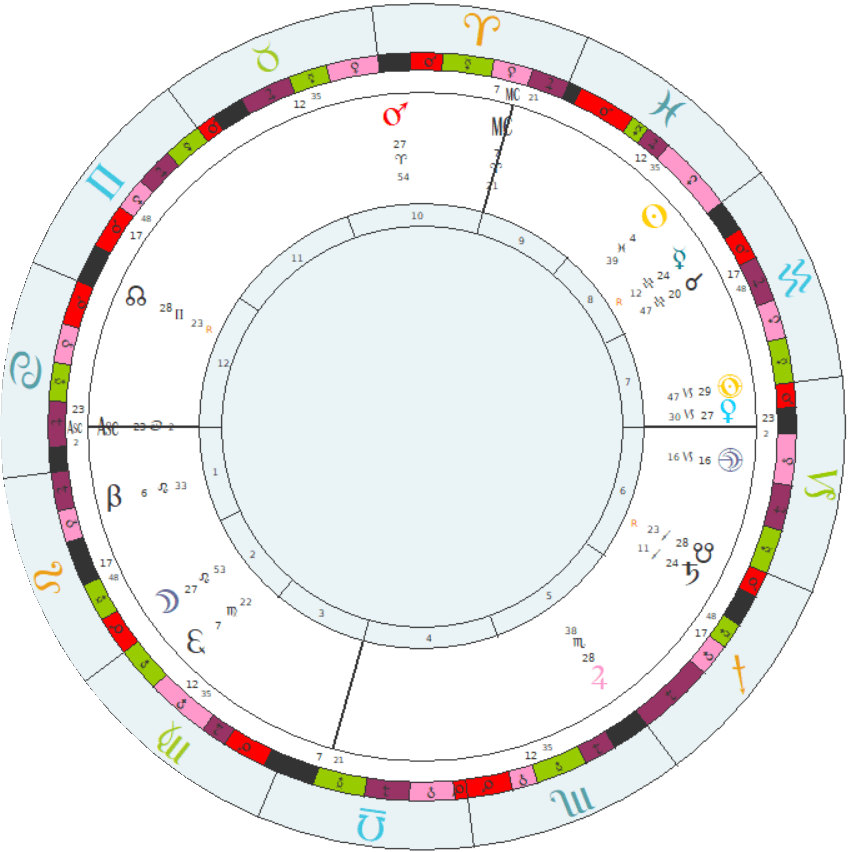
Let us consider the chart of the late Scottish signer, Lena Zavaroni [2]:

With the Sun in the third place, the chart is nocturnal, and we must turn to the Moon and then the three triplicity lords of the Moon. We find her in Taurus. The order is thus the Moon, Venus, and Mars, respectively.

Lena Zavaroni in 1974

On first glance, we see the Moon is quite strong. She is in the house of her exaltation, of the sect and in her triplicity, and occupies a pivot. Such conditions are favourable in keeping the Moon comfortable in her significations, as well as some prominence in the public eye [3]. However, she suffers a tight aspect with Saturn. As this is a night-chart, Saturn is the out-of-sect malefic and is in a dark place (the sixth house of illness). The Moon’s twelfth part also falls with Saturn, too. Valens emphasises the importance of the domicile lord. Sadly, that is Venus, who is not in great shape. Traversing Scorpio, her singular strength is angularity. Otherwise, she is the house and bound of Mars with whom she is in wide conjunction. The third ruler is Mars, also in Scorpio. Mars is in a loose aspect with the diurnal Jupiter, who is retrograde and in a dark house (house of death).

Having considered the triplicity lords of the sect-light, we now have a broad understanding of the flow or ease of success and prosperity throughout life. Here, we see a strong start, with some prominence, too, before a sudden downward turn with things evening out towards the end. It is not in itself a quantitive indicator. Strong sect-lights cannot overrule a weak financial promise, but they can soften the blow.

For determining the individual time-period of each lord, Vettius Valens [5] considers the ascension times [6], or the ‘cyclical return of the chronocractor (time-lord).’ Chris Brennan identifies the latter as the minor years of the planets [7] – an important, and underused, timing tool. For me, the latter has proven the more reliable.

Lena was born in November, 1963. The minor years of the Moon, Venus, and Mars are 25, 8, and 15, respectively. Thus, the Moon would rule until 1988 ; Venus until 1996 ; and Mars until 2011. The ascensional times of Taurus and Scorpio are 22.54 and 41.17, respectively. We convert these into years, saying Venus rules for 22-years, and Venus and Mars for 41 each. These time-frames are broad indicators and refined further through additional predictive techniques, such as releasing of the hyleg, profections and solar revolutions[8].

Zavaroni rose to fame at the age of ten, winning a talent show and becoming the youngest person to have a Top 10 UK album and hosted her own television shows in the late 1970s and early 80s. Sadly, at the age of 13, Zavaroni developed anorexia nervosa and never recovered. It is pertinent to note, that in addition to its aspect with Saturn (who brings illness), the Moon rules the twelfth sign.

Lena Zavaroni in later life

In 1989, she married but divorced eighteen months later. That year, her mother died of an overdose. Again, we can note that Venus and Mars are both in the house of family, but also rule the tenth (mother) and fourth (father) places, respectively. Also, Venus is inherently reliant on Mars and Zavaroni moved to live near her father, who was her primary support.

Zavaroni underwent a psychosurgical procedure in 1999. Despite initial signs of success, she developed pneumonia and died aged just 35. She had been living on benefits. Sadly, she is primarily remembered for her tragic career and death.

As you can see, one can tell much from such a simple technique. Try it. Since studying it frequently, after reading Abū’Ali al-Khayyāt [9], I’ve been consistently impressed.

§

References:
[1] Dykes, B. (2017). Carmen Astrologicum. Minneapolis, Minn.,: The Cazimi Press, pp. 61 – 62, and 98 – 106.
[2] Chart cast when using Sidereal system.
[3] Of course, not everyone who has their sect-light in the tenth place can expect celebrity or world fame. However, such placement is conducive to prominence within a chosen field, or social circle.
[4]The dark places are the second, sixth, eighth and twelfth. These four are all in aversion to the ascendant. As the joys of Mars and Saturn, the sixth and twelfth are considered the most malefic.
[5] Valens, V. (2010). Anthologies (Riley, Translation), PDF: http://www.csus.edu/indiv/r/rileymt/Vettius%20Valens%20entire.pdf
[6]Each sign takes a different length of time to rise over the horizon depending on location. The ascension times refers to the number of degrees that pass the midheaven in the time it takes for a sign to rise in the east.
[7] Brennan, C. (2017). Hellenistic Astrology: The Study of Fate and Fortune. 1st ed. Denver, Colorado: Amor Fati Publications, p.495 – 510.
[8]For the astrologer, the prediction is primarily concerned with timing events found in the birth chart. Nothing can ever be forecast if it is not promised in the nativity. Contrary to contemporary practice, transits themselves were never considered to either influence or cause events, and not all planets are active either at the same time or throughout life – hence the importance of the time-lords (chronocrators).
[9] Dykes, B. (2009). Persian Nativities Volume I: Māsha’allāh & Abū’Ali al-Khayyāt. 1st ed. Minneapolis, MN: Cazimi Press, pp. 240 – 256

Article was written in 2019