The WT? Card

The Horseshoe is a classic spread for the Tarot cards and one of the first I committed to memory. I’ve always found it clear and concise. Being so well-known, it does exist in several variations (I use one of two different variations depending upon the question).

Regardless of how familiar you are with a spread, there will be times when the cards throw you a curveball. A card will appear that makes no sense. The Questioner will insist that the card or your interpretation (or even both) is wrong. What can you do? Some deal clarifying cards. I never do that: I always go with the card. Not everything will make sense straight away. Plus, the cards can reveal circumstances or details we were not privy to. If the other cards are “spot on,” then a rogue WT? card must be given the benefit of the doubt.

I had a WT? card appear in May when reading for a someone who had taken out a grievance at work. After she had made her complaint, a counter-grievance was made. The complaint centered on the Questioner feeling victimized due to comments made by a male colleague. It was very complicated.

The WT? threw both the Questioner and I. But it also was a moment where I had to put my faith in the cards.

The Horseshoe is laid out as follows:

  1.  The Past.
  2. The Present.
  3. The Future.
  4. The Questioner.
  5. The Other People Involved.
  6. The Obstacle.
  7. The Outcome.

In Classic Tarot Spreads, Sandor Konraad suggested reading card #4 first. This card describes the Questioner and how she approaches the situation, so it’s helpful to see what is said here first. 

Similarly, cards #3 and #7 have to be considered together as both describe the future. In my experience, this is best done last.

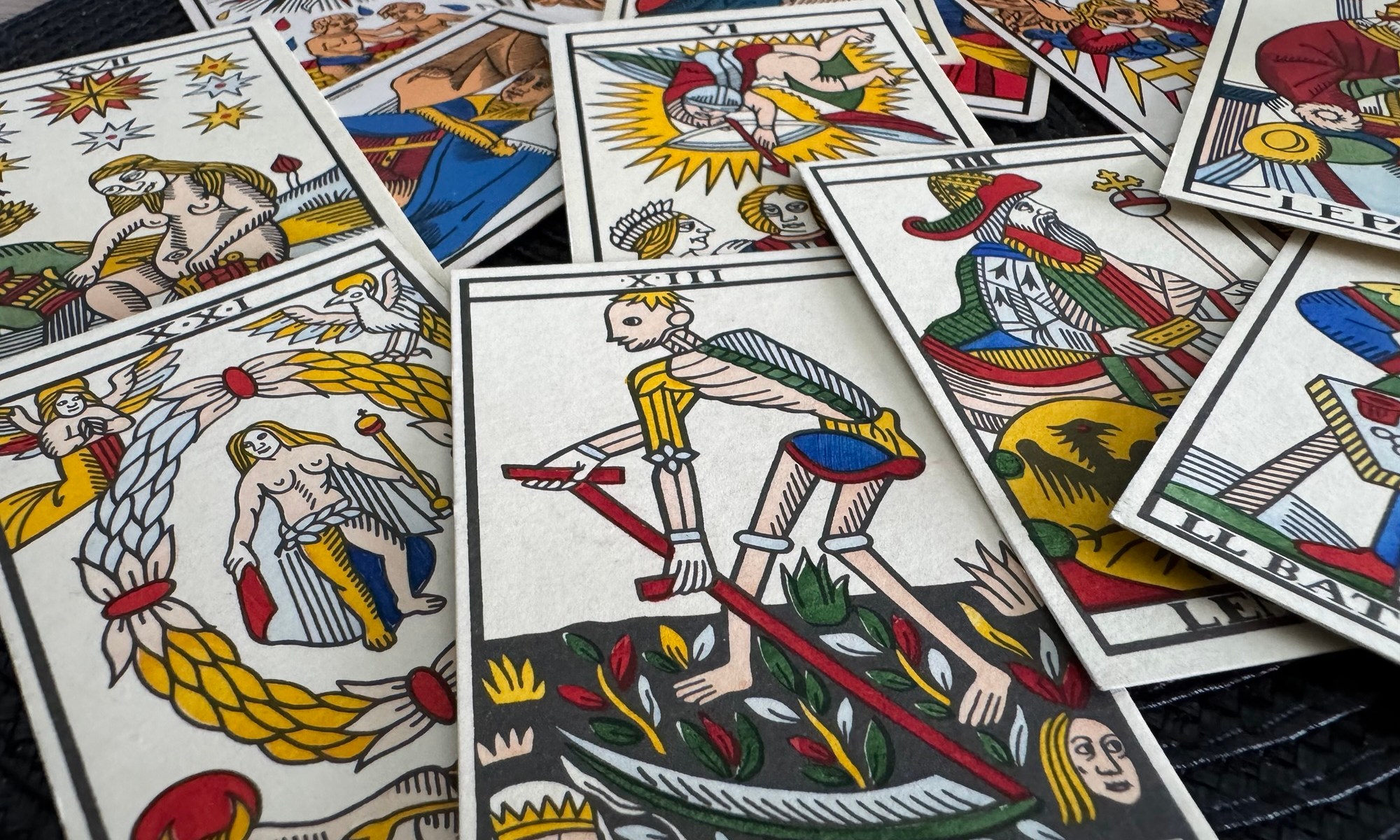
Using the Rolla Nordic Tarot, I laid out the Horseshoe as follows:

  1.  Ace of Rods.
  2.  9 of Rods.
  3. Arcanum VII. The Chariot.
  4. 4 of Swords.
  5. 7 of Pentacles.
  6. King of Rods.
  7. Arcanum XIV. The Angel of Time.

The Questioner appears as the 4 of Swords. The entire affair is regrettable, and she wants to put it behind her. It has affected her health (Swords) and seen her on half-pay due to sickness absence (The 4 of Swords can indicate financial reversals). 

Let’s look at cards #1 and #2. All aces signify news. The Questioner received an e-mail (Ace of Rods) that triggered a formal complaint (also in writing). She has sought advice from the Union, who have supported and advised the Questioner (9 of Rods). Part of that advice was identifying supportive statements from colleagues.

Card #6 represents the current obstacle. Here we find the King of Rods. Rods are the earth suit, and the King has fallen next to an air card (Pentacles). He’s thus undignified. The King of Rods is said to be an “Active type of man oriented towards efficiency” (Garnder) and “helpful in successful business ventures” (Pushong). Nordic says he has a “Lawyer or Stockbroker outlook.” Undignified, he is pedantic and obsessed with detail and procedure at the expense of the main objective. What should be a simple task becomes a long-drawn-out affair.

The Questioner identified this person as the HR investigating officer. He had interviewed the Questioner as part of the investigation, which was very “unpleasant” and “intrusive.” After the meeting, he e-mailed an additional ten questions. Nothing seemed to be moving.

So what was the WT? card? It was the 7 of Pentacles. Sevens indicate changes or movement, and the card often infers travel (in general), a business trip, or changes to how you earn. When I told the Questioner that it appeared as if either the King of Rods or another person was away, she could not understand the card’s message. None of the panel have roles requiring traveling. I pointed out that this could be annual leave, but she shook her head. The other associations did not seize me. I reiterated if not the King, then someone was away.

The pence suit is ruled by Jupiter, who rules Sagittarius and Pisces and whose day of the week is Thursday. I doubted we would have to wait for December or even 12-days (Jupiter has a 12-year cycle). The reading was done on Tuesday (Mars’s day). I told the Questioner we would need to wait and see, and by Thursday, we should have a clearer idea. Fingers crossed!

Cards #3 and #7, VII. The Chariot and XIV. The Angel of Time/Temperance, come from the Greater Arcana.

Arcanum XIV. The Angel of Time signifies diplomacy and moderation but is also, as its title suggests, is a symbol of time. As an outcome, there is always a delay with this card. Nothing will be rushed; everything has its appointed moment. You must be patient.

The card predicts that rather than direct action (disciplinary action, warnings, etc.), the resolution will focus on attempts to restore professional, if not harmonious, working relationships over time. The Questioner will be expected to give a little. As colleagues, their roles require crossover. They will need to find a way of working together.

In doing so, the future is bright as Arcanum. VII The Chariot predicts a successful period and progress in her career. As a chariot is a mode of transport, this is often in a new place or at least a new role (often but not always with promotion). In time, this will all be behind her and she can forge ahead realizing a personal ambition.

The Questioner had hoped her colleague would be redeployed if not disciplined. However, Arcanum XIV. infers steps will be taken to restore harmony between them, perhaps through mediation. If the Questioner can demonstrate some willingness, she will be rewarded in the long term and move forward. The Chariot shows movement in her life (her future) rather than her colleague’s.

On Wednesday, the Questioner contacted HR for an update and to discuss a phased return to work. She learned that the HR advisor, the King of Rods, was out of the office (he was on mandatory training) and would not return until the following Monday. No update was given, and the Questioner was told to wait.

§

Deck: The Rolla Nordic Tarot, US Games Systems, Inc.

The Tarot Shows the Path by Rolla Nordic, published by Regency Press in 1960.
The Tarot Speaks by Richard Gardner, published by Universal-Tandem in 1974.
The Tarot Of The Magi by Carlyle A. Pushong, published by Regency Press in 1969.
Classic Tarot Spreads by Sandor Konraad, published by Whitford Press in 1997.

The Lives We Lived in Each Day

BELIEF in reincarnation and karma have become extremely popular in the West. Of course, the belief in karma and reincarnation are ancient; they have been part of the teachings of Hinduism, Jainism, Sikhism and Buddhism for over a millennia. Interest in the West is relatively new beginning with the rise of theosophy.

Since the late 1990s, readers have often been consulted about issues related to past lives, karma and incarnated purposes. Quite often, these seekers are looking for an explanation for problems that are firmly of this life. However, others have more interesting queries.

The cartomante was consultanted by such a seeker in the summer. In her question, the client had explained that she had been involved in a whirlwind relationship. Within less than four months, they had become engaged and were living together. There were plans to start a family. Her friends and family felt it was all too soon. Our querent, however, said it was as if they had done it all before. Did she and her fiancé share a past connection?

Different opinions exist on reincarnation; various methods of analysis are also endorsed. On the subject itself, my own opinions are irrelevant. My preferred method is one outlined by Teresa Michelsen in Designing Your Own Tarot Spreads. Having worked with the spread over some time, one has observed that it often explains connections or trends – through the lens of reincarnation – in a manner that is intelligible and relatable. It does not, however, prove such links exist.

The Spread

To perform this reading, first remove the Fool card and then shuffle the remaining 77-cards. Once done, you deal nine-cards face down. The cartomante must now shuffle the Fool into these nine-cards and then deal them in a classical 3×3 or carré :

01 – 02 – 03

04 – 05 – 06

07 – 08 – 09

When the Fool card appears, the next card is dealt on it. Should the Fool appear last, one can (in my experience) be sure there is no such “connection.”

Cards 1 – 3 describe the present incarnation, with the first card being the circumstances of the end of this life. The remaining six cards are past incarnations with card nine being the oldest incarnation. The carré thus moves – left to right, top to bottom – backwards in time.

For this spread, one always utilises either the Ancestral Path Tarot or the Tarot of the Ages. The former is used here. Created by the extremely talented artist, Julie Cuccia-Watts, the lesser arcana is divided into the four continents: Africa, America, Asia and Europe. There is an inherent quality and balance that lends itself to such readings.

The Reading

The cards as they fell:

The Fool was the eighth card dealt indicating that the seeker and her fiancé had spent several lifetimes together. Cards to the Fool’s right can be ignored. We start with the card that covers the Fool then proceed upwards, moving right to the left.

The Fool/Ten of Staves: In the Ancestral Path, staves depict the continent of Africa, and we see, on this card, a mother with two children. In this lifetime, the seeker and fiancé share a parent-child bond and learned lessons connected to shared responsibility, support and the importance of family. It was not an easy life, but as it is upright, it is not one that necessarily proved difficult for the souls.

VI – The Lovers: Next, the souls incarnated as a couple. If we consider the card, there was a strong bond built on a foundation of mutual respect, understanding and love. As a trump, this is a life that proved significant in the souls’ development and a happy one.

X – The Wheel of Fortune: The Wheel of Fortune illustrates the zodiac and helical phases of the planets. Here, the souls incarnate together one more time. At this point, they have completed a specific series of lessons and move on to new a cycle.

Prince of Cups, reversed: In a more recent lifetime, the fiancé incarnates in Europe. He sets out on his quest with idealism and vigour. However, the lifetime proves challenging, and answers allude him, with the reversal pointing towards unresolved issues.

Queen of Sacred Circles: In contrast, the querent finds herself in the Americas, where she lived a long, happy life taking on the role of matriarch within her family. There was a relative comfort here with the soul finding the lifetime rewarding. Interestingly, within the Ancestral Path Tarot system, this is the card associated with the seeker’s current birthdate.

Three of Cups, reversed: We now enter the present lifetime. The card portrays Arthur, Gwenhwyfar, and Lancelot. It is clear that this is a moment of reconnection; however, the reversal shows that this was fuelled by a sense of being lost, being misunderstood and isolated or lonely.

Two of Cups: Looking at the cards, it is clear that this is the present moment. The seeker and her fiancé are drawn together due to their bond, with eyes only for each other. There is a mirroring between this card and the Lovers as the souls become lost in each other.

Ace of Cups, reversed: Aces in this system are the culmination points. Traditionally, this is the home. Reversed, it shows that the souls are unlikely to realise their lessons and places when the current incarnations close. It cannot be stressed this in itself does not necessarily occur to their reconnection; however, their current preoccupation with each other may be detracting from different areas of their development.

There we have the past life connection reading. Generally, one can use it as a springboard to probe more deeply into specific events and incarnations and their current effect on the present incarnation. Here, that would be the Wheel of Fortune; it being the cusp of one cycle and the next.

How one does this is dependent on the cartomante.

§

References:

Cards, Ancestral Path Tarot © Julie Cuccia-Watts, US Games, 1995.
Michelsen, T. (2003). Designing Your Own Tarot Spreads. 1st ed. St. Paul, Minn.: Llewellyn Publications.

Title, taken from BedShaped by Keane.

Horseshoe

Programme two of my one-to-one tuition course with the Marseille tarots focuses on helping deliver the same precise and succinct answers, delivered with the linear draws, with spreads and positional draws of various sizes. The plan was developed in response to numerous e-mails and comments from readers, and my earliest students. Often students find themselves becoming hesitant or losing focus when reading cards in patterns, especially those with positional contexts. Here we prevent such habits, building proficiency and incisiveness.

Quite often students tell me how surprised they are that a Celtic Cross or the Widdershins’ Star can be read as a snappy sentence, just as one can a line of five or nine cards. But the reality is they can be. It is all just a matter of orientation.

The linear draws flow from the first card to the last card. Leaving aside reflection, cards relate solely through progressive attendance. Thus, there is no question of a positional relationship found in a draw such as Astrological Wheel or Celtic Cross. The challenge for the cartomante, therefore, is to cultivate the same sense of directional ease through knowing where each place falls in the course of the narrative.

The Horseshoe

« Le fer a cheval » or horseshoe spread is cartomantic standard. In addition to providing clear answers to precise questions – including yes or no – it offers useful advice on how to solve problems or situations.

It is the first draw covered in the second programme.

Although we focus on the Marseille tarot, here, it can be employed with the l’oracle de Belline, the Petit Lenormand, l’oracle de la Triade and le tarot persan de Madame Indira, et cetera. It is thus extremely versatile and, therefore, a useful addition to the cartomante’s repertoire.

The Basics

The draw is composed of seven cards, which are to be arranged as shown below. As with numerous spreads, there are variations to be found. The one described, here, has served me well. I also use a second variation which can be seen in a later article.

    • Card one determines the consultant in the face of her question giving insight into her attitude and position.
    • Card two defines the present situation in relation to the question which can either aid or hinder or shed let on external influences or individuals.
    • Card three represents the future and how matters will play out.
    • Cards four and five advise on the direction the consultant should take, what to do and how best to act.
    • Card six is the main obstacle to be overcome and can provide guidance on where to forbear.
  • Card seven is the response.

Relating the Cards

Although the reader can advance through the cards in numerical order one can then struggle to formulate the core answer. The core answer is a succinct pronunciation that summarises the cards’ response taking into consideration how the cards relate to and engage with each other.

A sequential stroll through the cards will thus provide a disjointed and pedestrian answer. One also runs the risk of turning the reading into seven one-card readings, rather than a seven-card reading. Unfortunately, the majority of Anglo-Saxon cartomantes fall into this trap and have made the latter a virtue of necessity.

Narration

The first card advises the cartomante on the temperament and position the client occupies in relation to her question. It is thus the point of departure and also can be seen as a significator.

Both card two (the present state of affairs) and card six are connected with the latter describing the main obstacle arising out of the present situation.

Now that the cartomante is appraised of both the situation and difficulties he turns to the fourth and fifth cards. These two cards advise the seeker on how she can best proceed to resolve the challenges she faces. Thus, both cards are key to offsetting card six.

Naturally, card seven and card three are closely connected. The cartomante will need weigh these two cards against each other and see if there are signs of dissonance.

For example, the cartomante finds himself reading for a client who wants to know if she will reconcile with an ex-partner: the seventh card is le soleil and the third card is le diable. The disparity between these cards indicates that although the two will reconcile (le soleil) she will find herself in hellfire (le diable). Transpose the two cards then the answer is negative, but le soleil would, as occupying the future position, foretell warmer times and love in the near future.

Example Reading

At the end of January one of my mother’s friends asked if someone could read for her daughter. After 52-weeks’ maternity leave, the daughter had returned to the employment to discover her role (secretarial) had changed and was somewhat unhappy to find herself working for a different person. Due to the complex laws surrounding maternity leave, the seeker felt that there were grounds for complaint, although was somewhat wary of initiating a grievance.

Her question was: “Will I be able to resolve this to my advantage?”

The cards as they fell:

Answer:

Yes, but with the aid of a steward or mediator; you can then cut through the mess and find yourself in a satisfying condition.

Delineation:

For clarity, we will breakdown the spread and delineation.

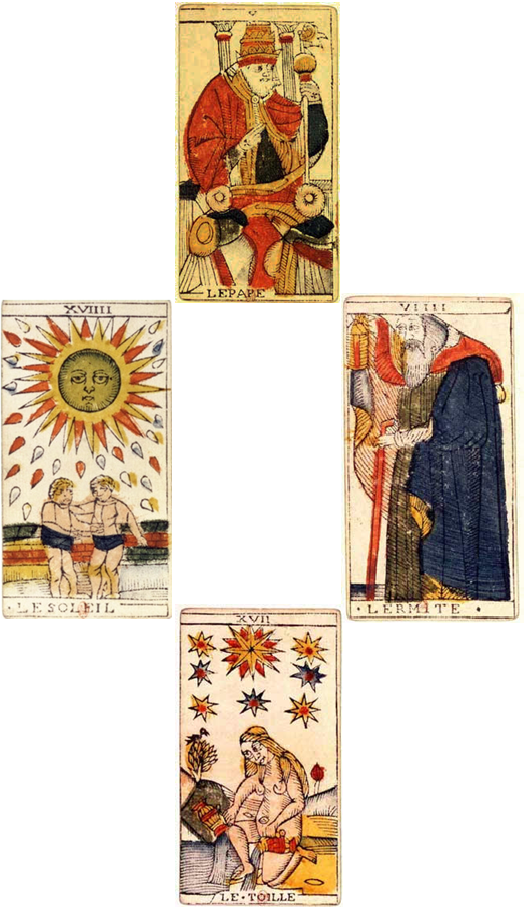
The client appears as l’Ermite which shows the client is searching for a solution and guidance, not being in a position where she can act autonomously.

Presently, her employer is undertaking some form of restructuring, that has come at the same time the seeker returns to work (Jugement), which has resulted in considerable confusion (la Lune).

With La Lune in mind, the client will need to solicit advice from one who can weigh the situation appropriately (la Justice) and, therefore, identify the right moment to act and deal the winning card (le Bateleur). It is important that she keeps her feet firmly on the ground (la Lune contrasted with la Justice and le Bateleur).

Thus, with the appropriate aid (le Pape), she will be in a strong position to resolve the situation to her satisfaction (la Force). We notice that both l’Ermite and le Pape are turned from each other – the seeker has not sort appropriate advice and would benefit from either union representation or some mediation (le Pape).

Despite the draw utilising positional contexts, we are able to retain the incisiveness of a linear draw. We just need to know how positions relate to each other in the same way attendance in lines flows. As with all of cartomancy, it comes down to looking.

§


Cards: Les Tarots Marseille de Jean Noblet, Paris, vers 1650 © Éditions Letarot.com (2001).