Tarot de Marseille: The Picturebook of Fate: The Fours Part 3

This article continues my series examining the trumps of the Tarot de Marseille, adapted from my unpublished manuscript, Tarot de Marseille: The Picturebook of Fate. As throughout this series, the emphasis is placed upon the traditional eikōn of the card, its historical context, and the practical significations I have found useful through divinatory practice. The interpretations presented here reflect my own experience of working with the Tarot de Marseille and should be understood as a working method rather than a definitive authority.

The Fours: The Emperor and Death

Let us now turn to another example, once again utilising the classic tirage en ligne, or linear draw. As before, the cards are read sequentially, each developing the story told by the previous card. This reading was done in 2010.

Due to an acrimonious divorce, Celeste had not seen her grandchildren for almost eighteen months. Following mediation, her former daughter-in-law agreed to restore contact. Although encouraged by this development, Celeste remained understandably cautious. Earlier attempts at reconciliation had broken down, and she feared the arrangement would prove short-lived.

Her question was simple: “Is this a lasting truce?”

The cards drawn were:
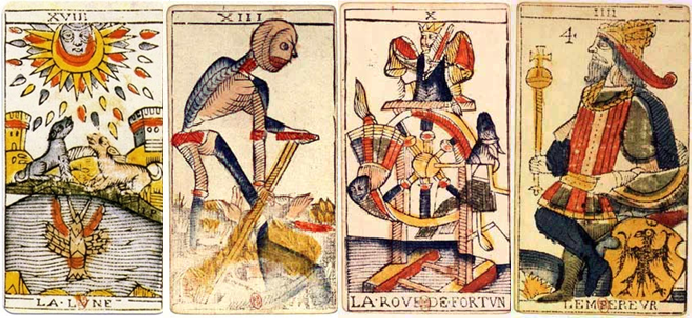
Moon Death Wheel of FortuneEmperor

The reading begins with the Moon, which reveals the source of the problem. The Moon is a card of confusion, anxiety, misunderstanding, and emotional instability. In this instance, the dispute appears to have been sustained not merely by events themselves, but by the fears, assumptions, and misunderstandings surrounding them. Hurt feelings gradually acquired a life of their own, and perceptions became more influential than reality. The result was a situation in which distrust and uncertainty repeatedly undermined attempts at reconciliation.

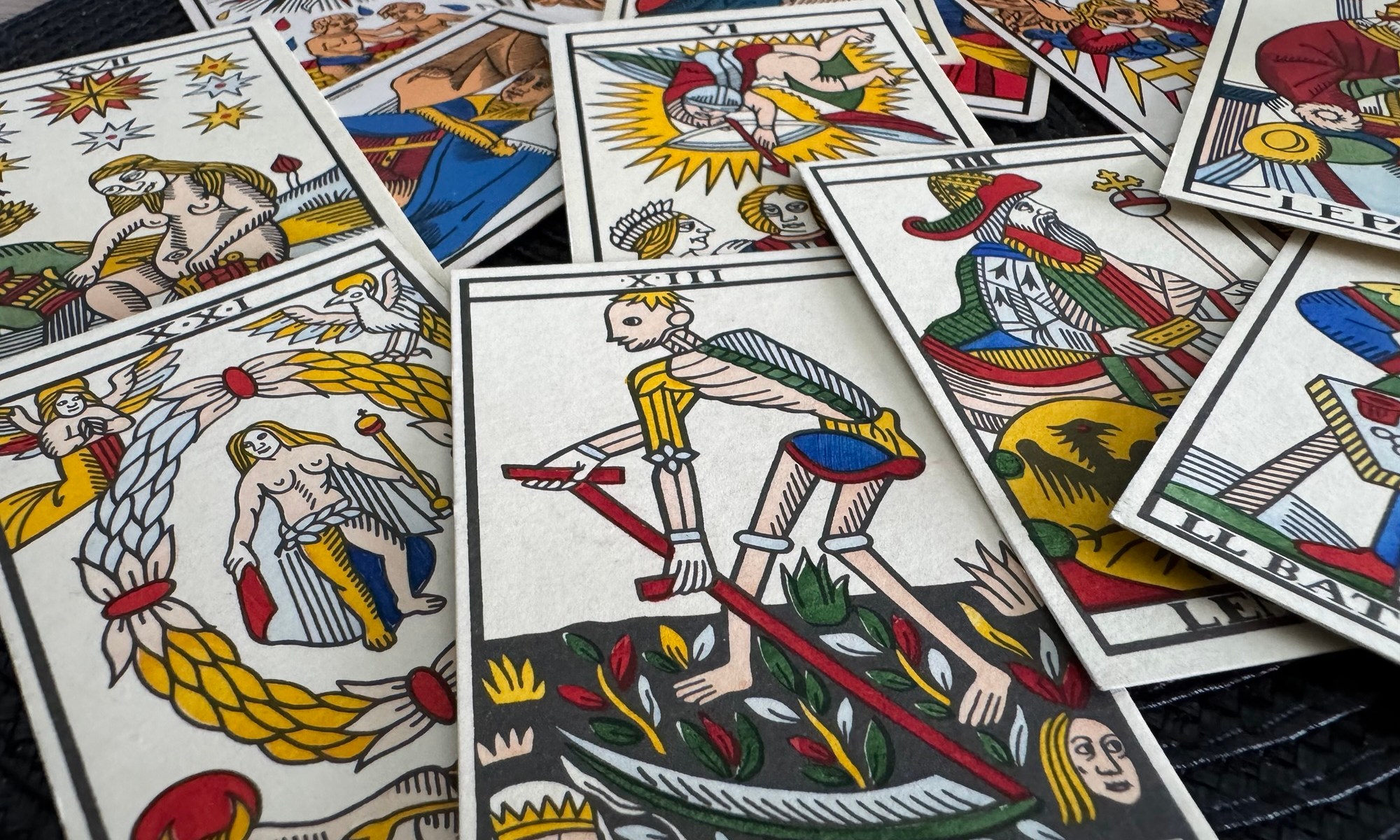
The appearance of Death immediately afterwards is highly significant. Death acts upon the circumstances created by the Moon. Its scythe cuts away what has outlived its usefulness and brings matters to a definitive conclusion. Here, the card suggests that the confusion, resentment, and destructive patterns represented by the Moon are finally being brought to an end.

The placement of Death before the Wheel of Fortune is particularly striking. The scythe appears almost to cut across the endless turning of the Wheel itself. What is dying is not merely the disagreement, but the pattern of disagreement. Every previous attempt at reconciliation seems to have followed the same course. Contact resumed, relations improved, old grievances resurfaced, and the parties eventually found themselves back where they had started. The Wheel depicts this repeated return to the same point. Death intervenes by terminating the cycle itself.

The Wheel of Fortune therefore describes more than fluctuating circumstances. It reveals the repetitive nature of the conflict: periods of peace followed by renewed hostility, agreements followed by breakdowns, and reconciliation followed by further separation. The card shows a situation trapped within its own momentum.

The reading concludes with the Emperor. This is the card that ultimately answers the question. The Emperor imposes structure, order, and boundaries. Unlike the Sun, he does not suggest emotional warmth or renewed friendship. Instead, he establishes clear expectations and rules that all parties are required to respect.

The Emperor’s appearance is particularly appropriate following formal mediation. Unlike the Pope, who reconciles through wisdom and goodwill, the Emperor reconciles through structure. Expectations are defined, boundaries established, responsibilities clarified, and consequences understood.

In practical terms, the Emperor reflects the mediated agreement itself. Contact is restored not because everybody suddenly likes one another, but because a framework has been established within which each person understands their role and limitations. The relationship becomes governed by structure rather than emotion.

Taken together, the cards tell a coherent story. The confusion and emotional turmoil of the Moon are brought to an end by Death. In doing so, Death cuts through the repetitive cycle represented by the Wheel of Fortune, allowing the situation to move forward rather than endlessly repeating itself. The Emperor then provides a stable framework capable of sustaining the new arrangement.

My conclusion was that the truce appeared considerably more durable than previous attempts. The cards did not suggest warmth, forgiveness, or a complete healing of old wounds. Rather, they suggested that a dysfunctional cycle had been broken and replaced by a workable structure. The parties involved did not need to become friends; they merely needed to respect the framework established by the Emperor.

This example illustrates an important principle of the tirage en ligne: the cards often reveal not merely an answer, but the process by which that answer comes about. Here, each card acts upon the next, transforming confusion into closure, closure into change, and change into stability. The conflict itself is not what ends. What ends is the cycle of conflict.

§

Tarot Cards: Jean Dodal Tarot via Wikipedia Commons. Public Domain.

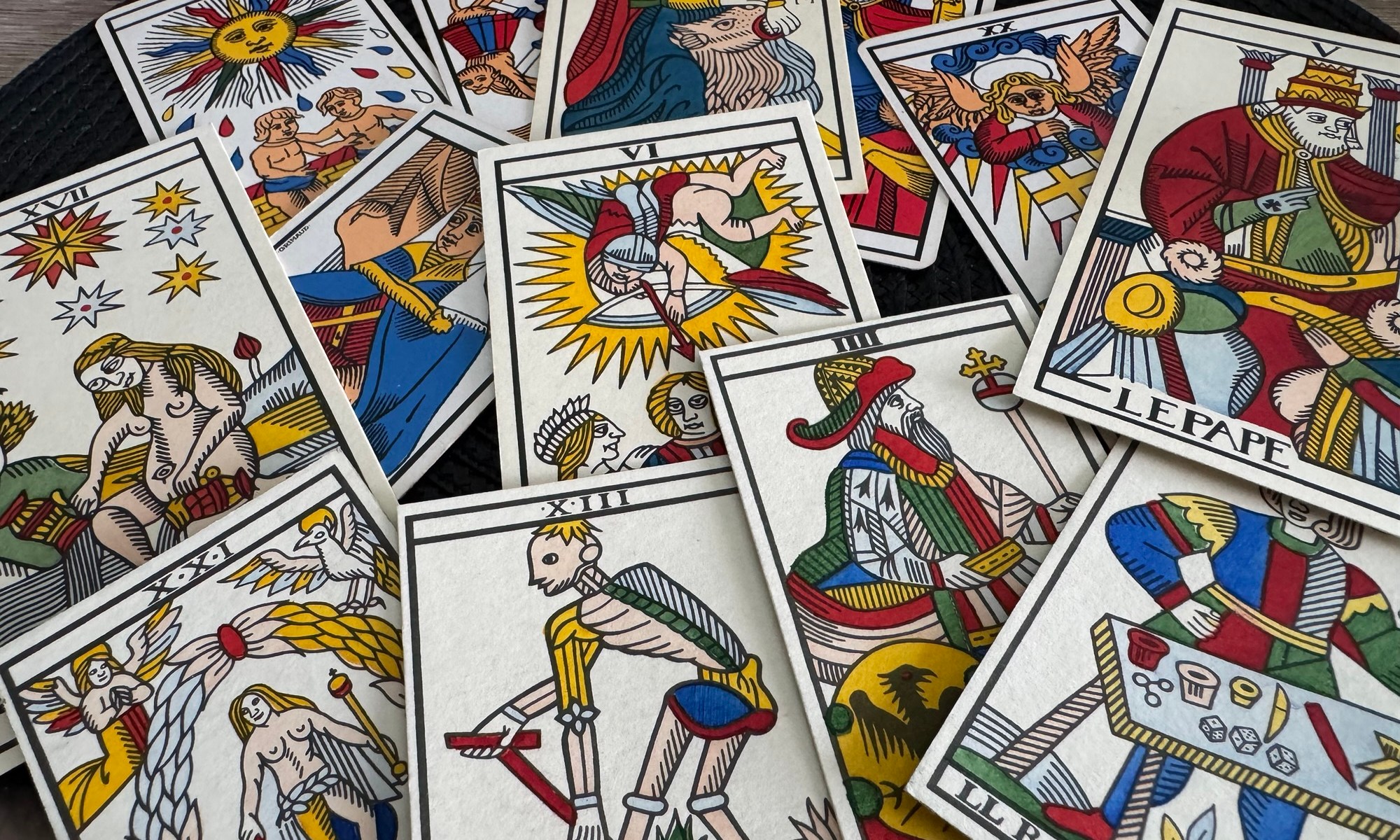
Featured Image: Ancient Tarot Major Arcana © BP Grimaud/John Waddington Ltd, Leeds & London, Les Tarot de Marseille Jean Noblet, 1650 © Editions «letarot.com» (2001 [hand stencilled trumps]). Les Tarot de Marseille Jean Dodal, 1701 et 1715 © Editions «letarot.com» (2002 [hand stencilled trumps])
Tarot de Marseille: The Picturebook of Fate: The Fours Part 2

This article continues my series examining the trumps of the Tarot de Marseille, adapted from my unpublished manuscript, Tarot de Marseille: The Picturebook of Fate. As throughout this series, the emphasis is placed upon the traditional eikōn of the card, its historical context, and the practical significations I have found useful through divinatory practice. The interpretations presented here reflect my own experience of working with the Tarot de Marseille and should be understood as a working method rather than a definitive authority.

The Fours: The Emperor and Death

Trump XIII, La Mort, or Death, is traditionally left untitled in the Marseille packs; hence the designation L’Arcane sans nom, the Nameless Arcanum. Death: one of the two certainties of life. But how should we read it? Is it really just a card of transformation and change? Does it ever signify death itself? Whilst modern interpretations often soften its message, the Marseille card is neither subtle nor ambiguous. It speaks of endings.

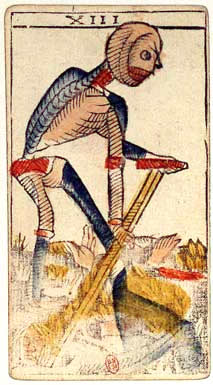
The traditional eikōn of the thirteenth trump is one of the most familiar in the Tarot and would have been readily understood by medieval and early modern audiences. Here we see a personification of Death: an animated skeleton wielding a great scythe. At her feet lie severed hands, feet, and crowned heads. The message is straightforward. Death comes for princes and paupers alike. Rank, wealth, beauty, and power offer no exemption from her harvest.

The essence of the Death card is demise; its function is to terminate. Death marks the point at which something reaches its natural conclusion. In the words of Ecclesiastes, “There is a season for everything, a time for every occupation under heaven: a time for giving birth, a time for dying…”

Death is perhaps the most feared card in the Tarot, yet it represents the one fate from which none of us can escape. Curiously, we seldom speak of death directly. Instead, we rely upon euphemisms: people pass away, pass on, or fall asleep. It is from such discomfort that the popular notion of Death as a card of “transformation” largely arises. Yet the dead do not transform. They decompose. The body breaks down and returns to its constituent parts. Before anything new can emerge, something old must first come to an end.

This is the true meaning of the Death card. Something has reached the end of its allotted season and must be cut away. Situations wither, relationships come to an end, opportunities are lost, and chapters of life close. As Ecclesiastes reminds us, there is “a time for planting; a time for uprooting what has been planted.” Death marks precisely such a season. Something has fulfilled its purpose and can continue no longer.

Significantly, the card does not reveal what follows the ending. In this respect, Death is one of the clearest trumps in the pack. It makes no promises about renewal, rebirth, or what may come next. Death merely informs us that something is finished. To understand what is ending, and what consequences may follow, one must look to where Death directs her scythe.

Death cuts to the bone. In a reading, the scythe cuts directly to the heart of the matter, stripping away pretence, delay, and indecision. For this reason, the card frequently appears when a difficult choice can no longer be postponed. The querent stands at a crossroads and must decide upon a course of action. Death’s message is blunt: choose, or circumstances will choose for you.

Nor is the card confined to symbolic endings. It is not uncommon for Death to herald financial losses, periods of hardship, the termination of agreements, redundancies, or the ending of relationships. Whilst the card seldom predicts physical death directly, it invariably signifies the end of something important. Death arrives with her scythe, and once she has passed, matters cannot remain as they were before.

Although rare, the Death card can on occasion foretell an actual death. In practice, such indications are seldom unexpected and usually concern someone already elderly, infirm, or approaching the end of their natural life. One should be cautious, however, and never rely upon Death alone. Where such a meaning is intended, it will ordinarily be corroborated by surrounding cards and the wider context of the reading

General: The end of a situation, phase of life, partnership, or established way of doing things. The card signifies conclusions, loss, separation, and the necessity of letting go. Material or financial losses are common, though not inevitable. Death frequently appears when an important decision can no longer be avoided and circumstances compel decisive action.

Love: Relationships often enter a crucial and sometimes painful phase under this card. Matters cannot continue as they have, and changes become unavoidable. In some cases this leads to reconciliation through honesty; in others, to separation, whether temporary or permanent. When Death is prominent, there is often a profound sense of loneliness or emotional distance. For those who are single, the card is generally unfavourable for new relationships. More often than not, it suggests that a previous attachment has not yet been laid to rest and that time alone is needed before moving forward.

Career: Death is naturally associated with undertakers, morticians, pathologists, bereavement counsellors, and others who work directly with the dead. It may also signify occupations involving clearance, disposal, recycling, demolition, or waste management. In employment matters, the card often indicates a contraction in opportunities within the preferred field. A change of direction, retraining, or accepting a reduction in status or remuneration may be necessary. Unfortunately, it can also point towards redundancies, closures, and downturns affecting a particular industry or workplace.

Finance: Significant financial losses may occur under this card. More commonly, it signifies a period in which financial obligations exceed available resources, forcing difficult choices and sacrifices. The querent may need to reduce expenditure, liquidate assets, or abandon expensive commitments. Death can also indicate burdensome debts, particularly where repayment has become unrealistic without substantial change.

Health: Anatomically, Death is associated with the skeletal system, including the teeth. The card may indicate fractures, osteoporosis, rickets, osteomyelitis, temporomandibular disorders, and dental complaints, particularly toothache. When supported by surrounding cards, especially the House of God, it may signify surgical intervention.

Essence: Demise.
Function: Termination.
Polarity: Negative.
Astrological Association: None.
Timing: Now.

§

Tarot Cards: Jean Dodal Tarot via Wikipedia Commons. Public Domain.

Featured Image: Ancient Tarot Major Arcana © BP Grimaud/John Waddington Ltd, Leeds & London, Les Tarot de Marseille Jean Noblet, 1650 © Editions «letarot.com» (2001 [hand stencilled trumps]). Les Tarot de Marseille Jean Dodal, 1701 et 1715 © Editions «letarot.com» (2002 [hand stencilled trumps])
Tarot de Marseille: The Picturebook of Fate: The Fours Part 1

This article continues my series examining the trumps of the Tarot de Marseille, adapted from my unpublished manuscript, Tarot de Marseille: The Picturebook of Fate. As throughout this series, the emphasis is placed upon the traditional eikōn of the card, its historical context, and the practical significations I have found useful through divinatory practice. The interpretations presented here reflect my own experience of working with the Tarot de Marseille and should be understood as a working method rather than a definitive authority.

The Fours: The Emperor and Death

Trump IV, L’Empereur, or the Emperor, is a card often overshadowed by more flamboyant trumps. What is there to know? Is the Emperor merely a symbol of masculine authority or the father archetype? Does he speak of status and worldly success? Or is he simply the overbearing manager determined to control every aspect of our lives? As is so often the case, the truth lies somewhere in between.

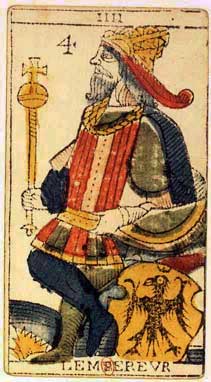
The traditional eikōn of the Emperor is remarkably consistent throughout the classical tarot tradition. An enthroned ruler sits in profile, crowned and armoured, holding an oversized sceptre as the emblem of his authority. His legs are traditionally crossed and a large shield rests at his side. Everything about the image communicates stability, power, and command. Unlike many of the other trumps, the Emperor is not engaged in any obvious activity. He has already secured his position and now concerns himself with maintaining it.

The essence of the Emperor is control; his function is to manage. The card therefore speaks of structure, order, responsibility, and authority. The Emperor understands that ambitions, resources, and people require direction if they are to achieve anything worthwhile. Whilst the Empress brings people together through interaction and communication, the Emperor takes responsibility for ensuring that things are done.

Unlike the Empress, the Emperor does not meet our gaze. He has little interest in conversation for its own sake. His attention is directed towards the affairs of his realm. He is concerned with leadership, administration, and practical results. Where others discuss possibilities, the Emperor asks what must be done and who will do it. The Emperor’s authority should not be understood as privilege alone. It is also a burden. Someone must maintain order, make difficult decisions, allocate resources, and accept responsibility when matters go wrong. The Emperor therefore signifies stewardship as much as power. His concern is not merely obtaining authority, but exercising it wisely and ensuring that obligations are met.

For this reason, the Emperor is often a favourable card in a reading. It frequently points towards a successful outcome, particularly where discipline, organisation, and sound judgement are required. Yet success brings responsibilities of its own. The Emperor reminds us that achievement is not merely a matter of obtaining something; it is also a matter of maintaining and protecting it.The card frequently appears when success ceases to be an aspiration and becomes a responsibility. Acquiring a home, accepting a promotion, starting a business, or becoming a parent all bring obligations that cannot be ignored. The Emperor therefore asks not simply whether we can attain our objectives, but whether we are prepared to bear the burden of what follows.

At other times, the Emperor appears because the querent must assume responsibility themselves. The card may indicate that matters have drifted for long enough and now require firm direction. Decisions must be made, standards enforced, and leadership shown. Whatever is under consideration cannot be left to chance. The Emperor demands that someone take control of the situation and steer it towards a satisfactory conclusion.

General: The successful conclusion of an undertaking and the attainment of a position of stability, authority, or influence. The Emperor brings structure, order, and permanence. What has been built is now established, but with success comes responsibility. The card frequently signifies leadership, accountability, and the need to maintain what has been achieved.

Love: Relationships under the Emperor are built upon strong foundations and characterised by stability, loyalty, and long-term potential. The card may indicate a partner who is reserved, pragmatic, and reluctant to discuss their emotions openly. Nevertheless, their feelings are usually genuine and expressed through actions rather than words. For those who are single, the Emperor often points towards a relationship arising through work or professional connections. Such relationships tend to progress quickly towards commitment, although the card cautions that one partner may prefer to take charge. Whether this dynamic is desirable is a matter for the querent to consider.

Career: The Emperor is associated with positions of authority, management, leadership, corporate governance, and politics. It frequently appears in connection with senior appointments, business ownership, administration, and executive roles. For women, the card may signify employment within traditionally male-dominated professions, such as construction, engineering, mechanics, or other skilled trades. More generally, the Emperor promises favourable career prospects, advancement, increased responsibility, and improved remuneration.

Finance: Financial circumstances are generally secure and well managed under the Emperor. The card signifies stability, careful planning, and the accumulation of assets. However, it often suggests that money could be employed more effectively. Investments, pensions, property, and other long-term financial arrangements may warrant attention. The emphasis is not merely upon preserving wealth, but upon managing it wisely so that it continues to grow.

Health: Anatomically, the Emperor is associated with the spine, back, and heart. It may indicate cardiovascular conditions, including hypercholesterolaemia, hypertension, hypotension, angina, and cardiac arrhythmias. More broadly, the card is associated with andrology and illnesses more commonly encountered in men, including heart disease, Parkinson’s disease, and lung cancer. In positive contexts, it signifies resilience, stability, and the ability to manage long-term health concerns effectively.

Essence: Control.
Function: Manage.
Polarity: Neutral.
Astrological Association: Leo.
Timing: August.

§

Tarot Cards: Jean Dodal Tarot via Wikipedia Commons. Public Domain.

Featured Image: Ancient Tarot Major Arcana © BP Grimaud/John Waddington Ltd, Leeds & London, Les Tarot de Marseille Jean Noblet, 1650 © Editions «letarot.com» (2001 [hand stencilled trumps]). Les Tarot de Marseille Jean Dodal, 1701 et 1715 © Editions «letarot.com» (2002 [hand stencilled trumps])