Tarot de Marseille: The Picturebook of Fate: The Fours Part 1

This article continues my series examining the trumps of the Tarot de Marseille, adapted from my unpublished manuscript, Tarot de Marseille: The Picturebook of Fate. As throughout this series, the emphasis is placed upon the traditional eikōn of the card, its historical context, and the practical significations I have found useful through divinatory practice. The interpretations presented here reflect my own experience of working with the Tarot de Marseille and should be understood as a working method rather than a definitive authority.

The Fours: The Emperor and Death

Trump IV, L’Empereur, or the Emperor, is a card often overshadowed by more flamboyant trumps. What is there to know? Is the Emperor merely a symbol of masculine authority or the father archetype? Does he speak of status and worldly success? Or is he simply the overbearing manager determined to control every aspect of our lives? As is so often the case, the truth lies somewhere in between.

The traditional eikōn of the Emperor is remarkably consistent throughout the classical tarot tradition. An enthroned ruler sits in profile, crowned and armoured, holding an oversized sceptre as the emblem of his authority. His legs are traditionally crossed and a large shield rests at his side. Everything about the image communicates stability, power, and command. Unlike many of the other trumps, the Emperor is not engaged in any obvious activity. He has already secured his position and now concerns himself with maintaining it.
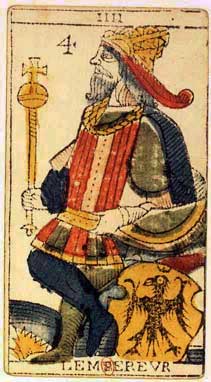
The essence of the Emperor is control; his function is to manage. The card therefore speaks of structure, order, responsibility, and authority. The Emperor understands that ambitions, resources, and people require direction if they are to achieve anything worthwhile. Whilst the Empress brings people together through interaction and communication, the Emperor takes responsibility for ensuring that things are done.

Unlike the Empress, the Emperor does not meet our gaze. He has little interest in conversation for its own sake. His attention is directed towards the affairs of his realm. He is concerned with leadership, administration, and practical results. Where others discuss possibilities, the Emperor asks what must be done and who will do it. The Emperor’s authority should not be understood as privilege alone. It is also a burden. Someone must maintain order, make difficult decisions, allocate resources, and accept responsibility when matters go wrong. The Emperor therefore signifies stewardship as much as power. His concern is not merely obtaining authority, but exercising it wisely and ensuring that obligations are met.

For this reason, the Emperor is often a favourable card in a reading. It frequently points towards a successful outcome, particularly where discipline, organisation, and sound judgement are required. Yet success brings responsibilities of its own. The Emperor reminds us that achievement is not merely a matter of obtaining something; it is also a matter of maintaining and protecting it.The card frequently appears when success ceases to be an aspiration and becomes a responsibility. Acquiring a home, accepting a promotion, starting a business, or becoming a parent all bring obligations that cannot be ignored. The Emperor therefore asks not simply whether we can attain our objectives, but whether we are prepared to bear the burden of what follows.

At other times, the Emperor appears because the querent must assume responsibility themselves. The card may indicate that matters have drifted for long enough and now require firm direction. Decisions must be made, standards enforced, and leadership shown. Whatever is under consideration cannot be left to chance. The Emperor demands that someone take control of the situation and steer it towards a satisfactory conclusion.

General: The successful conclusion of an undertaking and the attainment of a position of stability, authority, or influence. The Emperor brings structure, order, and permanence. What has been built is now established, but with success comes responsibility. The card frequently signifies leadership, accountability, and the need to maintain what has been achieved.

Love: Relationships under the Emperor are built upon strong foundations and characterised by stability, loyalty, and long-term potential. The card may indicate a partner who is reserved, pragmatic, and reluctant to discuss their emotions openly. Nevertheless, their feelings are usually genuine and expressed through actions rather than words. For those who are single, the Emperor often points towards a relationship arising through work or professional connections. Such relationships tend to progress quickly towards commitment, although the card cautions that one partner may prefer to take charge. Whether this dynamic is desirable is a matter for the querent to consider.

Career: The Emperor is associated with positions of authority, management, leadership, corporate governance, and politics. It frequently appears in connection with senior appointments, business ownership, administration, and executive roles. For women, the card may signify employment within traditionally male-dominated professions, such as construction, engineering, mechanics, or other skilled trades. More generally, the Emperor promises favourable career prospects, advancement, increased responsibility, and improved remuneration.

Finance: Financial circumstances are generally secure and well managed under the Emperor. The card signifies stability, careful planning, and the accumulation of assets. However, it often suggests that money could be employed more effectively. Investments, pensions, property, and other long-term financial arrangements may warrant attention. The emphasis is not merely upon preserving wealth, but upon managing it wisely so that it continues to grow.

Health: Anatomically, the Emperor is associated with the spine, back, and heart. It may indicate cardiovascular conditions, including hypercholesterolaemia, hypertension, hypotension, angina, and cardiac arrhythmias. More broadly, the card is associated with andrology and illnesses more commonly encountered in men, including heart disease, Parkinson’s disease, and lung cancer. In positive contexts, it signifies resilience, stability, and the ability to manage long-term health concerns effectively.

Essence: Control.
Function: Manage.
Polarity: Neutral.
Astrological Association: Leo.
Timing: August.

§

Tarot Cards: Jean Dodal Tarot via Wikipedia Commons. Public Domain.

Featured Image: Ancient Tarot Major Arcana © BP Grimaud/John Waddington Ltd, Leeds & London, Les Tarot de Marseille Jean Noblet, 1650 © Editions «letarot.com» (2001 [hand stencilled trumps]). Les Tarot de Marseille Jean Dodal, 1701 et 1715 © Editions «letarot.com» (2002 [hand stencilled trumps])
Tarot de Marseille: The Picturebook of Fate: The Threes Part 4

This article continues my series examining the trumps of the Tarot de Marseille, adapted from my unpublished manuscript, Tarot de Marseille: The Picturebook of Fate. As throughout this series, the emphasis is placed upon the traditional eikōn of the card, its historical context, and the practical significations I have found useful through divinatory practice. The interpretations presented here reflect my own experience of working with the Tarot de Marseille and should be understood as a working method rather than a definitive authority.

The Threes: The Empress, the Hanged Man and the World

Let us now consider a different style of reading.

This example uses the tirage en ligne, or linear draw, a common feature of the French cartomantic tradition. Unlike the previous examples, there are no fixed positions. Instead, the cards are read sequentially, each developing the story told by the previous card.

The reading was conducted for Patricia. Her husband, Kevin, was a self-employed carpenter who had begun to experience difficulties obtaining sufficient work. As both were now in their early sixties, Patricia was understandably concerned that a prolonged decline in business could affect their retirement plans.

Her question was:

“What can be done to increase the business?”

The cards drawn were:

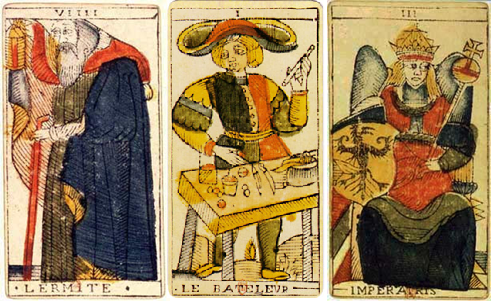
The Hermit – The Juggler – The Empress

The Hermit describes Kevin’s current approach. Like the Hermit, he relies upon experience, reputation, and the quality of his work. There is a sense of prudence and discretion here. Existing customers value his skills, but the card also suggests a reluctance to promote himself or adapt to changing circumstances. The Hermit carries a lantern rather than a banner. He seeks to be discovered rather than noticed.

The Juggler introduces the necessary change. Whereas the Hermit is discreet, the Juggler actively attracts attention. He understands presentation, visibility, and differentiation. The card suggests that Kevin must identify what distinguishes him from the many other carpenters operating in the area. What particular skills, services, or experience set him apart? The Juggler asks him to define his unique selling point and make it visible to potential customers.

For example, Kevin may possess specialist knowledge in restoration work, bespoke cabinetry, traditional joinery, or some other area in which he excels. Such expertise has considerable value, but only if potential customers are aware of it. The cards suggest that he should stop marketing himself merely as a carpenter and begin promoting whatever makes his business distinctive.

Having identified those strengths, the Empress shows how they should be used. The Empress is a communicator and network builder. She spreads information, makes introductions, and ensures that people know what is available. The card therefore advises greater emphasis upon marketing, referrals, networking, local advertising, social media, and recommendations from satisfied customers. It is not enough to possess expertise; others must know that expertise exists.

The three cards form a natural sequence. The Hermit possesses knowledge and experience. The Juggler packages that experience into something distinctive and memorable. The Empress then communicates it to the wider world. The problem is not a lack of skill, but the failure to move through the latter two stages.

It is also worth noting that the reading begins with the Hermit and concludes with the Empress. Symbolically, this is a movement from privacy towards visibility. Kevin’s experience remains his greatest asset, but the cards indicate that he has become too discreet. The knowledge that serves him well must now be brought into the public eye.

My conclusion was that Kevin’s difficulty did not arise from a lack of ability or experience. The opposite was true. The Hermit suggested that he possessed valuable skills developed over many years. The problem was visibility. Those skills first needed to be defined and differentiated by the Juggler, and then communicated by the Empress. In short, Kevin did not need to become a better carpenter; he needed to become better known.

This example illustrates an important principle of the tirage en ligne: each card develops the action of the previous one. The cards do not merely provide three separate answers. Together, they tell a story.

§

Tarot Cards: Jean Dodal Tarot via Wikipedia Commons. Public Domain.

Featured Image: Ancient Tarot Major Arcana © BP Grimaud/John Waddington Ltd, Leeds & London, Les Tarot de Marseille Jean Noblet, 1650 © Editions «letarot.com» (2001 [hand stencilled trumps]). Les Tarot de Marseille Jean Dodal, 1701 et 1715 © Editions «letarot.com» (2002 [hand stencilled trumps])

Tarot de Marseille: The Picturebook of Fate: The Threes Part 3

This article continues my series examining the trumps of the Tarot de Marseille, adapted from my unpublished manuscript, Tarot de Marseille: The Picturebook of Fate. As throughout this series, the emphasis is placed upon the traditional eikōn of the card, its historical context, and the practical significations I have found useful through divinatory practice. The interpretations presented here reflect my own experience of working with the Tarot de Marseille and should be understood as a working method rather than a definitive authority.

The Threes: The Empress, the Hanged Man and the World

Trump XXI, Le Monde, or the World, is one of the most recognisable cards in the Tarot. Does it signify the integration of opposites and the harmonising of the anima and animus? Is it merely a card of completion and success? Or does it speak of travel, the wider world, and horizons broadened by experience? Whilst each of these interpretations contains an element of truth, the Marseille World speaks above all of attainment, fulfilment, and wholeness.

The essence of the World is totality; its function is to elevate. Here we encounter a state in which something has reached its proper fulfilment and been raised to its highest condition. The card therefore signifies completion, accomplishment, and the realisation of a long-sought objective.

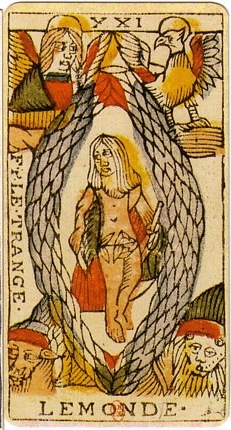
The traditional eikōn of the World is both familiar and strangely abstract. At its centre stands a figure balanced upon one leg and enclosed within a mandorla. In the four corners appear an angel, a lion, a bull, and an eagle. Whilst later traditions have offered a variety of interpretations, the image is clearly indebted to the medieval Maiestas Domini, or Christ in Glory. In such images, Christ is depicted enthroned within a mandorla and accompanied by the symbols of the four Evangelists: Saint Matthew, Saint Mark, Saint Luke, and Saint John. The Tarot omits Christ Himself, replacing Him with a more ambiguous figure that may be understood as the Soul, Wisdom, or perfected humanity.

The significance of the image lies in its attainment of the highest possible condition. The World represents the fulfilment of a desire that has long motivated effort and aspiration. Saint Augustine of Hippo wrote that the human heart remains restless until it rests in God1. Saint Thomas Aquinas developed this idea through his teaching on the Beatific Vision, in which the soul finally beholds and enjoys its Creator directly. Likewise, the life of Saint Francis demonstrates the profound joy that comes from orientating oneself wholly towards the highest good — Deus meus et omnia2. Whether one interprets the card in explicitly religious terms or not, the underlying principle remains the same: the attainment of that which has been sought above all else.

For this reason, the World signifies the fulfilment of the soul’s desire. It is not merely success, nor simply the completion of a project. Rather, it is the moment at which striving gives way to attainment and aspiration to satisfaction. The journey has reached its proper conclusion and the goal stands before us.

In divination, the World is one of the most welcome cards. It often indicates that a venture, phase of life, or long-term undertaking is nearing its successful completion. One graduates from university, receives the long-desired promotion, purchases a dream home, or meets the person one will marry. Whatever the matter under consideration, the card brings a sense of having arrived. The destination has been reached and the effort justified.

The fulfilment promised by the World differs subtly from that of the Sun. The Sun is characterised by shared happiness, warmth, and mutuality; the World by personal attainment and individual accomplishment. It is worth remembering that the central figure stands alone. Others may celebrate our success, but the achievement itself belongs to us. The World therefore represents the satisfaction that comes from accomplishing something meaningful through our own efforts.

The World also possesses strong associations with travel, foreign countries, and a cosmopolitan outlook. The horizons of the querent are broadened and the limits of the familiar surpassed. Whether through travel, education, or experience, the individual is elevated beyond their previous condition. Thus the World signifies not merely an end, but the successful completion of one stage of life and the threshold of another.

General: A sense of personal gratification and triumph with the outcome or the realisation of a personal goal. Matters reaching their natural conclusion and synthesis. Travel and at times emigration or relocating.

Love: If a prominent position the World often shows a relationship entering a milestone be it going steady, to celebrating an important anniversary. The relationship is a source of pride and pleasure, with a sense of belonging. People looking for love will often find opportunities to meet new people, especially during travel or visiting new places.

Career: The card does point towards the travel sector especially roles which involves travelling (pilot, cabin crew, travel representative) as well as translators, interpreters and anthropologists. It can indicate a promotion especially if it involves the need for relocation or moving work premises.

Finances: Incomes are stable, and a sense of material stability and independence is felt. In times of hardship the World often indicates opportunities and assistance are available to turn things around.

Health: The World card pertains to viruses and infections that are transmitted between people or through the environment. This includes influenza and herpes simplex.

Essence: Totality.
Function: Elevate.
Polarity: Neutral.
Astrological Association: None.
Timing: None.

§

Tarot Cards: Jean Dodal Tarot via Wikipedia Commons. Public Domain.

Featured Image: Ancient Tarot Major Arcana © BP Grimaud/John Waddington Ltd, Leeds & London, Les Tarot de Marseille Jean Noblet, 1650 © Editions «letarot.com» (2001 [hand stencilled trumps]). Les Tarot de Marseille Jean Dodal, 1701 et 1715 © Editions «letarot.com» (2002 [hand stencilled trumps])

  1. For thou hast made us for thyself and restless is our heart until it comes to rest in thee. Confessions, Book I: Chapter I ↩︎
  2. My God and My All ↩︎